Battle in the Shallows below Island Fredrick
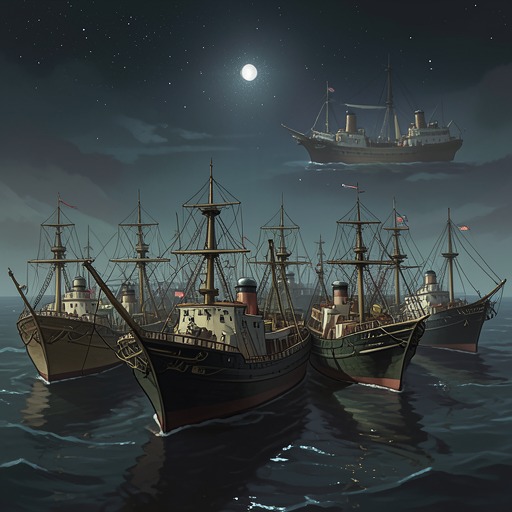
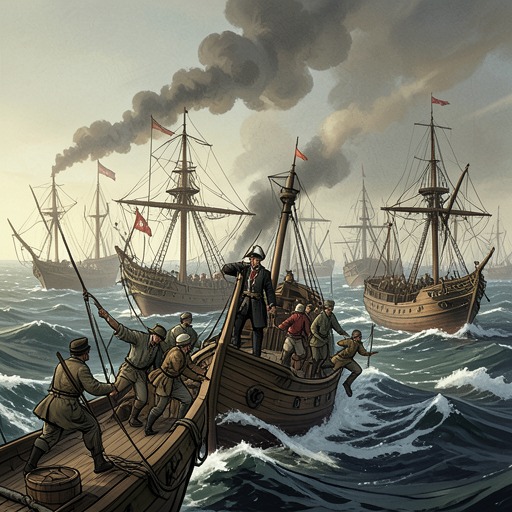
BlackwaterThe Battle in the Shallows below Island Fredrick is a multi-stage fleet engagement in which Henri Marcell’s forces use the shoal zone, mines, and missile attacks to disrupt a Union advance before the arrival of Danubia turns the battle decisively in their favor. Its course makes logistics and uncertainty as consequential as firepower: Marcell’s squadron lacks the Panzerters it expected, Union ships must contend with a minefield, and deceptive signals shape what each side believes it is seeing.
Background and Constraints
Marcell enters the battle with a force whose strength is not easily measured by a single ship count. The Blackwater can field thirty-six Panzerters and is described as closer to a squadron than an escort carrier, while also being fast despite not being designed primarily for speed. Yet Marcell’s ships have not received the Panzerters they were supposed to take on. They have spare parts, fuel, and food, but the absent aircraft represent a substantial reduction in available firepower. The mismatch between the force’s potential and its actual equipment frames the tactics that follow.
The wider campaign is shaped by the expectation that the Tharcian forces will move on Phobos. Marcell’s stated aim is to disrupt their plans, and the force’s preparations include a plan to conceal larger ships behind the radar shadow of light cruisers and smaller vessels. Electronic-warfare suites are intended to make the formation appear to contain many more small ships than it does. This is deception through the management of an enemy’s picture of the battlefield, not simply concealment of individual vessels.
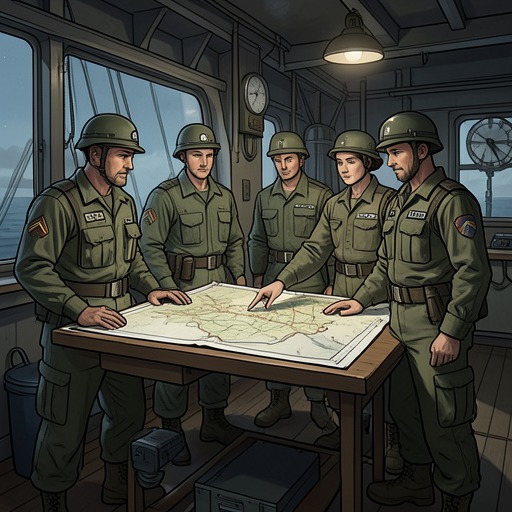
Marcell also has to account for civilians and limited supplies alongside military requirements. Civilian ships arrive from the Amazon Sea, reportedly fleeing a Union attack, prompting suspicion as he examines their positions and relative speeds. In a separate exchange, he invokes Article Four of the Maritime Code of Conduct in requesting that the passenger liner River Jewel take on evacuees. He then asks for reports on food and water aboard civilian and military ships, as well as ammunition counts for military vessels, recognizing that point-defense cannons cannot run dry during a fight. These details establish that the engagement’s stakes and limits extend beyond the ships exchanging fire.
Diversions and the First Engagements
As the battle approaches, silence grips Blackwater’s bridge while Marcell studies the command overlay. His plan uses torpedo frigates, destroyers, and a diversion force to divide Union attention. The frigates angle their bows to send torpedoes almost vertically into the path of the approaching Union force. Meanwhile, escorts move away from the torpedo boats, then enter and leave the shoal zone in a maneuver intended to make the Union believe they are fleeing. Duncan Glenn clings to a destroyer as the final wing of the diversion force slips behind the search pattern.
The torpedo frigates launch, their vessels then moving deeper into the shoal-zone dust. They are prepared, if an opportunity presents itself, to turn back and join the destroyers and Glenn in an attack run. The design of the operation depends on timing and on the enemy’s interpretation of movements: the torpedoes threaten the approaching ships, while the ships laying them and the diversion force attempt to shape the Union response.
The first clear loss is a Union corvette. It bursts apart when its atmosphere ignites; the relatively small ship lacks the extensive network of sealing bulkhead doors that might have contained the damage. Debris strikes nearby vessels as they fire point-defense cannons at the torpedoes. The episode shows how a hit can become a wider hazard in a formation, even as the Union ships attempt to defend themselves.
The orbit patrol’s intervention is not part of Marcell’s original plan. Its cutters have point defenses, but they are law-enforcement vessels rather than dedicated warships; they are smaller than Union corvettes and lack powerful engines. One cutter nevertheless strikes a reconnaissance cruiser at full speed, scraping open a large gap in the larger vessel’s hull before crumpling and burning. The exposed atmosphere reacts with fine metallic powder outside the cruiser. The reaction travels from the hull’s wounds into hallways and air ducts, illustrating how damage to a ship can carry consequences far beyond the initial impact.
The Minefield and Escalation
After receiving an encrypted source that appears to be Tharcian, Marcell orders Schuster to follow the Union formation and Opera to tell the rest of the squadron they are moving out. He also orders a full-power broadcast on an open channel, claiming that a large task force from the belt is five hours away after refueling at Deimos. The broadcast is a deliberate attempt to influence what Union forces believe about the strength and timing of the forces around them.
The enemy presence grows: Schuster reports that more ships are combing the minefield, including reconnaissance cruisers, corvettes, destroyers, and another battlecarrier. Marcell’s minefield supplies an advantage, but it also constrains the ships sent to clear it. The mines use magnets to attach to spaceborne vessels, while sensor packages prevent them from attaching to ships with friendly identification. Once attached, adjustable explosives form a shaped charge capable of opening a ship to hard space. Union vessels must move relatively slowly and use point defenses manually to target the mines, leaving them more exposed to fast missiles.
Three missiles approach the lead destroyer from widely separated angles while minelayers are expected to make contact first. The target is a Joe Steele-class destroyer, and its crew must decide how to distinguish the missiles from the mine threat. From Marcell’s perspective, the commander mistakes the third missile for another minelayer and conserves point-defense ammunition for what seems to be a more immediate danger. The missile releases its booster and strikes the destroyer with multiple megathermal warheads, most amidships. The destroyer is lost, and the sequence makes the minefield’s strategic effect clear: it forces an enemy choice that can make a missile attack more difficult to read and counter.
Close-Range Attack
Marcell escalates from the minefield and missile pressure to a direct assault. He orders Gunnery Sergeant Hoffmann to launch all the minelayers and anti-ship missiles against Union ships moving through the minefield. He then tells Promise Squadron to fire a missile barrage and, once firing ceases, leave the shoal zone and move among the Union ships, closing to point-blank range before opening fire. The plan changes the character of the engagement: the shoal zone first supports concealment and misdirection, then becomes a space the squadron must leave to bring its weapons close to the enemy.
Before authorizing the action, Marcell gives Hoffmann permission to fire. The narrative briefly sets that clipped order against the imagined musical grandeur of a film battle, while the actual command remains spare. Marcell subsequently orders the fleet to breach the surface. That transition signals the next phase of the engagement, though the available account does not detail every ship’s movement or the full result of this particular assault.
Danubia and the Battle’s Outcome
At 0730 Colony Time on 2 November 2135, fresh Tharcian destroyers emerge from the shoal zone behind an approaching capital ship. They race past it and strip away its escorts with railgun fire and focused laser barrages. Their appearance changes the balance of the scene from raids and feints among smaller ships to the entry of major fleet power.
The immense ship that follows is Danubia, sister ship to the Battlecruiser Vespa. Marcell momentarily imagines the ghost of Vespa has come to rescue him before recognizing the ship as her sister. Danubia engages the Union battlecarrier Prosperity & Labor, which Marcell’s account presents as having little chance against the incoming fire. Union battlecarriers carry their railguns in a belt line ahead of the engineering section, allowing them to direct their guns forward or astern while still launching Panzerters rapidly. Prosperity & Labor manages to launch some aircraft, but they flee the destruction rather than continue the fight.
Danubia’s railgun bombardment breaks Prosperity & Labor apart under the strain of repeated fire, and Danubia’s angled prow delivers the final blow by shearing the battlecarrier in half. The account is specific about the scale of this reversal: a premier Union capital ship is destroyed, its launched Panzerters scatter, and the battle’s momentum now visibly belongs to the Tharcian force.
The Union cruisers are also disabled, their drives dying and leaving them adrift in the melee. Knowledge & Industry, however, continues to fight. Its drive goes out as Danubia approaches, but the battlecruiser sends boarding pods rather than firing a railgun salvo. Tharcian marines enter the stricken ship armed with fighting bars and MP-88s, while smaller ships and Panzerters pass the capital ship. The account thus closes the battle’s largest reversal with a different kind of action: after ship destruction and the loss of propulsion, the struggle reaches the decks of a vessel still resisting.
Marcell allows himself a small smile as he realizes that his side has won. That recognition follows, rather than precedes, the sequence of diversions, minefield attacks, close-range orders, and the arrival of Danubia. The victory is consequently presented as the culmination of a changing engagement whose decisive force comes not from one tactic alone but from the combination of deception, constrained enemy movement, sustained attack, and reinforcements emerging from the shoal zone.