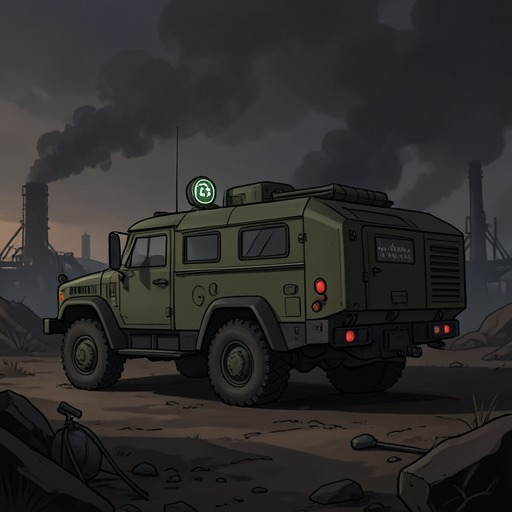
Ozelot Emergency Field Test
BlackwaterThe Ozelot Emergency Field Test is the combat trial that converts a classified weapons program into a visible strategic fact. Its immediate tally—five Martians shot down, a sixth disabled, and two corvettes destroyed—demonstrates the machine’s power, but also compromises the secrecy surrounding its existence. The test’s significance lies in both outcomes: the Ozelot proves itself in battle, and the battle gives its opponents evidence from which to infer the direction of Tharcian weapons development.
Background and Emergency Deployment
The Ozelot is presented as a Tharcian Panzerter whose existence had been confidential. Fleet Admiral Von Braun later reads a report acknowledging that this confidentiality has been compromised, and refers to the trial as the “Emergency Field Test,” the designation used by Warrant Officer Huber. The available account does not detail why the machine was sent into combat or give a full sequence of the engagement; it does establish that the test was conducted under operational conditions rather than remaining a concealed development effort.
The word “emergency” therefore marks a consequential crossing of boundaries: a secret design has been exposed through its use. The test provides an immediate assessment of performance, but makes the Ozelot’s existence and capabilities available for enemy analysis. Von Braun considers this compromise inevitable in time, yet the report makes clear that it has already occurred.
Performance and Technical Evidence
The trial report records five Martians shot down and a sixth disabled, alongside two corvettes. This is a substantial result across both mobile suits and spacecraft, and Von Braun judges the field test promising. The recorded losses are not merely a score: they give the enemy a concrete basis for evaluating a machine previously unknown to them.
The technical assessment comes from an examination of the Ozelot’s image by a pilot who had fought it. The unit’s head resembles a combination of an old flight helmet and a knight’s helmet, with an antenna spike at the crown. Its streamlined frame differs from the more intricate Tharcian designs the observer had encountered, while its armor appears more durable than that of earlier units. The observer cannot place it as a straightforward evolution of either the Mark IV or the Panther; it looks more like a Mark III, though some connection in its development remains unidentified.
The machine’s joints appear to have high tolerances and faster reactions, and additional nozzles in its backpack account for its exceptional thrust. Its weapon is identified as a laser rifle, but one that seems to overcome a limitation in the models familiar to the observer. Earlier Union laser rifles could fire only a few times before overheating; this weapon fired more than three shots at higher output. The observer presents these points as informed deductions from the image and the encounter, not as knowledge of a blueprint: without one, the Ozelot’s precise design and development remain unknown.
Exposure and Intelligence Consequences
The decisive consequence of the test is that the enemy can now recognize that Tharcian engineers have been developing Panzerters outside its awareness. Admiral Gray tells Agent Raven that the encounter forced the enemy to reveal its hand: they now know that new machines exist, have an initial indication of how Tharcian designs are trending, and have a better idea of what to expect. The information changes the Ozelot from a purely technical secret into an intelligence problem.
That knowledge answers some questions while sharpening others. Gray’s next concern is where the machines are being developed and how. He turns to a massive space station as the apparent lead and says that Raven and another agent will go there. The field test thus initiates an investigative consequence beyond the immediate engagement: observed battlefield performance points toward the production network behind the design, but does not yet disclose its location or method.
Strategic Assessment and Aftermath
On 4 November 2135, at 2200 Deimos time, Von Braun reads the report in his office at the Tharcian Naval Command Complex in Tranquil City. He accepts that the Ozelot’s secrecy has been breached and weighs the positive test results against the broader consequences of Tharcian procurement decisions. His private remark that the navy should have waited before committing to the Panther contrasts the Ozelot’s demonstrated promise with the decision to favor another system because Rainer Orbital Industries claimed to have working space- and ground-types ready “now.” The passage does not establish that the Panther and Ozelot are the same machine; it places the test within a larger contest over development, readiness, and acquisition.
The trial therefore carries a double verdict. The Ozelot has proved capable of inflicting severe losses, and its novel features suggest a meaningful change in Tharcian design. Yet a successful field test has also supplied the enemy with the evidence needed to identify that change and begin tracing its origins. The machine’s effectiveness and its exposure are inseparable outcomes of the same combat use.