Battle of Promise
BlackwaterThe Battle of Promise is a major engagement at Mars Lagrange 9 (Promise) in which the Union tries to distort Tharcian perceptions of its strength and timing, while Henri Marcell uses observation, deception, and improvised tactics to complicate the assault. The battle’s course is defined not simply by weapons exchanges but by who can interpret incomplete signals, keep forces supplied, and force the opponent to react under uncertainty.
Strategic Deception and the Change of Orders
The Union task force turns away from the Amazon Sea and heads for the Gulf of Promise under a revised order. Its objectives include disrupting Tharcian plans involving Phobos and striking at a strategically important region: Promise contains a pilot training settlement, and food and trade move through it. The Lusatia, Pommern, and Wojtek clusters are identified as part of the Tharcian core, making the operation a threat to more than a single settlement.
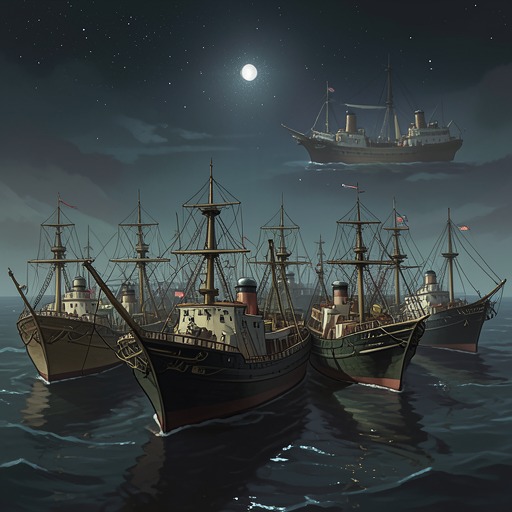
The plan relies on manufacturing a false picture of the approaching force. Five reconnaissance and electronic-warfare cruisers are to make the Union ships appear to be a civilian flotilla fleeing the Amazon Sea. Meanwhile, the task force’s three battlecruisers and two heavy cruisers hide in the radar shadow of light cruisers and smaller vessels. Electronic countermeasures make the smaller formation appear larger, a depth-perception trick applied to sensors. Reports reaching Deimos are meant to reinforce the deception: their timing should make the Tharcians believe that the main attack has begun hours earlier than it has, potentially drawing their forces toward Deimos before they are ready.
The operation is not merely a trick played on distant sensors. Rocco Swift questions whether the ships’ drive signatures will give them away, and the briefing explains how the larger vessels are concealed behind the smaller ones. The scene establishes the battle’s governing contest: each side must decide whether a pattern is genuine, staged, or deliberately incomplete, and a mistaken reading can shape where forces move before the main fighting begins.
Marcell Recognizes the Feint
As a flotilla of civilian ships enters the system, reportedly escaping a Union attack in the Amazon Sea, Marcell notices that its formation is unusually uniform and that the vessels are not moving as quickly as fleeing ships should. Gunnery Sergeant Hoffmann shares his suspicion. Marcell connects the apparent civilian flight to an earlier Union deception at Vespa, where smaller ships were concealed in the radar shadow of capital ships to misrepresent fleet size. He interprets the new formation as a similar ploy, used in reverse.
Marcell orders action stations and has Opera warn the Gulf Squadron. The alarm is urgent because the local force lacks dedicated electronic-warfare assets to counter the spoofing. Marcell points out that the Orbit Patrol does have them: if the squadron illuminates the approaching ships with targeting sensors, one ship may fire, exposing the false appearance to everyone. His warning is therefore not a claim that the deception has already been disproved. It is an attempt to make the enemy’s own response reveal what ordinary observation cannot.
The alert comes as Blackwater is short of the Panzerters it was supposed to receive. The ship can field thirty-six of them, but the missing machines represent a substantial loss of available firepower. Marcell has spare parts, fuel, and food aboard, yet the absence of the expected fighters makes his concern immediate: the fleet must fight with what is present while a pilot and machine remain away from the ship.
The Assault and the Squadron’s Losses
During the battle, the Union’s apparent formation gives way to a larger force. The Corsair is struck by railgun fire before it can obtain a sensor return; battlecarriers and heavy cruisers emerge from behind the screen of smaller ships, followed by additional vessels and waves of Panzerters. The initial concealment has not only disguised numbers but delayed a clear understanding of the force confronting the Gulf Squadron.
The Union attack reaches the docking areas as well as the ships fighting above. Destroyers and corvettes fire missiles at the bays while other vessels enter them. Blackwater’s point defenses can engage incoming missiles, and its railgun salvos silence landers and the marine Panzerters left drifting by Ensign Horn. Those local successes do not reverse the larger balance of the battle. Marcell sees that the Gulf Squadron is faring badly, and the loss of its most consequential ships threatens the squadron’s ability to continue resisting.
The Impervious is destroyed when its missile magazines detonate. The resulting wreckage also damages several smaller ships. The Advantage is lost soon afterward, overwhelmed by railgun fire from Union battlecarriers and their Panzerters. As those ships disappear, Marcell realizes that communications have become unreliable: he is receiving messages from larger vessels but doubts they can hear him, and he is not hearing from the smaller ships. A brief, frantic transmission from an Orbit Patrol cutter after a smaller cruiser is hit underscores how rapidly a coherent command picture is breaking apart.
The engagement’s tactical pressures extend beyond the main ships. In a later close encounter, Rocco Swift has eight torpedoes as he assesses an enemy scout cruiser and its escorts. He estimates that the cruiser may require four torpedoes, depending on its compartmentalization and the effectiveness of its point defenses; its destroyer and corvette escorts pose separate threats. Elsewhere, a report of a salvo of dud rounds interrupts the fighting. Rocco asks what happened, learns that the entire salvo failed and that the magazines may be defective, then continues engaging enemy Panzerters. The episode makes ammunition reliability another uncertainty within a battle already shaped by deception and interrupted communication.
Countermeasures, Mines, and False Signals
After the initial reversals, Marcell uses the same logic of misdirection against the Union. Recognizing that the enemy has concealed its numbers and intentions through a reverse Gray stack maneuver, he orders Blackwater to follow the Union formation, informs the squadron of the movement, and takes several cutters for navigation. He also orders a full-power broadcast on an open channel claiming that a large task force from the belt is five hours away after refueling at Deimos.
Marcell does not know whether a squadron is actually present in the upper shoal zone, or whether any ships are there at all. He says so when Opera challenges his assumption. Jamming and interference prevent him from confirming the situation, but the Union will hear the broadcast. His aim is to make it consider possibilities it cannot easily rule out, changing the enemy’s posture from acting against the Tharcians to reacting to them. The broadcast is an invented signal within the battle, not reliable intelligence about reinforcements.
Blackwater’s next tactic uses mines and missiles together. The deployable magnetic mines seek a ship’s hull but avoid vessels with friendly identification signals. Once attached, their adjustable explosives form shaped charges. A ship clearing such a minefield must proceed slowly and use point defenses on manual fire, leaving it more exposed to fast-moving missiles. The launching ship’s forward movement is intended to help conceal the missile launch itself, while the mines add a new constraint to the Union formation’s movement.
The layered attack briefly divides the Union’s defensive attention. Point defenses fire on the incoming missiles, then slacken when the left-hand missile begins dispersing mines. The Union commander appears to mistake the third missile for another minelayer and conserves point-defense ammunition for a more immediate threat. That decision gives the missile an opening: it releases multiple megathermal warheads into a destroyer, with most striking amidships. The destroyer’s drive fails and the vessel splits apart. In this sequence, the minefield is not only a weapon but a means of manipulating what the opposing commander believes the next missile will do.
Combat Readiness and the Human Cost of Supply
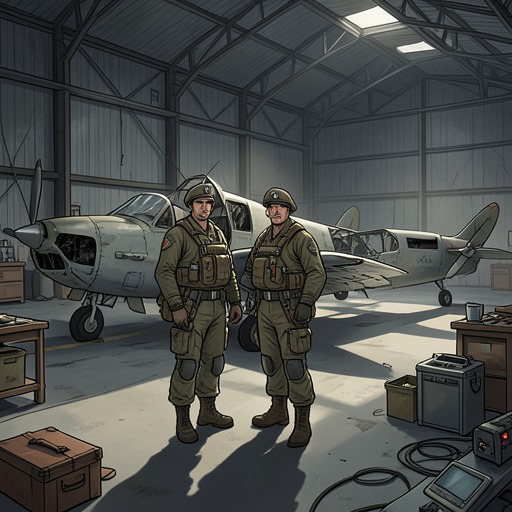
The battle’s fighting capacity depends on work performed away from the firing line. Earlier, a maintainer tells Rocco Swift that his Panzerter’s knee joints have had to be replaced again because he is stressing them beyond standard tolerances. Rocco replies that he will try to remember the warning the next time the Tharcians are shooting at him, then asks whether the machine is fully operational. The exchange shows a continuing tension between keeping a machine within maintenance limits and demanding maximum performance in combat.
Roland Horn is also assigned unfinished testing on a Panzerter III. He is told to test its thrusters inside the pressurized colony, where existing performance data from vacuum conditions does not answer how the system behaves in a pressurized environment, and then to take the machine to the colony’s edge to test its Vulcan guns. These tasks belong to the battle’s wider conditions of readiness: the Panzerter has to be tested and maintained even as the fleet’s operational needs press forward.
At 1830 Colony Time on 2 November 2135, Marcell is guiding Blackwater through the shoal zone below Island Fredrick. Civilian vessels cannot travel independently with the same awareness or communication range as military ships; they need to remain near a cutter or warship. Many have been hurriedly boarded and crowded with civilians and pets, and they were not outfitted for a prolonged journey. Marcell requests an accounting of food and water aboard every ship, along with ammunition counts for the military vessels, because point-defense guns cannot be allowed to run dry during a fight.
That inventory poses a moral and operational dilemma. Marcell must weigh rationing his crew to give civilians more supplies against maintaining the food intake of sailors and pilots, whose combat workload drives up their needs. Neglecting the civilians could affect children’s health over the long term, while undermining his crew could weaken the force on which their survival depends. The battle thus reaches beyond the exchange of fire: its outcome and aftermath are bound to transport, maintenance, ammunition, food, and the protection of people who cannot fight for themselves.
Significance
The Battle of Promise makes deception a practical instrument of combat rather than a background element. The Union’s staged civilian appearance and hidden heavier ships delay recognition of its strength; Marcell’s warning, false reinforcement broadcast, and combined mine-and-missile attack exploit the same uncertainty in return. Neither side possesses a complete picture, and tactical decisions are made on evidence that may have been planted to provoke a particular response.
The battle also refuses a clean separation between battlefield action and the labor that sustains it. Missing Panzerters, repeated joint repairs, untested thrusters and guns, a failed ammunition salvo, vulnerable communications, and the accounting of civilian food and water all shape what the combatants can do. Blackwater can defend itself effectively in particular moments, yet the destruction of the Impervious and the loss of the Advantage reveal the scale of the danger to the Gulf Squadron. Promise is therefore both a contest of force and a test of whether its defenders can preserve coordination and judgment amid losses, uncertain signals, and limited supplies.