Blackwater's Retreat with the Civilian Fleet into the Debris Field
BlackwaterBlackwater’s retreat with the civilian fleet into the debris field is both a defensive maneuver and the beginning of Henri Marcell’s improvised command of a refugee convoy. By taking the ships into the shoal zone below Island Fredrick, Marcell gains concealment and a chance to protect them from Union forces; the same refuge, however, makes navigation, communications, food, and military readiness inseparable problems. The retreat’s significance lies not in escape alone, but in the way it turns a warship’s hiding place into a fragile operating base for civilians and combatants alike.
The ship and the retreat
Blackwater was described as an escort, but her armament and air wing made her a formidable fighting platform: thirty-six point-defense cannons, torpedo tubes, missile cells, sixteen 130-mm railguns, and capacity for thirty-six Panzerters. Marcell regarded her as closer to a squadron than an escort carrier. Yet the aircraft and their pilots were not simply available at the moment he needed them; he had to go and retrieve them. The contrast between Blackwater’s substantial nominal strength and the practical work required to assemble it anticipates the retreat’s central constraint: a force could look powerful on paper and still lack the people and machines needed to fight effectively.
The broader campaign also turns on concealment and the reading of signals. Before the crisis at Promise, Union planners intended to disguise a task force as a civilian flotilla fleeing the Amazon Sea. Electronic-warfare cruisers would falsify the apparent scale and location of the force, while larger ships hid in the radar shadows of smaller ones. Marcell later faces a similar problem from the other side: a reported civilian flotilla enters the system, but its uniform formation and restrained speed make him doubt that it is what it claims to be. He and Gunnery Sergeant Hoffmann recognize that an enemy might be using civilian appearances as cover, and that targeting sensors or a single premature shot could expose the deception.
With the Gulf Squadron scattered across the Gulf of Promise but beginning to form up beside the orbit patrol, Marcell studies the tactical picture and weighs how to respond. A Union destroyer, Corsair, approaches with patrol cutters under the stated purpose of delivering relief and medical aid; Marcell reads the movement as an effort to create a standoff and investigate the flotilla. He sees the shoal zone as an alternative if events go badly: the civilian ships might be led through it, while Blackwater and the other vessels could use their positions near the colonies above Fredrick to create a vertical envelopment. The route offers protection, but it is also a commitment to operating in a place where safety depends on knowledge of the terrain.
Entering the shoal zone
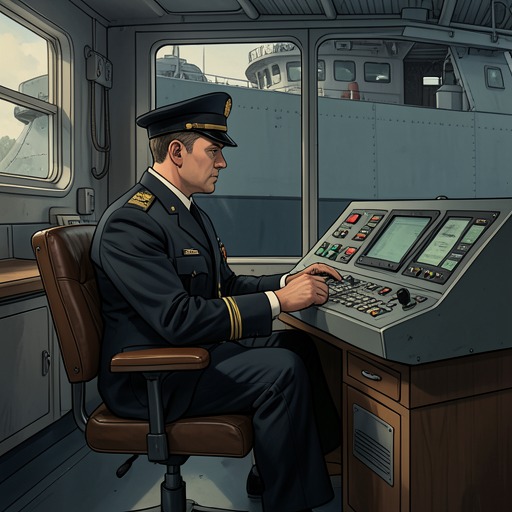
At 1830 Colony Time on 2 November 2135, Schuster guides Blackwater through the layer of dust and detritus below Island Fredrick. The ship groans as it passes through the debris, and occasional impacts against the hull unsettle Marcell’s confidence in the maps. Schuster nevertheless keeps the ship on course and reports that Blackwater is holding in its designated pocket. Marcell’s relief is practical rather than triumphant: the maneuver has worked, and the ship now occupies a position from which it can help shelter the others.
That success depends on work done before the emergency. Marcell credits the orbit patrol’s search-and-rescue, anti-piracy, and anti-smuggling operations, whose maps have been made to support navigation through the shoal zone. Astrogation buoys allow military ships to see beyond the debris and communicate with one another. Civilian vessels, by contrast, must remain near a cutter or warship; otherwise, they risk isolation, unable to see or communicate beyond a short range. The retreat is thus not simply a matter of steering into cover. It relies on a shared navigational infrastructure and on the military ships staying close enough to make that infrastructure useful to the refugees.
The hiding place also sets limits on what the convoy can do next. Marcell identifies resupply and communications as immediate needs. Most civilian vessels were not equipped for a prolonged voyage: people had crowded aboard in haste, bringing children and pets with them. Marcell orders a count of food and water on every ship and ammunition aboard the military vessels, knowing that point-defense weapons cannot be allowed to run dry in the middle of a fight. What had begun as a tactical retreat therefore becomes a logistics problem measured in provisions, ammunition, and the ability of separate ships to remain connected.
Command under competing demands
The retreat leaves Marcell responsible for an organization that has formed around him faster than it has been properly supplied. All the destroyer captains defer to him, and none appears to dispute his authority, even though the squadron is improvised. When more civilian ships attempt to escape from the Pommern cluster and Union vessels move to intercept them, Marcell orders Violence and Venomous and five escorts to deploy. He also sends Roland Horn and Duncan Glenn on an immediate flight mission with Commander Anna Strauss. The fresh reports of refugees force him to set aside, at least temporarily, the question of how to divide food and water already aboard.
Those choices carry a cost in readiness. Blackwater has taken on spare parts, fuel, and food, but not the Panzerters she was supposed to receive; Marcell recognizes that this sharply reduces the force’s available firepower. He also learns that the returning crew has brought aboard only half the maintainers needed to operate three squadrons. He judges that they will be lucky to field one, then orders Engineering to bring the ship up and get underway. The mismatch between the number of squadrons the ship can nominally support and the number the crew can maintain makes personnel as decisive as weaponry.
Civilian protection and combat readiness pull in opposite directions. Marcell knows that continuous operations will raise the food requirements of his crew, particularly the pilots, whose numbers have recently doubled. Strictly rationing for the military might keep its people at peak performance, but depriving civilians would carry long-term consequences for children. He sees no easy solution: the crew’s condition affects the convoy’s ability to defend itself, while the children’s health represents a future the convoy is supposed to preserve. The decision is not abstract compassion set against military necessity; both sides of the choice concern survival, but on different timescales.
Deception, defense, and the retreat’s purpose
Marcell’s response to uncertainty is to use uncertainty himself. When Union jamming and interference prevent him from knowing whether another squadron occupies the upper shoal zone, he orders Blackwater to follow the Union formation and tells Opera to broadcast openly that a large task force from the belt is five hours away after refueling at Deimos. He admits that he does not know whether the force he describes exists. The broadcast is a deliberate false signal intended to make Union commanders reconsider their options and, if possible, react to his squadron rather than dictate its movements.
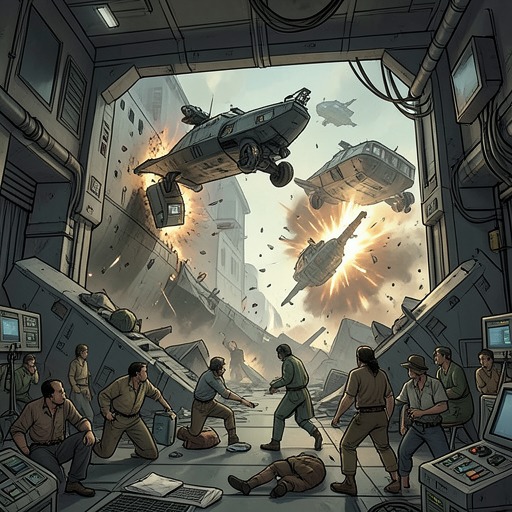
That bluff belongs to a wider pattern of tactical misdirection, not to an assumption that deception guarantees control. Marcell plans to use forward movement to obscure a ship launching missiles, while deployable magnetic mines add another threat. The mines can attach to ships that lack friendly identification, then form shaped charges; to clear them, an opposing ship must slow down and use manually directed point defense. That careful exploitation of the enemy’s attention has a vulnerable point, however. Union point defenses initially engage incoming missiles, then ease off when they interpret a third missile as another minelayer. The missile instead releases megathermal warheads into a destroyer, whose drive fails as the ship splits apart. The outcome shows how the retreat’s defensive logic develops into an active contest of interpretation: what matters is not only what weapons are present, but what the opposing commander believes they are seeing.
The shoal zone does not end the danger or resolve the convoy’s shortages. It gives Blackwater and the civilian ships a position from which they can remain together, use navigational aids, and respond to further attempts to intercept refugees. Marcell’s command therefore takes shape around a repeated balance: concealment against exposure, ammunition and fuel against immediate deployment, and the military crew’s readiness against the civilians’ need for food and water. The retreat makes Blackwater more than an escort with a powerful armament. It becomes the coordinating vessel for a scattered, under-equipped community whose survival depends on the same warship that must preserve its ability to fight.