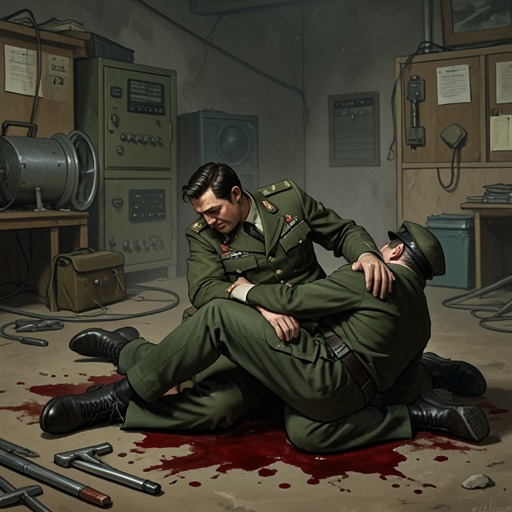
Roland and Val's Engagement at Fredrick
BlackwaterRoland and Val's Engagement at Fredrick is important not only as a remembered clash between Roland Horn and Valentin Fulbright, but as the experience that makes Roland wary when he is asked to undertake another intelligence-linked mission. Later revelations about Fulbright's covert attack on the Tharcian pilot pipeline connect the encounter to a wider struggle over training, equipment, and the use of misleading information in the war.
Background and Recollection
When Captain Henri Marcell assigns Roland to inspect a military transport, search for survivors, and return, Roland thinks back to his battle with Val inside Fredrick. The assignment has an immediate practical purpose: the isolated force needs fuel, ammunition, and any other supplies it can recover. But Roland remembers that the earlier encounter began with what he describes in thought as double-agent business, and the recollection makes him consider whether the new task might be another trap. His response holds two judgments together: suspicion shaped by Fredrick and recognition that the group's shortages are too serious to ignore.
The recollection therefore gives Fredrick a continuing effect beyond the battle itself. It is not presented as a full account of how Roland and Val fought, but as a reference point that changes how Roland assesses a subsequent mission. Roland agrees to go, asking only for time to get a clean flight suit; accepting the task does not erase his concern, but the need for fuel and ammunition outweighs it.
The Pilot Pipeline and Fulbright's Operation
The later strategic context explains why the conflict at Fredrick belongs to more than a personal rivalry. In a briefing about the Union taskforce's plans, its commander says the Tharcians are expected to move on Phobos. The Union intends to disrupt that move using five reconnaissance and electronic-warfare cruisers to imitate a civilian flotilla fleeing the Amazon Sea. By coordinating misleading transmissions with genuine reports from the Lagrange point, the taskforce hopes to make the Tharcians believe an attack began hours earlier than it did and draw them toward Deimos before they are ready.
The deception extends from communications to the apparent size of the force. The commander explains that three battlecruisers and two heavy cruisers will hide in the radar shadow of lighter ships, while electronic-warfare systems make the formation appear to have more small vessels behind it. The stated purpose is to conceal the heavier ships' presence through a depth-perception trick. That operational setting makes Fulbright's later disclosure especially significant: the conflict is being shaped not only by direct engagements but by false appearances, hidden capabilities, and attempts to influence the opponent's deployment.
Fulbright supplies a separate piece of that hidden history when questioned about the ship. He says that the Union would have tried to destroy it during the battle if it had posed a serious threat, then claims that he and others crippled it before it could fire. He identifies the settlement where it docked as the last stop in the Tharcian pilot pipeline in the Gulf, and says he planted bombs in the barracks before stealing the newest model Panzerter. The account casts the pipeline as a vulnerable strategic link: disrupting the settlement's training facilities and taking its advanced machine could impair the Tharcians' ability to develop and field pilots.
Fulbright's Assessment of Roland
Fulbright describes the ship's remaining air strength as negligible: he says it has a single outdated Mark III and that he knows its pilot personally. He characterizes that pilot as a middling performer who is talented enough to meet what Fulbright calls the Tharcian naval air corps' lax standards, but not notably accomplished. The exchange places the earlier confrontation in the shadow of Fulbright's confidence in his own operation and his dismissive evaluation of the opposing pilot.
That assessment is also a strategic claim made by a participant, rather than an independent account of Roland's abilities. Fulbright presents the captured newer Panzerter and the damaged ship as evidence that he had already neutralized the threat. His emphasis on knowing the pilot personally links the material contest over machines and training to an individual antagonism, while the available recollection from Roland shows the encounter's lasting consequence as caution about covert operations.
The Wider Campaign and Its Stakes
Elsewhere in the campaign, Henri Marcell detects a civilian flotilla entering the system from the Amazon Sea under reports that it is fleeing a Union attack. The ships' unusually uniform formation and restrained speed prompt suspicion that the apparent flight may conceal another purpose. The uncertainty matters because the flotilla is treated as civilian traffic even as military forces operate nearby: Marcell invokes the Maritime Code of Conduct's requirement to take on evacuees when addressing the passenger liner River Jewel.
The contrast between apparent civilian movement and actual military maneuver echoes the broader deception surrounding the taskforce. At the same time, the civilians are not prepared for a prolonged voyage: many ships have been hastily boarded and crowded with people and pets. Marcell seeks inventories of food, water, and military ammunition, facing a choice between rationing supplies for his own crew and giving them to civilians. This humanitarian and logistical pressure establishes the human stakes within which intelligence games and battles unfold; it does not, however, establish that the flotilla is directly connected to Roland and Val's engagement.
Significance
The engagement's clearest narrative function is causal and retrospective. For Roland, Fredrick becomes a warning that a mission framed by secret intelligence may conceal another trap. For the reader, Fulbright's later account supplies a wider strategic frame: the contest involves the Tharcian training pipeline, a stolen advanced Panzerter, and a ship Fulbright says he crippled before it could fire. The available evidence does not narrate the full course or outcome of Roland and Val's battle, so the encounter's significance lies here in its remembered effect and in the later disclosures that connect it to covert action.
Across these episodes, information itself becomes part of the battlefield. Union forces plan to disguise fleet strength and manipulate the timing of reports; Fulbright describes sabotage and theft as means of weakening a pilot pipeline; Roland, remembering Fredrick, weighs the possibility of deception against the force's urgent need for supplies. The engagement thus anchors a recurring tension in the campaign: survival depends on reading appearances carefully, yet action cannot always wait until uncertainty has been resolved.