Roland's Defense of the Fredrick Anchorage
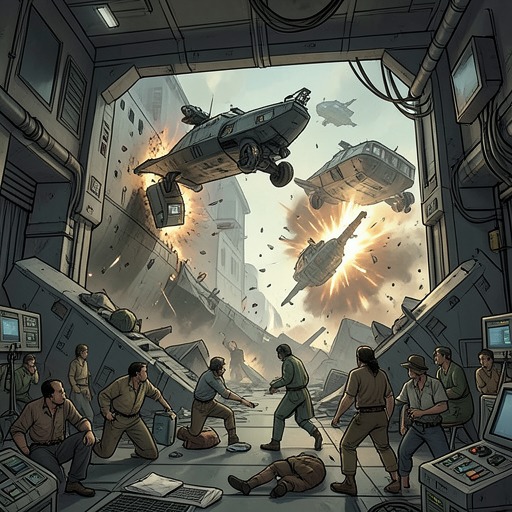
BlackwaterRoland's Defense of the Fredrick Anchorage marks Roland's transition from training to combat: sent out to protect the docking bay at Island Fredrick, he must defend a crowded refuge while the Union attack unfolds around him. He turns a narrowly defined assignment—intercept missiles and landers—into a defense of the people and ships at the anchorage, and ends the engagement with his first two kills.
Setting and Stakes
The defense takes place on 2 November 2135, at the launch deck of the TNV Blackwater, docked at Island Fredrick in the Lusatia cluster. The colony's docking bay is both a strategic point and a place of refuge. Civilians are being taken aboard ships, and the bay must remain intact while the surrounding space fills with combat. The Blackwater's captain, Henri Marcell, invokes Article Four of the Maritime Code of Conduct when requesting that the passenger liner River Jewel take on evacuees; almost immediately, the ship's crew spots a Union assault vessel approaching the docks. The episode thus places the obligation to receive evacuees beside the immediate danger to the facility sheltering them.
The Blackwater can contribute substantial force: it carries thirty-six Panzerters and is described as more like a squadron than an escort carrier. But those machines and pilots are not aboard when the fighting begins. Marcell notes that the ship has received spare parts, fuel, and food, but not its expected Panzerters, a shortfall that reduces its available firepower. His hope that a young pilot in the colony will prevail becomes concrete when Roland is assigned to defend the bay.
Roland's First Launch
Commander Anna Strauss gives Roland a direct task: shoot down any missiles or landers that approach the docking bay. He confirms the limited assignment, and Strauss tells him that the ship's crew will take over anti-missile and lander duty once the engines are heated and the obstructing lander is moved. Before launch, Roland touches his grandfather's combat wings in his flight-suit pocket and reminds himself that this is not a simulation. He has failed simulated catapult launches before; now real people are depending on him.
As the launch deck opens to space, Roland vaults forward in his Panzerter, working to keep its center of gravity ahead of the machine and to clear the gap between the wreckage of the assault lander and the docking bay. He enters a battle marked by laser fire, missiles, and railgun flashes. When three missiles head for the docking collar, he fires rifle rounds whose proximity fuses destroy two. He then uses the Panzerter's Vulcan cannons against the third, shielding his machine from the resulting debris. His first defense succeeds, but the incoming attack is not over.
Fighting the Assault Landers
Two assault landers burn through the Lusatia cluster, then reverse thrust to approach the bay. Roland holds his fire while their engines are exposed, recognizing that rounds fired through the exhaust would melt or be deflected. He maneuvers under point-defense fire and targets the nearer vessel's port-side engineering section, disabling its thrusters. The crew cuts power to the opposite thrusters to prevent the craft from tearing itself apart. Roland then concentrates fire on the connecting trusses of the second lander, crippling it as well.
The damaged vessels open their bays. Shuttles emerge, followed by Union Panzerters painted sea-green, with saucer-shaped heads and a horizontal line of red sensors. Roland's own machine has limited fuel, and he judges that the released pilots are not his most immediate threat. Rather than engage them directly, he intercepts their shuttles before they can reach the docking collar, firing ahead of their formation and placing the incoming craft between himself and the Union machines. That choice buys the anchorage time, though the Union pilots then leave the shuttles and advance on Roland.
Close Combat and Outcome
With his engine pushed hard and his firing opportunity narrow, Roland cuts his thrusters and kicks off with his Panzerter's legs as the Union pilots close in. His first bursts glance off the lead machine, but subsequent shots disable it. He collides with the drifting wreck, uses it to turn, and moves against the second opponent. The Union pilot strikes Roland's rifle with a long-handled weapon, breaking its cooling jacket. Roland responds by kicking away the enemy's rifle and drawing his plasma sword; he cuts through a seam in the opposing machine's abdomen, destroying it.
The assault shuttles are still headed for the docking collar when the Blackwater intervenes. Its prow breaks apart the lander that had blocked the bay opening, and its railguns punch through the approaching shuttles. Point-defense fire from the Tharcian defenders follows, leaving disabled drives and debris over Fredrick's docking bay. Strauss calls Roland back to base for another mission. He acknowledges the order and heads for a Blackwater recovery hatch, newly aware that he has achieved his first two kills and measuring them against his grandfather's twenty-eight.
Civilian Stakes and the Wider Battle
The anchorage’s defense is framed by the civilians it is meant to shelter. As the battle develops, many civilian vessels prove unprepared for an extended journey: they have been hastily filled with frightened people and their pets, and must remain near a military vessel or cutter to avoid becoming isolated. The Blackwater’s crew therefore faces a problem beyond holding the docking bay. Marcell asks ships to report their food, water, and ammunition, weighing the needs of civilians against the calories required by crews and pilots in near-constant combat. The immediate defense of Fredrick belongs to a larger struggle to keep evacuees supplied and within reach of protection.
Humanitarian Pressure and the Wider Battle
The anchorage’s defense is framed by the civilians it is meant to shelter, and the task persists after Roland returns to the Blackwater. Many civilian vessels are ill-equipped for an extended journey: they have been hastily filled with people and their pets, and must stay close to a cutter or warship or risk losing the ability to communicate and see beyond a short range. Marcell asks for reports on food, water, and military ammunition, aware that near-constant combat increases the crews’ and pilots’ needs even as rationing civilians could have lasting consequences for children. Holding the docking bay is therefore only one part of protecting the evacuees; ships must also keep them supplied and connected while operating under threat.
That humanitarian burden shapes later decisions in the same campaign. When Marcell considers pursuing a supply drone, he acknowledges the possibility that it could be a trap but describes the risk as calculated: he sees an opportunity to keep civilians fed. He connects his responsibility to the people in his care with an earlier crisis at Vespa, where civilians had likewise been caught in a war they did not choose. The rescue effort is not separate from the fighting: scarcity draws the fleet toward danger, while the need to protect civilians constrains how its commanders use their forces.
The Anchorage Within the Wider Campaign
The fight at Fredrick is one part of a campaign in which the Union's forces exploit concealment and the defenders' limited ability to respond. Marcell is told that enemy ships appear to be using spoofing to mask their drive signatures; the Gulf Squadron lacks dedicated electronic-warfare assets, but the orbit patrol can expose the ruse if the squadron activates its targeting sensors and provokes a premature shot. At the same time, the Blackwater's missing Panzerters leave a serious gap in firepower. Roland's defense matters in that context not only because it protects the docking bay, but because a lone pilot is covering a position that the carrier's expected fighter complement should have helped secure.
The strain continues beyond the immediate engagement. Civilian vessels, hastily loaded with evacuees and pets, are poorly prepared for a prolonged journey and must stay close to military ships or cutters to maintain communication and awareness. Marcell's request for reports on food, water, and ammunition makes the protection of the anchorage part of a wider logistical problem: the fleet must preserve combat readiness without ignoring civilians' needs, including children's health. His later decision to risk pursuing a supply drone follows the same pressure. He sees a chance to keep people fed, while recognizing the danger of a trap and recalling that civilians had been drawn into war at Vespa without choosing it. The episode's humanitarian stakes therefore persist after Roland's return: defense means not only stopping attackers at the bay, but keeping the displaced supplied and protected as the battle moves on.