Roland's Rescue and Reconnaissance Mission to the Military Transport
BlackwaterRoland's Rescue and Reconnaissance Mission to the Military Transport begins with an encrypted signal and a simple assignment: reach a damaged military transport, investigate its secret cargo, find survivors, and return. It becomes a test of judgment under hostile pressure, binding an intelligence objective to a rescue and bringing Roland into contact with Charlotte Huber and the experimental Ozelot. The mission's decisive turn is not merely that he reaches the transport, but that he continues to act after the route back has begun to look impossible.
The assignment and its constraints
The mission begins when a captain shows Roland a navigational chart and marks a point inside a debris field. An encrypted communications burst had come from there about twenty minutes earlier; the key was characteristic of military transports and used only when a vessel carried top-secret cargo. The signal therefore promised both a possible rescue and intelligence about something the Union considered important. Roland's orders made the two purposes explicit: inspect the transport, look for survivors, and return.
The flight was not planned as a routine patrol. The unit would receive drop tanks to provide sufficient fuel for the outbound leg, while Commander Anna Strauss judged that Roland's ability to use terrain could make a return on internal reserves possible. That qualification exposed the mission's narrow margin: fuel was allocated for reaching the target, but the way back depended on Roland's flying and the conditions he encountered. He accepted the assignment and went to get a clean flight suit.
The broader wartime situation helps explain why a small reconnaissance flight mattered. The Tharcian command expected the Union to move on Phobos and planned to disrupt it; a separate fleet deception put battlecruisers and heavy cruisers behind the radar shadow of smaller ships while electronic warfare made the force seem larger. Elsewhere, Marcell noticed civilian ships fleeing an attack from the Amazon Sea, and his squadron lacked the Panzerters it had expected despite receiving spare parts, fuel, and food. These episodes establish a campaign in which uncertain signals, constrained supplies, and incomplete forces shape operations. They frame Roland's task without making it part of Marcell's separate fleet action.
In the ruined colony
On receiving the signal, Roland bent his machine's knees and rode the hangar catapult into space. After checking his astrogation, he set course for the damaged transport. The mission soon carried him into a ruined colony, where a gray-and-indigo tinhat broke through a weakened section of an interior wall and lined up a shot. Roland pushed away and accelerated clear, but escaping that first attacker did not end the danger: more tinhats entered the colony, including a green machine he had already encountered. As he raced for the opening through which he had entered, a jet-black tinhat rose into his path.
The threat turned the search into an immediate contest over movement and access. Rather than advance through a safe, controlled wreck site, Roland had to maneuver amid damaged structures and enemy machines while trying to reach the transport. The shoal zone's dust and scattered rock rubbed against his Panzerter, producing small impacts he had learned to ignore. The physical noise had become familiar; the more consequential fact was that he understood the trip might be one-way.
At one point, Roland identified a remaining way to affect what would happen even if he could not return as planned: switching off the beacon would keep the enemy from finding it. He strapped himself in, pushed off the hulk of a carrier, and used his machine's thrusters to set course for the transport. The decision made the beacon itself part of the mission's tactical stakes. Reaching the wreck was not enough if an active signal could reveal its location to the enemy.
The record places the encounter near the wreck of the military transport below Island Fredrick, in the shoal zone of Mars Lagrange 9 (Promise), within the Lusatia cluster in Tharcian space. Roland's arrival at the transport came through a high-speed collision, but his cockpit's restraints and water-filled crash bags cushioned the impact. The system absorbed enough of the force to leave him shaken rather than with the fractures or head and neck injuries he feared. When a door finally opened, the transport's atmosphere reached him, giving him a way inside the wreck rather than leaving him stranded outside it.
Charlotte and the Ozelot
Inside the unfolding rescue, Roland identified himself to Charlotte and immediately asked where the beacon was and how they could shut it down. The exchange confirms that the mission had brought him to a survivor, but also shows that his original operational concern remained active: the signal had to be dealt with even after contact was made. Charlotte was not simply a person to extract; she could help him address the device and the circumstances that had drawn enemy attention to the wreck.
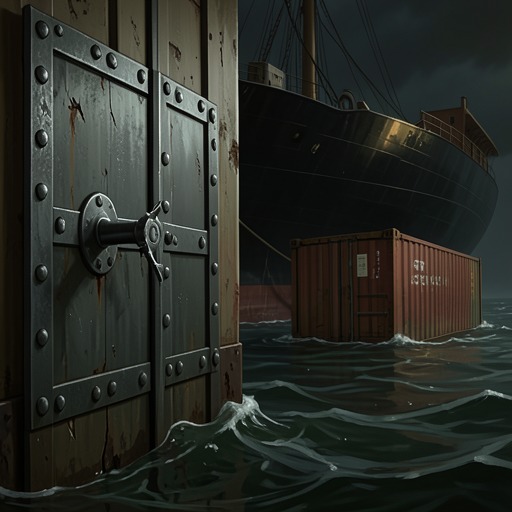
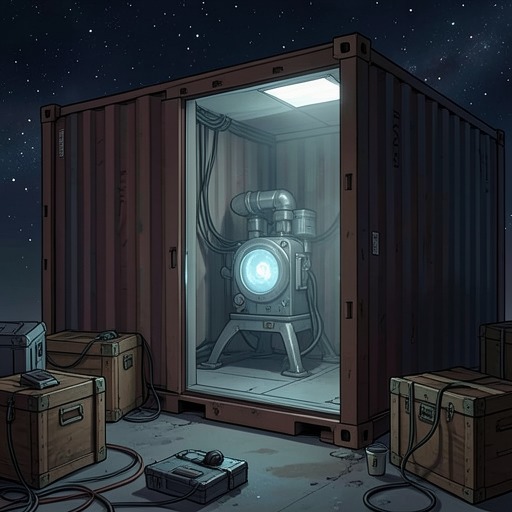
The encounter also changed the equipment available to Roland. Charlotte connected her tablet to a terminal on a large container and explained that its control systems resembled those of the Mark III, but with wider tolerances and substantially higher performance. The readouts and displays were meant to feel familiar to a pilot accustomed to that machine. The container held a Panzerter that had been fueled for planned mock-battle trials against Panthers, a detail that made it immediately usable in the emergency rather than merely an object of investigation.
Charlotte presented the machine as the Ozelot. Its arrival transformed the mission's balance: Roland, who had entered the wreck in his familiar machine and under growing pressure, now had access to a higher-performance prototype with known, compatible controls and fuel already aboard. That advantage was not a guarantee of safety. The enemy remained present, and the Ozelot's appearance coincided with a renewed confrontation over the transport and its cargo.
The enemy and the interrupted return
The mission's hostile contact included Valentin Fulbright. When Fulbright's voice returned over the communications net, he was complaining; soon after, the transport's cargo doors opened and Roland's targeting computer registered a silhouette in the darkness as Unknown. A Tharcian Panzerter then evaded by rolling aside, its thrusters burning blue, and disappeared. The sequence underscores how little certainty the wreck offered: an encrypted signal could identify the kind of vessel and imply valuable cargo, but it did not make the people, machines, or intentions inside it transparent.
Roland's later fighting continued amid the colony's ruins. He steadied his breathing and fired as the tinhats entered a trap's cone. Nearby, a building burst apart and a black Panzerter appeared, introducing another immediate threat into the close-quarters contest. The mission was thus not a single approach followed by a clean extraction. Each attempt to move toward the objective risked drawing Roland into another engagement, and the damaged buildings left little separation between reconnaissance, rescue, and combat.
When Roland found the green tinhat waiting for him, he prepared to throw himself at the Union machine. A private hail interrupted that decision. The voice on the channel said that fuel was low, that it could either recover Fulbright or continue fighting for another five minutes, and that intelligence assets took priority; as a result, the Gray Ghost would escape while the speaker assisted Fulbright. Roland then shot toward the colony's opening. The exchange exposed how fuel scarcity constrained even an apparent ally's options and made the immediate contest over people and intelligence more important than pursuing the enemy pilot.
Rescue, continuity, and significance
The military transport's name, Danubia, becomes visible in its aft superstructure as its navigation lights illuminate it. Roland tells Charlotte they will be all right, repeating the assurance as he smiles. That confidence marks a change in the scene's immediate outlook: the mission had carried him through a damaged colony, an uncertain return, and multiple enemy contacts, but the transport and its survivor now offered a concrete basis for continuing. The reassurance is a human counterpoint to the operation's technical vocabulary of beacons, reserves, targeting, and classified cargo.
The rescue and investigation were still underway afterward. Roland stood just inside the Ozelot's open cockpit while the machine kept station near the wrecked transport ships. Charlotte had pushed off, and marines from the Danubia were helping her move among the wrecks as she opened cargo containers. Roland asked whether there were signs of other Panzerters, showing that the question of enemy presence remained unresolved even after the survivors had been reached. With Charlotte working through the containers and the marine team assisting her, the original reconnaissance purpose continued alongside the rescue.
At the end of the supplied sequence, Roland closes the cockpit and prepares to take off. The mission therefore does not conclude with a confirmed inventory of the secret cargo, a complete report on survivors, or a narrated safe return. Its endpoint is renewed movement: Roland remains in the Ozelot near the wreck, Charlotte and the Danubia's marines are still searching the containers, and the question of other Panzerters is open. That unfinished ending preserves the mission's double character. Rescue establishes a reason to stay and help; reconnaissance keeps the cargo and any remaining enemy machines in view; fuel and danger continue to set limits on what can be accomplished.