Bloodhounds as a closed circle of suspects
BloodhoundsThe Bloodhounds’ status as a closed circle of suspects grows out of two crimes that converge on the same small group: the planned theft of the Penny Black and the murder of Sid Towers. Their shared knowledge of Milo Motion’s movements and their planned discussion of a locked-room murder turn a reading-group meeting into a point of investigative pressure. Yet membership alone does not identify the culprit: the group narrows the field, while the police must still test each member’s opportunity and alibi.
How the Circle Forms
The first suspicion arises from what the Bloodhounds know about Milo. Shirley-Ann Miller reasons that only the group knew he was going to the police, and concludes that one of its members must have killed Sid. The inference gives the Bloodhounds a sharply defined place in the murder inquiry, but it remains an inference made within the group, not a disclosed solution. The fact that the attacker was aboard the boat as well as Sid makes the question of who knew what, and when, especially consequential.
A separate line of reasoning connects the group to the Penny Black theft. Peter Diamond observes that the stamp’s appearance the previous night was planned rather than accidental, and that Milo had been selected as the fall guy. Julie Hargreaves identifies the specific opportunity required: the thief knew Milo would bring the book to the Bloodhounds meeting and open it at chapter seventeen. The group’s shared knowledge therefore bears on both the design of the frame-up and the murder investigation, though the two lines of suspicion should not be mistaken for proof that the same person committed both crimes.
Who Is Under Suspicion
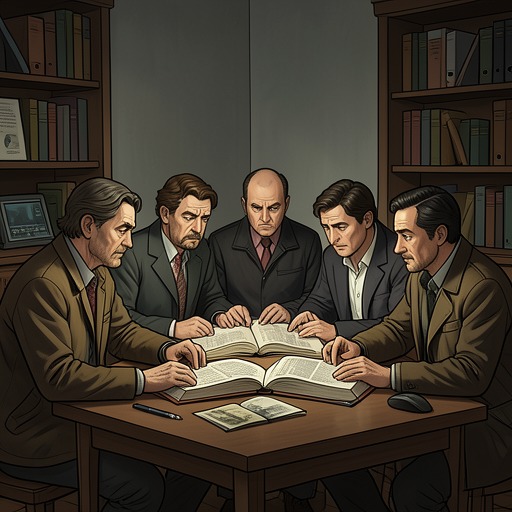
The detectives’ first enumeration makes the circle concrete. John Wigfull counts six Bloodhounds and removes Milo from consideration, leaving five: Polly Wycherley, Miss Chilmark, Jessica Shaw, Shirley-Ann Miller, and Rupert Darby. When Sid is raised as a possible additional name, his death is the immediate answer. This exchange fixes the practical boundaries of the suspect pool while also marking how the murder has altered the group: Sid is no longer one of the living candidates who can be questioned as a perpetrator.
The meeting’s subject intensifies the irony. A locked-room murder was precisely the topic the Bloodhounds were preparing to discuss on Monday evening. Shirley-Ann points out to Miss Chilmark that Milo was expected to read from the book and that all of them are now under suspicion. Miss Chilmark is quick to distance herself from having proposed that subject; Shirley-Ann replies that the distinction does not matter, since the members knew about Milo’s reading regardless. In this setting, a shared literary interest becomes relevant not as evidence of guilt in itself, but because it establishes what the members could anticipate about the evening and the book.
Interviews and Opportunity
The group’s suspect status becomes a sustained police process rather than a single accusation. Shirley-Ann says the police have visited Polly and herself, and asks Miss Chilmark whether they called on her; Miss Chilmark confirms that they did, briefly. Later, John Wigfull reports that every Bloodhound has given a statement to the murder squad and that he is conducting follow-up interviews with Julie Hargreaves. He has already spoken to Milo, Jessica, Rupert, and Miss Chilmark, with Shirley-Ann and Polly still to interview. The sequence shows the inquiry moving through the circle member by member, without yet producing a decisive lead.
At that stage, Milo is the only person the police can eliminate. He was being interviewed when Sid was killed, and the timing makes it physically impossible for him to return to the boatyard, commit the murder, and be back in time to clock in downstairs. The others have no alibi worth mentioning, according to Wigfull, and each appears to have had access to a vehicle that could have taken them to the boatyard. The group is closed in the investigative sense, but its members are not equally placed: Milo’s whereabouts remove him, while the others remain subject to questions of access and opportunity.
Limits and Significance of the Closed Circle
The police do not treat the remaining suspects as a list of equally plausible perpetrators. Peter Diamond’s count and Wigfull’s count expose the difference between defining a pool and solving a crime: the group can be enumerated, but the evidence has not yet separated one member from the rest. The elimination of Milo is firm because of the interview and the timing; the absence of useful alibis for the others is a weakness in their accounts, not a demonstration that any particular member was aboard the boat.
The possibility that a woman could have struck Sid is also raised directly. Wigfull answers that it would present no problem. The exchange prevents the investigation from excluding the women on the basis of assumption about physical capacity, leaving them within the same practical field of inquiry as Rupert. In the narrative, the Bloodhounds’ closed-circle status thus functions both as a structural constraint and as a source of uncertainty: shared knowledge concentrates suspicion, but only the investigation of individual movements can turn that suspicion into a case.