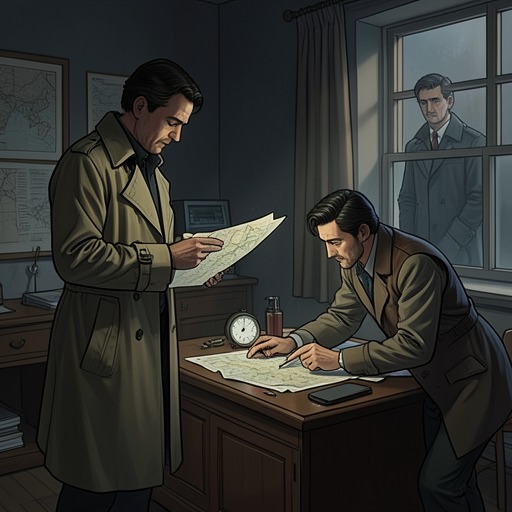
Milo Motion’s locked-room mystery
BloodhoundsMilo Motion’s locked-room mystery turns on the gap between a lock’s appearance and its actual history: the cabin seemed inaccessible, but its padlock had been covertly exchanged. The solution explains how a murderer could enter and leave without a spare key to Milo’s lock, transforming an apparently impossible crime into a practical deception. It resolves the mechanics of the cabin’s security, though not by itself the identity or motive of the killer.
The Apparent Impossibility
The investigation treats the murder aboard Milo Motion’s boat as an impossible crime. The cabin was locked, and the padlock seemed to make entry without Milo’s key out of the question. When Peter Diamond revisits the problem with Julie Hargreaves, he emphasizes the contradiction at its heart: a locked-room murder, a dead man who continues to taunt the investigators with riddles, and other unresolved questions leave the evidence in conflict rather than pointing to a single explanation.
The padlock’s apparent uniqueness gives the puzzle its force. Milo had shown the investigators the key and explained where he had bought the lock; he regarded it as impossible for anyone to have a spare. When John Wigfull later examines another padlock recovered from the dead man’s pockets, he recognizes the same make but objects that resemblance does not establish that it could have secured Milo’s cabin. The locksmith had said that identical keys could not be made, and Milo’s own key had been recovered by divers from the canal among his lost keys. It fitted his lock. Taken at face value, the evidence seems to exclude the very substitution that Wigfull had once suspected.
Reconsidering the Crime
The locked-room question also shapes Diamond’s account of why Sid Towers might have gone to the boatyard. Sid was a student of the locked-room puzzle, trained in security, and interested in the kind of problem presented by Milo’s cabin. Diamond considers whether Sid went to Limpley Stoke boatyard out of curiosity, hoping to inspect the narrowboat and work out what had happened. Polly Wycherley agrees that this could be right. The possibility makes Sid’s interest in the puzzle part of the circumstances surrounding his visit, rather than merely an incidental hobby.
Diamond weighs that possibility against a blackmail theory. Sid’s work at Impregnable gave him access to confidential files and to former police officers with inside knowledge of private indiscretions. Such access could have made him dangerous to members of the Bloodhounds of Bath, including people whose finances or private relationships raised questions. But the theory lacks supporting evidence that Sid received substantial sums: he lived in a poor flat in Oak Street, beneath the viaduct, and worked unsocial hours as a night watchman. Diamond also questions why a victim of extortion would end his life through such an elaborate locked-cabin scenario. Neither the proposed blackmail motive nor the murder’s unusual construction sits comfortably with the other.
Diamond’s alternative is that the killing was not planned in advance. In this account, the Penny Black’s astonishing appearance created a real-life locked-room puzzle that drew Sid to the boat. He encountered the person responsible there, and was killed because of what he discovered rather than because of who he was. Julie Hargreaves asks what the murderer was doing at the scene; her question gives Diamond the conceptual break he needs. He recognizes that it supplies the solution to the locked-room mechanism, even though it does not name the murderer.
The Padlock Substitution
Diamond reconstructs the deception by distinguishing the padlock’s body from the key that operates it. Milo’s lock and its one available key are genuine; the recovered lock can look indistinguishable from it while being cut for a different key. When the two keys are placed together, their cuts visibly differ. The physical comparison therefore does not disprove substitution. It shows why the apparent match of the locks had misdirected attention from the fact that they belonged to different keys.
The crucial interval occurs while Milo is aboard. In Diamond’s reconstruction, Milo uses his own key to open the padlock, then leaves it hanging from the exterior staple with its shackle unfastened. The cabin door is bolted from the inside. Although the lock remains in place, it is no longer securing the door: anyone can lift it off the staple. The visible presence of the padlock therefore gives a misleading impression of security.
The offender then removes Milo’s unfastened lock and hangs a similar padlock in its place. This substitute has a different key, but Milo does not notice the exchange. When he later leaves, he closes the door, lifts the substitute lock from the staple, slots the hasp over it, and presses the lock shut. A padlock of this kind locks automatically when pressed closed, so Milo does not need to use his key. He believes he has secured the cabin with his own lock, but he has actually attached the offender’s.
That change gives the offender access without requiring Milo’s key or a duplicate. The offender can later unlock the substitute, enter the cabin, commit the crime, and leave. On departure, the offender replaces the substitute with Milo’s original padlock and presses it closed. When Milo returns, his key opens the lock he recognizes, leaving him unable to understand how anyone could have entered. The scene thus appears to preserve the original security even though the operative lock was changed twice.
What the Solution Establishes
The explanation converts the cabin’s locked condition from proof that entry was impossible into evidence of how carefully the appearance of impossibility was constructed. The key was not copied; the lock was exchanged during a moment when its shackle was open and it was not actually securing the door. The automatic closing mechanism then allowed Milo himself to complete the deception unknowingly. A small, ordinary action—pressing a padlock shut—helped conceal the substitution.
Diamond’s demonstration persuades the assembled investigators. Wigfull’s earlier objection had depended on treating the lock found among the dead man’s possessions as though it had to be operated by Milo’s key. The comparison of the keys exposes that assumption, while the sequence of opening, hanging, swapping, and pressing the locks into place accounts for the cabin’s apparent security. The breakthrough answers how the locked-room effect was achieved; Diamond’s separate speculation about Sid’s visit and the motive for the killing remains a theory rather than a deduction established by the mechanism.
The puzzle’s resolution also changes the status of the physical evidence. The padlock is no longer simply a barrier whose supposed inviolability makes the murder inexplicable. Its similarity to Milo’s lock, its distinct key, and the moment when an open-shackle lock could be lifted from the staple become parts of a coherent sequence. What looked like an unbroken chain of security was instead a performance maintained by swapping one lock for another.