Rabo’s Abstract Expressionist painting collection
BluebeardRabo’s Abstract Expressionist painting collection gives material form to the novel’s central irony: the paintings that Rabo regards as self-contained works of art become, in a house turned museum, objects of worship, questions from visitors, and assets with astonishing exchange value. His collection predates his marriage to Edith and remains intact even as his own paintings fail; in the end, its display joins the house and the potato barn in a public tour that Rabo describes less as conventional art criticism than as an attraction for ordinary visitors.
Ownership and Value
The collection belongs to Rabo long before his marriage to Edith. He stresses that the paintings were already his property before he joined his life to hers, and that their value matches or exceeds the real estate, stocks, and bonds she left him, including a one-quarter share in the Cincinnati Bengals. This ownership history matters to his self-understanding: whatever judgments can be made about him as a painter, he refuses the implication that he married for wealth. He presents himself instead as a collector whose eye and decisions have produced an achievement distinct from his own work.
That distinction is sharpened by Rabo’s rueful assessment of himself. He concedes that he may have been a poor painter but takes pride in having become an exceptional collector. His collection, then, is not merely the backdrop to his artistic reputation; it is the enduring counterweight to the ridicule directed at his paintings. Rabo’s own pictures can be dismissed, and later physically destroyed, while the works he collected continue to command attention and high prices.
The collection’s value is not only a matter of Rabo’s private estimate. During Circe Berman’s five weeks in residence, she witnesses visitors arriving from as far away as Switzerland and Japan to venerate some of the paintings almost as gods. Rabo also sells a Rothko directly from the wall to a representative of the Getty Museum for $1.5 million. The transaction makes a work in a domestic interior suddenly legible as a major financial asset, even while Circe’s response is to call it bad rubbish and urge Rabo to get rid of the rest. Her contempt and the buyer’s price put radically different judgments of the same collection into the room together.
The House as Exhibition
Edith makes the collection visible by changing the way the family house presents art. The 1981 issue of Architect & Decorator shows the foyer from the open front door and describes it as containing enough work to serve as the core of a small museum’s permanent collection, a prelude to the treasures in the rooms beyond. The magazine’s account credits the transformation of the Victorian house for modern art to Edith, not Rabo. She brings his collection out of storage and reshapes the inherited interior to accommodate it, turning a family home into a place where works can be encountered as an exhibition.
The domestic setting never quite becomes a neutral museum. After Edith’s death, the servants leave because the house has become too lonely; Rabo hires replacements and describes himself as little more than a guard in a museum. Celeste and her friends use the tennis courts, swimming pool, and private oceanfront while ignoring him, a casual indifference set against the reverence of visiting art lovers. Rabo’s home thus holds two contrasting kinds of use: a lived-in property, with its own household and grounds, and a collection displayed under the watch of an isolated owner.
Visitors repeatedly ask what the pictures are supposed to mean, and Rabo answers as best he can. His reply reflects the position he assigns to the paintings: they are about nothing but themselves. Circe challenges that outlook by insisting on communication as a reason for being alive and mocking the collection’s lack of reference beyond itself. The paintings’ titles, too, are deliberately uncommunicative, intensifying the dispute over whether art should explain something outside its own form or stand without such explanation.
Collapse and Contrast
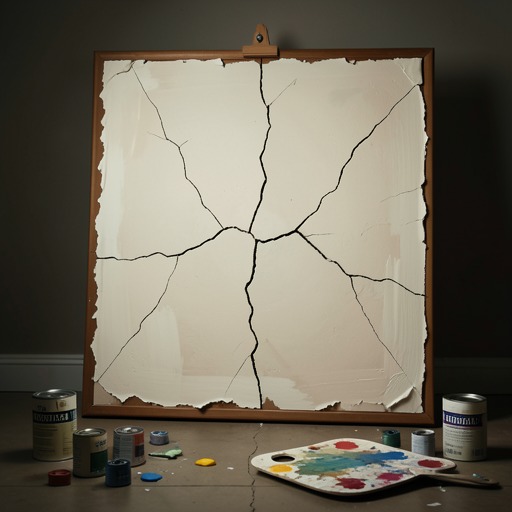
Rabo’s pride in collecting is set beside a devastating failure in his career as a painter. In the early 1960s, unforeseen chemical reactions between the sizing of his canvases, acrylic wall paint, and colored tape destroy his works. Buyers who had paid fifteen, twenty, or even thirty thousand dollars find blank canvases and scraps of colored tape on the floor. The advertised promise that Sateen Dura-Luxe would outlast the Mona Lisa’s smile becomes a bitter joke: the paint disappears from the local market, while the famous smile endures.
The collapse makes the collection’s relative permanence and market standing more striking, but it also complicates any simple contrast between artistic value and money. Rabo’s paintings had attracted buyers and substantial prices before they came apart; the collected works likewise attract both worship and multimillion-dollar sales. Price can register cultural prestige without settling the question of what a painting means, and it cannot guarantee that a work’s materials will last. The collection remains a success for Rabo where his own celebrated picture does not, but its monetary worth does not resolve Circe’s objection that the paintings communicate nothing.
The novel’s authorial note frames this tension through the grotesque prices paid for art and the concentration of wealth that can give playfulness an inappropriate, distressing seriousness. That framing resonates with the collection’s double life: these are objects of aesthetic attention, privately owned property, museum-worthy treasures, and commodities whose value can be made visible in a sale. The contrast does not reduce the collection to a market critique; it shows how the market, the museum, and the owner’s own account all compete to define what the works are.
Public Display and Spectacle
By the end, Rabo’s collection forms part of a regular tour of his museum. Visitors first see the little girls swinging in the foyer, then the earliest works of the first Abstract Expressionists, and finally the immense work in the potato barn. The route places the collection within a larger arrangement of art and display: the foyer introduces visitors to the house’s holdings, while the barn offers an experience that exceeds the ordinary scale of a gallery visit. Visitors can pass through the barn more than once, moving in one end and out the other after Rabo has opened the sliding doors to ease the flow.
Rabo notes that no solemn critic has appeared, although lay visitors have asked what kind of painting the barn work is. His answer calls it a tourist attraction, a World’s Fair, and Disneyland rather than a painting. The comparison marks a change in the collection’s public setting: art is not simply hung for expert interpretation but arranged along a visitor route, encountered as spectacle, and assessed by the people who come to see it. Rabo says the attraction is gruesome, without anything cute in it, resisting the reassuring cheerfulness suggested by the theme-park comparison.
The collection’s final significance lies in this unsettled role. It has been Rabo’s personal property, Edith’s reason for remaking the foyer, an object of international visitors’ reverence, the subject of Circe’s scorn, and one component of a museum tour that deliberately welcomes popular attention. Rabo can answer questions, arrange a route, and sell a Rothko, but none of those acts closes the argument over what the paintings are for. Their passage from private holding to public spectacle makes that unresolved question part of the collection itself.