about 1915, before Rabo’s birth
The Armenian Massacre
During the mass killing of Armenians by the [Ottoman Empire](entity:location-recall-location-7413dd69b421), Rabo’s mother survives by pretending to be dead among the bodies. His father, then a teacher, hides in a privy and remembers the village’s terrible silence after the soldiers leave.
Their survival is the inheritance that shapes the family: his mother can imagine a future elsewhere, while his father remains haunted by the world and relatives he has lost. The massacre also establishes the book’s recurring questions about survival, guilt, and what violence does to those left alive.
after the Armenian massacre, before Rabo’s birth
The Parents Escape
Rabo’s parents flee through [Persia](entity:location-recall-location-3460cfb5a6fb), where other Armenians shelter them, and decide to continue to [Cairo](entity:location-recall-location-118fd4a034f6). His mother carries jewels gathered from the killing field; she insists that she never took the stones still inside the dead woman’s mouth.
In Cairo, the couple meets [Vartan Mamigonian](entity:character-recall-character-vartan-mamigonian-62c271316ca1), an Armenian survivor who has grown wealthy making military boots. Trusting a fellow survivor, they tell him about the jewels and their hope of joining the Armenian community in [Paris](entity:location-recall-location-657453741ed3). His advice will redirect the course of their lives.
after the parents reach Cairo, before World War I
The California Property Scam
[Vartan Mamigonian](entity:character-recall-character-vartan-mamigonian-62c271316ca1) invents a prosperous Armenian community in [San Ignacio](entity:location-recall-location-san-ignacio-811c98944136), [California](entity:location-recall-location-7255928c66a8), and fabricates letters, a photograph, and a deed for a grand house and twenty acres. He presents the supposed property and a teaching job as a better destination than [Paris](entity:location-recall-location-657453741ed3), inducing Rabo’s parents to give him most of the jewels.
The promised estate does not exist. The deception sends Rabo’s educated father into an isolated life in California, where he becomes a cobbler rather than a respected teacher, and it becomes a lasting source of bitterness in the family.
1916
Rabo’s Birth
[Rabo Karabekian](entity:character-recall-character-rabo-karabekian-6fdf6f541792) is born in [San Ignacio](entity:location-recall-location-san-ignacio-811c98944136) to Armenian immigrant parents. He grows up far from an Armenian community, with his mother and father as the only people nearby who speak the family language.
His father’s education and grief, his mother’s resourcefulness, and the family’s distance from their lost relatives form the complicated inheritance that Rabo will later try to understand through his autobiography.
Rabo’s childhood in San Ignacio
The Cobbler’s Lament
Rabo’s father repairs shoes and repeatedly mourns the life he might have led: teaching, writing poetry, and translating Armenian literature. He speaks of Shakespeare in Armenian and remembers the language restrictions imposed on Armenians under Turkish rule.
His grief is not simply nostalgia. By making himself a cobbler despite his education, he seems to punish himself for surviving, and he treats the unfamiliar world around him as proof that the home he loved has vanished.
Rabo’s childhood, as his mother recounts the past
The Mother’s Jewels
Rabo’s mother explains that the jewels she carried out of the massacre paid for the family’s passage and helped make their eventual life in the United States possible. She took only the stones that fell from the dead woman’s mouth, leaving the jewels still inside as the woman’s personal property.
The story turns a horrific memory into the material origin of the family’s American future. It also leaves Rabo with an enduring sense that his country, his home, and his very presence there are connected to an act of survival amid mass death.
1928, when Rabo is twelve
A Mother’s Death
Rabo’s mother dies of tetanus after a cut becomes infected while she is working at a cannery built on the site of an old livery stable. Rabo later traces the infection to dormant bacteria in the dirt, awakened by the wound.
Her death leaves Rabo and his father alone together. It also robs his mother of the chance to see the [Great Depression](entity:event-recall-event-great-depression-09de517345d3) or learn that the celebrated artist she believed was guiding her son had not yet noticed him.
1927, when Rabo is eleven
The Artist on the Yacht
Rabo’s mother reads a magazine profile of [Dan Gregory](entity:character-recall-character-dan-gregory-bf453ed52340), an immensely successful Armenian-American illustrator whose yacht is named Ararat. Believing that a connection to a successful Armenian artist might open a door for her son, she urges Rabo to write him, praising his work and asking to become an artist.
Rabo sends many letters, copying Gregory’s illustrations and addressing them to the man his mother sees as a possible patron. His father distrusts the plan, but the correspondence becomes a source of hope for the family.
after 1927
Marilee’s First Reply
[Marilee Kemp](entity:character-recall-character-marilee-kemp-de9a336916f7), Gregory’s beautiful but isolated companion, answers Rabo’s letter in Gregory’s name and sends him detailed, affectionate letters. She is not Gregory’s business assistant, as she claims, but a lonely young woman kept at the margins of his life and sometimes beaten by him.
Her writing develops from a borrowed voice into an expressive one. For Rabo, her letters provide companionship and encouragement; for Marilee, he becomes the one reader who listens closely enough to help her discover that she can write.
during the Great Depression, when Rabo is about fifteen
The Bank Collapses
The [Luma County Savings and Loan Association](entity:organization-recall-organization-luma-county-savi-238c8f48020b) fails, wiping out the family’s savings and leading to foreclosure on the building where Rabo’s father lives and works. The shoe-repair shop closes, and father and son become tenants in what they once owned.
Rabo’s father reads Marilee’s letters and concludes that she has promised his son everything while having nothing to give. He compares her to [Vartan Mamigonian](entity:character-recall-character-vartan-mamigonian-62c271316ca1), fearing that the letters are another false promise designed to exploit the family’s hopes.
after the bank collapse, during Rabo’s adolescence
The Letters’ Real Gift
Marilee sends Rabo richly illustrated classics by [Dan Gregory](entity:character-recall-character-dan-gregory-bf453ed52340), along with expensive imported art materials taken from Gregory’s supply room. Rabo’s father asks why Gregory has not signed the books or sent money if he truly admires the boy’s work, and Rabo begins to see that Marilee—not Gregory—has been sustaining their correspondence.
[Circe Berman](entity:character-recall-character-circe-berman-46ed9f1eb727) will later interpret the exchange differently from Rabo’s father: Marilee was using Rabo as an audience, not merely as a route to status. The letters give her a reason to write, and their growing strength records her emergence as a writer.
Rabo’s teenage years in San Ignacio
Rabo’s First Cartoon
Seeking work after school, Rabo shows his drawings to the editor of the local newspaper. The editor tests him with a quick portrait of Benito Mussolini, then asks him to draw an angel labeled World Peace being force-fed castor oil by the dictator.
Rabo becomes a paid political cartoonist, making pictures from ideas supplied by the editor. His facility earns him money, but the work also foreshadows his lifelong question about the difference between technical skill and the deeper purpose or soul of art.
after the family loses its shop
The Father Makes Boots
With his shoe-repair business gone, Rabo’s father begins making elaborate cowboy boots decorated with stars, eagles, flowers, and broncos cut from tin cans and bottle caps. The boots are both durable and dazzling, and he sells them door to door.
Rabo is unsettled by the transformation. His father seems to disappear into the work, an experience Rabo later recognizes in [Terry Kitchen](entity:character-recall-character-terry-kitchen-39ff42b4fd59) when his friend becomes absorbed in painting.
Christmas season, 1932
The Apprenticeship Telegram
A telegram arrives inviting Rabo to become [Dan Gregory](entity:character-recall-character-dan-gregory-bf453ed52340)’s apprentice, with transportation, room, board, an allowance, and art lessons promised. The offer appears to fulfill his mother’s hopes, though she has died without knowing that Gregory has finally sent for him.
The invitation was actually secured by Marilee after Gregory nearly killed her by shoving her down a staircase. While recovering from severe injuries, she asked Gregory to bring Rabo to New York as the favor he had promised her.
before Rabo leaves California in 1933
Coates Warns of Europe
Rabo tells newspaper editor [Arnold Coates](entity:character-recall-character-arnold-coates-2780fcb2f0a9) about the apprenticeship. Coates encourages him to leave [San Ignacio](entity:location-recall-location-san-ignacio-811c98944136), but warns that Europe’s apparent cultural refinement coexists with militarism and a readiness to resume war.
Coates’s antiwar warning belongs to a moment when Americans still spoke of arms manufacturers as merchants of death. Rabo nevertheless leaves for New York, entering a city where he hopes to be reborn as an artist.
1933, before Rabo’s departure
The Father’s Funeral Suit
Rabo and his father order suits from Sears, but the father’s trousers arrive too small. He keeps the coat and calls it a good funeral suit, explaining that a man does not need to wear trousers to his own funeral.
The exchange captures the father’s bleak humor and his acceptance of death. Years later, Rabo will discover that his father arranged to be buried in properly fitting trousers and his own handmade cowboy boots.
Saint Valentine’s Day, 1933
The Journey to New York
At seventeen, Rabo travels by train from [California](entity:location-recall-location-7255928c66a8) to [New York City](entity:location-recall-location-7a11f2949ca3), carrying a cardboard suitcase and a portfolio. He imagines the journey as a birth, passing through the continent and emerging at [Grand Central Station](entity:location-recall-location-1fa7e2b7b509) into a new life.
No one meets him. Though Gregory has carefully sent travel instructions and money orders, Rabo is left to find his way alone, and his first encounter with the city makes him feel both insignificant and newly free.
1938
The Father’s Final Movie
Rabo’s father goes alone to the Bijou Theater in [San Ignacio](entity:location-recall-location-san-ignacio-811c98944136) to see Captains Courageous. When the film ends, the audience leaves, but he remains seated and dies in the theater.
Rabo is in [Manhattan](entity:location-recall-location-manhattan-5036578184bd) and does not learn of the death until later. His father’s solitary end fits the man’s estrangement from the world around him, and Rabo’s memories of him will remain tangled with anger, shame, and belated attempts at forgiveness.
February 1933, after Rabo reaches New York
The Door at Gregory’s
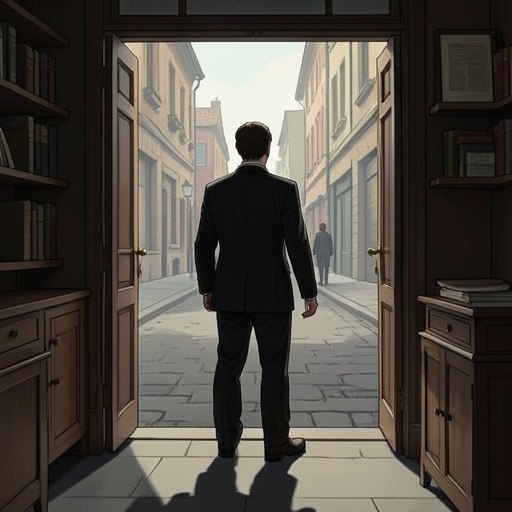
Rabo walks to [Dan Gregory’s New York mansion](entity:location-recall-location-492ca81e9fe9) and is met by [Fred Jones](entity:character-recall-character-fred-jones-24fdd36d2ef1), Gregory’s real assistant. Gregory refuses to welcome the apprentice, claiming he needs an apprentice no more than a squire or troubadour, yet has him put up in an extravagant guest room and wait for hours.
The grand house is both an instrument of status and a theater of humiliation. Rabo has arrived expecting a patron and finds a master who has already decided to make him feel unwelcome.
Rabo’s first night at the mansion, 1933
The Studio’s Impossible World
At midnight Fred leads Rabo to Gregory’s vast studio, a distorted world of six fireplaces, weapons, models, stuffed animals, skulls, dripping skylights, and dozens of mirrors. Gregory tells Rabo that being unwelcome helped make him what he is, then recounts his own difficult childhood and rise as an artist.
The studio reveals Gregory’s gift for building convincing illusions, but also his appetite for control and spectacle. He assigns Rabo an apparently impossible task: paint the room so accurately that it cannot be distinguished from a photograph.
Gregory’s account of his youth, told in 1933
The Counterfeit Ruble
Gregory tells Rabo how his master, Beskudnikov, challenged him to draw a counterfeit ruble good enough to fool merchants. After several rejected attempts, the young artist secretly spends a genuine ruble, then tricks Beskudnikov into retrieving the counterfeit from the tobacconist.
The tale explains Gregory’s audacity and his contempt for a teacher who could not recognize his achievement. It also sets up the rivalry he now stages with Rabo, whom he treats as a possible successor and a target for humiliation.
Rabo’s early apprenticeship, 1933
The Emperor’s Lesson
Gregory teaches Rabo to declare that modern art is fraudulent and that the emperor has no clothes. He praises Mussolini’s hostility to modern art and says the United States needs a frightening father to discipline its spoiled citizens.
He also insists that artists and storytellers are judges of good and evil, and demands that Rabo master the names and functions of every object he paints. The lessons fuse observation with political dogma, leaving Rabo to learn technique under a man whose moral certainty is itself deeply compromised.
within the first six months of the apprenticeship
Rabo Paints the Studio
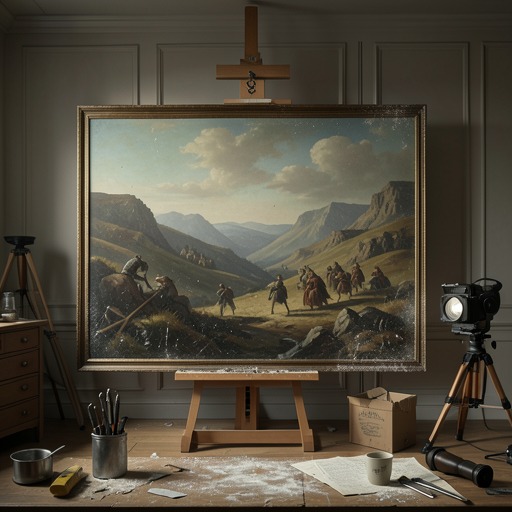
With little guidance from Gregory, Rabo works for six months on a meticulous painting of the studio. He renders its materials and objects with such precision that even droplets leaking from the skylight seem to contain the room in miniature.
Gregory dismisses the finished work as technically impressive but soulless, then burns it in a fireplace. The destruction teaches Rabo that perfect imitation cannot guarantee artistic life, and that technical mastery alone will not make him a serious painter.
during Rabo’s apprenticeship, 1933
A Family of Servants
Rabo meets [Sam Wu](entity:character-recall-character-sam-wu-056e815b25f7), a Chinese laundryman who brings Gregory’s shirts and has served as the model for the sinister fictional character Fu Manchu. Sam later becomes Gregory’s cook, and Rabo will trust him with paintings bought during the war.
In the mansion, Rabo is treated as an outsider by the household staff, but Sam’s presence becomes one of the few human connections he can carry into military service. Their relationship reminds him how small his circle of civilian acquaintances is.
two days after Rabo’s arrival, 1933
Marilee Returns Home
Marilee returns from the hospital in a wheelchair, still recovering from her broken limbs. Gregory does not stop working to greet her, while Rabo approaches her formally, feeling too young, awkward, and unworthy to express the affection he feels.
Marilee’s injuries conceal the violence that brought Rabo to the mansion. Neither she nor Gregory tells him the truth, so he continues to believe that his apprenticeship is a response to his promise and talent rather than to her plea.
during the first three years of Rabo’s apprenticeship
The Museum’s Seduction
Marilee and Rabo repeatedly visit the [Museum of Modern Art](entity:location-recall-location-1bf3f0b791d3), where they encounter the paintings Gregory condemns. Their shared visits become a private rebellion and a source of pleasure that neither can quite explain.
The museum changes the terms of Rabo’s artistic education. He begins to see modern painting not as an enemy to be dismissed, but as a possibility that can draw even Gregory’s loyal household into a new way of looking.
during Rabo’s apprenticeship, before 1936
The Warsaw of Nora’s Story
Rabo and Marilee discuss A Doll’s House after reading an edition illustrated by Gregory. Marilee argues that Nora’s departure from her home cannot be a happy liberation because the play never shows how a woman without money, education, or work survives afterward.
She imagines that Nora must commit suicide, exposing the gulf between an idealized ending and the practical dangers facing women. The conversation anticipates Marilee’s later insistence that male accounts of war and art conceal the costs borne by women.
Saint Patrick’s Day, 1936
A Night of Innocent Love
After years of companionship, Rabo and Marilee make love in an unused room of Gregory’s mansion. Rabo experiences the encounter as a masterpiece and imagines that it has committed them to a shared future; Marilee refuses to treat it as a promise.
She tells him that the clocks stopped while they were together and have now started again. She insists that she must remain with Gregory while Rabo must leave, exposing the different meanings each has attached to their intimacy.
Saint Patrick’s Day, 1936
Gregory’s Discovery
Gregory catches Rabo and Marilee leaving the [Museum of Modern Art](entity:location-recall-location-1bf3f0b791d3) during a parade. He accuses them of betraying him, not because they have seen particular paintings, but because their happiness seems to mock his authority and his demand for loyalty.
Gregory orders Rabo out of the house and tells him that he has been a son to him, while Marilee has been like a daughter. Rabo leaves without a backward glance, still unaware that Gregory had never truly welcomed him and that Marilee’s injuries had been caused by the art supplies she sent.
after March 17, 1936
Life on the Streets
Rabo spends his first night away from Gregory at the Vanderbilt YMCA, then struggles to find work during the Depression. He becomes a near-homeless drifter, reading in libraries and trying to educate himself while searching for food, shelter, and a livelihood.
The experience strips away his belief that talent and knowledge alone can secure a place in the world. He comes to suspect that social belonging, rather than self-improvement, is the deeper advantage offered by established institutions and families.
during the Great Depression, after Rabo leaves Gregory
Coulomb’s Intervention
In [Central Park](entity:location-recall-location-0d5dd0e00cc4), Rabo meets [Marc Coulomb](entity:character-recall-character-marc-coulomb-e8ef9d1dcf36), an Armenian from a prosperous Parisian family who recognizes his drawing ability. Coulomb buys him clothes and persuades an advertising agency to hire him by offering the family’s travel account in return.
The act of assistance gives Rabo a foothold in paid work. It also sharpens the irony of his history: his parents had hoped for [Paris](entity:location-recall-location-657453741ed3) but were diverted to [California](entity:location-recall-location-7255928c66a8) by [Vartan Mamigonian](entity:character-recall-character-vartan-mamigonian-62c271316ca1), while Rabo’s eventual artistic circle will help make New York the center of the art world.
after Rabo begins work at an advertising agency
The Rejected Student
Rabo takes his portfolio to the [Art Students League](entity:organization-recall-organization-bba987db87fa), hoping to join a class and become a serious painter. Teacher Nelson Bauerbeck sees that Rabo has technical ability but no apparent struggle or passion, and rejects him as a student.
The encounter gives Rabo a language for what his work lacks: personality, pain, or some necessary shortfall that makes a picture more than a display of competence. He later tries creative writing instead, but abandons that course when asked to describe appearances in words.
1938
Rabo’s Father Dies
Rabo’s father dies alone in the movie theater after watching Captains Courageous. Rabo attends the funeral as one of only three mourners and sees his father buried in a proper pair of trousers and his own cowboy boots.
The father’s death intensifies Rabo’s unresolved anger over the life the family lost and the choices his father made. Decades later, [Circe Berman](entity:character-recall-character-circe-berman-46ed9f1eb727)’s questions will bring that resentment back into the present and force Rabo to reconsider his father’s survival as a wound rather than a failure.
1939
The European War Begins
As [Germany](entity:location-recall-location-a3c24dd56e42) invades neighboring countries, the Depression continues to undermine Rabo’s livelihood. [Marc Coulomb](entity:character-recall-character-marc-coulomb-e8ef9d1dcf36)’s travel business collapses, and Rabo loses his advertising job.
With few prospects and a need for structure, he joins the peacetime [United States Army](entity:organization-recall-organization-united-states-ar-bc24e4a38db1). The decision carries him from precarious civilian life into the military institution that will provide him with another family and shape his wartime identity.
May 8, 1945
The Valley at War’s End
After the war in Europe ends, Rabo and other captured officers are marched through the countryside by guards who later disappear. They reach the rim of a vast valley filled with concentration-camp survivors, slave laborers, prisoners, displaced civilians, released asylum inmates, and soldiers from many armies.
The defeated German forces are still present, their weapons functioning but their purpose gone. The valley becomes the unforgettable image of humanity gathered at the edge of peace, and it will later supply the subject and setting of Rabo’s final great work.
after May 8, 1945
The Return to America
Rabo returns to the United States and receives cosmetic surgery for the ruined place where his eye had been. His first wife, [Dorothy](entity:character-recall-character-dorothy-b763ef1a8c45), had been his nurse at the military hospital, and they marry after the war.
The country that offers him treatment does not restore his place in civilian life. He is physically healed enough to return home but emotionally blank, without the military family that had given his life structure and without a clear idea of what should come next.
early postwar years
The Marriage and Its Drift
Rabo and [Dorothy](entity:character-recall-character-dorothy-b763ef1a8c45) have two sons, Henri and Terry, and attempt to build a conventional family life. Rabo studies business, works as an insurance salesman, and tries to meet the expectations of a husband and father.
He increasingly escapes into drinking and painting, spending nights away from the family in the [Union Square studio](entity:location-recall-location-01382b43af2e) he shares with [Terry Kitchen](entity:character-recall-character-terry-kitchen-39ff42b4fd59). His postwar identity cannot fit the domestic future he and Dorothy had planned, and the distance between them steadily grows.
late 1940s, after Rabo’s business studies
The Return to Painting
Rabo abandons his plan to become a businessman and begins painting large fields of color with [Sateen Dura-Luxe](entity:object-recall-object-sateen-dura-luxe-05a1dc763343). The act of laying on a single color can make the rest of the world disappear, an absorption he compares to a dangerous drug.
He joins New York painters who are trying to make work that cameras cannot reproduce. Though Rabo is technically gifted, he continues to doubt whether his work contains the soul he sees in the strongest paintings.
late 1940s, in New York
The First Art Circle
Rabo becomes a companion and benefactor to struggling painters who gather in bars near the [Cedar Tavern](entity:location-recall-location-72a2919d9061). His war savings, disability pension, and market investments allow him to pay for drinks, rent, cars, and other emergencies; the painters repay him with unwanted pictures.
He buys their company as much as their art, joining a new family after the loss of his Army platoon. The exchange will later leave him with a valuable collection assembled through generosity and chance rather than deliberate collecting.
early 1950s, before the painters’ rise
Kitchen’s Spray Rig
On a trip to Montauk with Rabo, [Terry Kitchen](entity:character-recall-character-terry-kitchen-39ff42b4fd59) sees a surplus paint-spraying rig and insists that Rabo buy it for him. Kitchen’s personality shifts even before he uses the device, as if he has discovered a new vocation.
With only red automobile paint available, he sprays bursts onto a board and recognizes an artistic possibility in the marks. The equipment will turn a talented but untrained man into an original painter and deepen the contrast between Rabo’s technical skill and Kitchen’s sudden creative transformation.
during the early years of Rabo’s painting career
A Non-Epiphany
Rabo recalls a conversation with Kitchen about moments when God seems to release people from the pressure of existence. Kitchen calls such intervals non-epiphanies, rare moments of ordinary human freedom rather than divine revelation.
The idea gives Rabo a way to understand the contentment he once felt after making love to Marilee. It also suggests that art and intimacy can briefly loosen the grip of life’s demands without providing a lasting answer to them.
1950
The Reunion in Florence
A court subpoena brought Labo to [Florence](entity:location-recall-location-706cb92b9779) to testify about a painting that a German general had stolen from a private residence and later recovered by his wartime art group. At a hotel, he received a note from Serice. Now Countess of Potomac, she invited him to her palace. Lab
during the 1950 Florence reunion
Marilee’s Reckoning
Sessie recounts the various abuses she has endured: her father's beatings, the rape by a football player, exploitation in the theater, Gregory's violence, and Labo's silence after their brief relationship. Labo then realizes she does not expect anything extraordinary, only that he shows a little
1940–1941, before the United States enters World War II
Marilee’s Rise in Italy
Sessie explained that she, Gregory, and [Fred Jones](entity:character-recall-character-fred-jones-24fdd36d2ef1) became highly sought-after guests in [Italy](entity:location-recall-location-125be658b0d0) under Mussolini's rule. The public attention finally brought her the respect she had been denied in New York; she also learned to speak fluent Italian, while Gregory and Jones continued to be involved in the dictator
after Pearl Harbor, 1941
The Marriage for Intelligence
After the Pearl Harbor incident, Mussolini ordered Bruno to marry Cecilia in order to allay rumors about his sexual orientation and political loyalty. An American representative persuaded her to accept the marriage, saying she could thus continue to approach Mussolini's circle and serve the United States
December 1940, at Sidi Barrani
Gregory and Jones Die
[Dan Gregory and Fred Jones](entity:relation-recall-relation-dan-gregory-and-fred-161870954a15) joined the Italian Army as civilian observers and painters, wearing Italian uniforms without ranks or unit insignia. The British army defeated the Italian forces at [Sidi Barrani](entity:location-recall-location-42a2937f00a6) and captured or killed the two men during the battle
near the end of World War II
Bruno’s Execution
Towards the end of world war ii, count bruno potamajore was executed by a firing squad. the people of florence gave serice a painting depicting him refusing to be blindfolded; however, she said the painting did not accurately capture what actually happened. according to the engagement
early 1950s, after Rabo returns from Florence
Rabo’s Art Career Begins
After returning from [Florence](entity:location-recall-location-706cb92b9779), Labo told [Dorothy](entity:character-recall-character-dorothy-b763ef1a8c45) that he had sold paintings worth ten thousand dollars and intended to devote himself to art. Dorothy was worried that he would abandon the stable life they had planned for themselves, and asked him to be a responsible husband and father
early 1950s, after Rabo returns from Florence
The Painters’ Supper
Labatier took Rabin and Kichin to the Cedar Lounge, where they gathered with several painters, Paul Slezin, and tailor [Isadore Finkelstein](entity:character-recall-character-isadore-finkelstein-27b219f8bebc). They joked about each other's clothing and uncertain futures, while Labatier paid for the custom suit with money he had brought
the night of the painters’ supper
Kitchen’s Father Appears
A middle-aged man dressed neatly sat with the painters, asking about Kichin's military service, economic status, and why he had no interest in marriage. After the man left, Kichin suspected the visitor was his father, but couldn't understand why his father would impersonate someone to question
early 1950s, after Rabo rents a house in Springs
The Barn and the Canvases
Labo rented a potato warehouse and bought a house in [Long Island](entity:location-recall-location-c9f1e30eb18c) [Springs](entity:location-recall-location-springs-29bca29397ae), but he did not bring the canvases home; instead, he stored them at "Anju" moving and storage company. [Dorothy](entity:character-recall-character-dorothy-b763ef1a8c45) was dissatisfied with those paintings and the move; Labo continued to support struggling painters and accepted
early 1950s, during the move to the Hamptons
Rabo Meets Edith
When Labo moved the paintings and equipment to the countryside, he saw Edith Tavert Fairbanks leading a tamed raccoon. She and her husband owned the abandoned [potato barn](entity:location-recall-location-c311715e884e) that Labo had rented; Edith instinctively cared for the animals, hinting at the nurturing role she would
1956
Kitchen’s Death
Terry Kichin had a fight with his father after drinking, and shot his father in the shoulder. After seeing what he had done, Kichin put the gun in his mouth and committed suicide; Labo saw shooting as a statement, although this act was not meant to kill his father
1956, a few weeks before Kitchen’s death
Pollock’s Fatal Crash
[Jackson Pollock](entity:character-recall-character-jackson-pollock-b4c81459c1c1) was killed in a car accident after drinking and crashing into a tree on the side of the road. At the time, he was driving on a deserted road. His death occurred several weeks before the suicide of Keith Haring and the breakdown of the marriage of Lee Krasner. These
1956, after Pollock and Kitchen die
Dorothy Leaves Rabo
Labo returned home from the studio to find [Dorothy](entity:character-recall-character-dorothy-b763ef1a8c45) and their son missing. She cut down the portraits of the boys from the plaster wall, leaving two square holes and a note saying she and the children had left forever
before Dorothy leaves, in the mid-1950s
The Murals of the Sons
During a quarrel, [Dorothy](entity:character-recall-character-dorothy-b763ef1a8c45) suspected that Labo would not draw realistically. He took a green crayon and directly drew a life-sized portrait of his sleeping son on the unfinished gypsum wall, without even entering the room to observe them carefully
1956 to the early 1960s
The Hermit Years
After his family leaves and his paintings begin to fail, Rabo abandons painting and withdraws into the [potato barn](entity:location-recall-location-c311715e884e) for about eight years. He becomes a hermit, avoiding people and letting the life he had built with [Dorothy](entity:character-recall-character-dorothy-b763ef1a8c45) disappear.
The retreat is a response to shame and grief, but it also leaves him isolated from the artistic community and from his sons. Years later, he will describe the period as a deliberate search for loneliness that he successfully found.
early 1960s
The Abstract Paintings Fail
The acrylic wall paint [Sateen Dura-Luxe](entity:object-recall-object-sateen-dura-luxe-05a1dc763343) reacts with the canvas sizing and colored tapes in Rabo’s paintings. His works peel apart, leaving bare canvases and debris where collectors had paid substantial sums for what they believed were durable artworks.
The failure destroys Rabo’s reputation and makes him a joke in art history. He later understands the disaster as a postwar miracle gone wrong: the promise of modern materials becomes a source of poison, waste, and humiliation.
after Rabo’s first marriage ends
A New Wife and Home
Rabo marries [Edith Taft Fairbanks](entity:character-recall-character-edith-taft-fairbank-4e00b64552e8), who has inherited a large [East Hampton](entity:location-recall-location-east-hampton-bba2710b11fa) house and welcomes him into it. She loves domestic life, tending the house, garden, food, pets, and guests while Rabo gradually becomes her devoted companion.
Edith also encourages him to bring his stored art collection into the house and redesigns the foyer to display it. Their marriage provides the stability and affection that Rabo’s first family never had, even though he remains estranged from his sons.
after the Florence reunion, over the following decades
Marilee’s Art Collection
Marilee buys ten Abstract Expressionist paintings from Rabo for her palace in [Florence](entity:location-recall-location-706cb92b9779), paying a thousand dollars each and leaving him to select the works. She later builds a major collection of American postwar art, second in scale only to Rabo’s.
The purchase gives Rabo’s struggling circle a patron and lets Marilee mark the palace with art that resists conventional representation. She and Rabo exchange letters about whether their paintings have truly achieved their aim of depicting nothing.
three months before Edith’s death
The Barn’s White Canvases
An inspector finds the eight large panels of Rabo’s collapsed painting locked in a basement beneath the [GEFFCo Building](entity:location-recall-location-geffco-5ca8ae7ff7c8). The panels are returned to him after years in storage, and he has their failed paint and tape removed, then restores the canvas surfaces to dazzling white.
Rabo calls the work a symbolic repair of the damage he caused, though he knows the explanation cannot fully account for why an artwork exists. He names the white expanse 《I Tried and Failed and Cleaned Up Afterwards, so It’s Your Turn Now》 and asks Edith to hold his wake in the barn.
two months after the white canvases are restored
Edith’s Death
Edith dies suddenly when her heart stops and she falls into a flower bed. Rabo attends her burial at [Green River Cemetery](entity:location-recall-location-b2aee9d9c673), near the graves of [Jackson Pollock](entity:character-recall-character-jackson-pollock-b4c81459c1c1) and [Terry Kitchen](entity:character-recall-character-terry-kitchen-39ff42b4fd59), and imagines the dead as souls freed from their unruly bodies.
After her funeral, he returns to the barn and sees the white canvases as a challenge rather than an exorcism. He buys fresh art supplies and begins painting again, entering a new artistic life after years of silence.
immediately after Edith’s death
The Renaissance Begins
Rabo buys all the materials he needs to paint and tells a young clerk that he is a painter, answering with the single word [Renaissance](entity:time-recall-time-renaissance-95b7e25b9862). He works behind closed doors in the [potato barn](entity:location-recall-location-c311715e884e) for six months.
The servants leave, and Rabo again becomes a solitary creature, keeping his new work hidden. When he finishes, he adds more locks to the doors and changes his will so the barn cannot be opened until after his burial.
after Rabo’s six months of painting
The Sealed Barn
Rabo locks the barn with six padlocks and has a lawyer write a new will. His sons will inherit his property only if they restore the family name Karabekian, and the barn must remain sealed until after his burial.
He believes he has made his final gift to the world, but cannot bear to learn how it will be judged. The locked studio becomes the central mystery of his later life and the forbidden room that gives the novel its [Bluebeard](entity:expression-recall-expression-bluebeard-21474b30b08b) frame.
summer 1987, when Rabo is seventy-one
Circe Arrives at the Beach
Years after Edith’s death, [Circe Berman](entity:character-recall-character-circe-berman-46ed9f1eb727) wanders onto Rabo’s private beach and sits staring out to sea. Rabo approaches her, and she abruptly asks how his parents died instead of exchanging a conventional greeting.
Her question breaks through the quiet he has built around himself. Circe is a widow, a writer, and a forceful presence who will make Rabo confront the past and attempt the autobiography he has long avoided.
summer 1987, soon after Circe and Rabo meet
The Parents’ Stories Return
Circe asks Rabo to recount his parents’ deaths and their histories. He revisits the massacre, his mother’s escape, and his father’s lonely life in [California](entity:location-recall-location-7255928c66a8), recalling the ways his father seemed to condemn himself for surviving.
Circe calls the father’s condition [Survivor’s Syndrome](entity:expression-recall-expression-survivor-s-syndrom-0218b359feea) and urges Rabo to forgive him. Rabo resists, insisting that he has already forgiven him many times, but the conversation reopens an old resentment that will shape the autobiography.
summer 1987, within days of their beach meeting
Circe Moves In
Circe settles into [Rabo’s East Hampton house](entity:location-recall-location-fc689cbb3471), saying she needs a quiet place to write. She initially claims to be preparing a biography of her late husband, Abe, but later admits that she is researching a novel about working-class teenagers in a wealthy resort community.
Rabo learns that she is the commercially successful young-adult novelist Polly Madison. Her energy overturns the household and forces Rabo into motion, though he is unsure whether she is a friend, a tormentor, or both.
early in Circe’s stay, summer 1987
Circe’s Critique of Art
At dinner, Circe dismisses Rabo’s paintings as uncommunicative and says she wants art to provide information. She imagines a picture of the Armenian massacre: a living girl trapped among corpses, staring at a dead woman whose mouth spills jewels.
Her proposed image challenges Rabo’s defense of abstraction and suggests that art might create meaning by facing historical suffering. Rabo is startled by the force of her vision, which gives his family’s private trauma a form that could speak to others.
during the first weeks of Circe’s stay
The Secret Writer
Circe reveals that she is Polly Madison, a prolific and popular novelist whose books have reached millions of young readers. Rabo keeps her identity from [Paul Slazinger](entity:character-recall-character-paul-slazinger-de6e68bcea9f), fearing that the discovery will devastate his friend’s pride as a professional writer.
The secret creates a comic imbalance: Slazinger patronizes the author whose success dwarfs his own, while the supposed amateur is actually far more accomplished in the literary marketplace. Circe’s books also connect her to the household’s young resident, [Celeste](entity:character-recall-character-celeste-9b8251b96088).
during Circe’s early stay
The Radio Theory
Circe tells Rabo that Abe’s last message, written with his remaining functional hand, was “I was a radio repairman.” She interprets it as a possible belief that human brains receive signals from elsewhere rather than containing all their own thoughts.
Rabo applies the idea to his father and to [Terry Kitchen](entity:character-recall-character-terry-kitchen-39ff42b4fd59), whose personalities seemed to change when they began making art. The theory gives him a strange way to understand creative transformation, though he does not know whether it explains anything beyond the mystery itself.
mid-summer 1987, while Rabo is away in New York
The Foyer’s Transformation
Circe takes advantage of Rabo’s trip to New York and transforms the pristine foyer of his house. She replaces Edith’s careful modern-art arrangement with black wallpaper patterned in enormous red roses, brown woodwork, and six Victorian pictures of girls on swings.
Rabo returns and thinks the house has suffered an axe murder, then discovers that Circe did the work herself. The shock exposes how deeply he identifies the foyer with Edith and how little he can tolerate another person changing the world she created.
the day Rabo returns from New York, summer 1987
Slazinger Learns the Truth
[Paul Slazinger](entity:character-recall-character-paul-slazinger-de6e68bcea9f) reveals that Circe has told him she is Polly Madison. He had tried to hide the rolls of wallpaper to stop the renovation, but Circe found them and disclosed her identity in anger.
Slazinger has read all her books and admires them, despite having treated her as an amateur. His resentment toward Rabo for keeping the secret is sharpened by the discovery that the writer he patronized is both more commercially successful and, in his view, better than he is.
the same evening as the foyer dispute
The Cook Names Herself
[Allison White](entity:character-recall-character-allison-white-ecdb58f68688) tells Rabo that she and [Celeste](entity:character-recall-character-celeste-9b8251b96088) had planned to leave, and that she feels invisible because he thinks of her only as the cook. She says she does not want to marry him; she wants to be recognized as a human being while living under his roof.
Her complaint echoes [Dorothy](entity:character-recall-character-dorothy-b763ef1a8c45)’s earlier accusation that Rabo treated her as if she did not exist. Celeste adds that Rabo thinks her stupid, forcing him to see that his loneliness has partly been made by his failure to notice the people around him.
the night of the foyer confrontation
Circe’s Date
Circe prepares to go to a dinner party and dancing with a psychiatrist she met on the beach. Rabo confronts her about the foyer and orders her to leave, accusing her of insulting Edith’s memory and vandalizing the house.
Circe argues that he has been listless and neglected before her arrival, and says that the pictures of girls on swings are serious because of the suffering that will follow their apparent innocence. Their argument exposes the different standards of seriousness each brings to art and to life.
after Circe leaves for her date
The Household Nearly Breaks
Allison and [Celeste](entity:character-recall-character-celeste-9b8251b96088) announce that they will leave when Circe does, and Paul has already walked out. Rabo realizes that his house, once lively under Edith, has become a place where the people who live with him feel unseen or used.
Circe returns in the middle of the night and tells him that she has persuaded Allison and Celeste to stay. Rabo accepts her help and goes upstairs, recognizing that the household’s survival now depends on the woman he had just thrown out.
after the household crisis, summer 1987
The Uneasy Contract
Rabo and Circe settle into an unspoken arrangement: she wants to keep living and writing in the house, while he wants her vivid presence to keep him from sinking back into isolation. She agrees to stop asking about the [potato barn](entity:location-recall-location-c311715e884e).
The truce allows Rabo to continue his autobiography while preserving the secret that controls the household. Circe’s influence is not gentle or neutral, but it gives him a reason to remain engaged with people and with his own past.
mid-August 1987
A Second Visit to New York
At Circe’s urging, Rabo travels alone to New York, retracing the route from [Grand Central Station](entity:location-recall-location-1fa7e2b7b509) to Gregory’s former mansion. The houses have been divided into apartments, and the old studio is inaccessible to him.
He encounters the aged actress [Barbira Mencken](entity:character-recall-character-barbira-mencken-6d4cc955bb31), Slazinger’s former wife, but does not speak to her. The trip briefly makes him feel young and self-sufficient, while also confirming that the people and places that once defined his life have largely vanished.
during Rabo’s return from New York, mid-August 1987
The Limousine Ride
Rabo accepts a ride home in a Cadillac limousine from Floyd Pomerantz, a wealthy television executive recently paid eleven million dollars to resign. Pomerantz asks whether there is still time for him to become a painter, and Rabo encourages him.
The conversation makes Rabo think about the difference between money acquired by accident and wealth extracted from others. Slazinger jokes that Rabo belongs in a Dumb Luck Hall of Fame, while imagining a separate hall for financiers who have legally taken vast fortunes.
Rabo’s return from New York, mid-August 1987
The House of Little Girls
Rabo returns to find the foyer transformed, loses his eye patch in the shock, and is exposed to the scar he has hidden even from Edith. The cook, [Celeste](entity:character-recall-character-celeste-9b8251b96088), and Slazinger show little alarm at his disfigurement, making him confront the possibility that he has mistaken his appearance for a barrier to human contact.
The pictures of girls on swings, which Rabo sees as destructive kitsch, are defended by Circe as images of children facing disease, poverty, violence, and death. The new foyer forces him to encounter an art that makes its emotional claims through recognizable figures rather than abstraction.
the night Slazinger arrives at the house
Circe’s Secret Pills
After [Paul Slazinger](entity:character-recall-character-paul-slazinger-de6e68bcea9f) arrives in a straitjacket, Rabo goes to Circe’s bedroom hoping to find a sleeping pill for him. He discovers a bathroom filled with drug samples left by Abe, and realizes that Circe has access to a vast supply of medication.
The discovery makes Rabo reinterpret her restless energy, sudden transformations, and erratic moods. He cannot tell what help she needs or how to offer it, so he returns to Slazinger and listens as his friend raves about literature and his own revolutionary theory.
late summer 1987
Slazinger’s Breakdown
Slazinger’s neighbors hear him calling for help from his windows, and a volunteer rescue squad brings him to Rabo’s house in a straitjacket. Once released, he asks to be put to bed in a room overlooking the ocean.
His breakdown reveals the severity of the psychological wounds he has carried since the war, including the grenade that nearly killed him. Rabo accepts him into the house, recognizing that his old friend has finally come to rely on the refuge he once refused to share.
during Slazinger’s first night at Rabo’s house
The Revolution Theory
Slazinger tells Rabo that successful revolutions require three kinds of people: an original genius, a respected citizen who can vouch for the genius, and a persuasive explainer who can make difficult ideas accessible. He considers the pattern applicable to [Abstract Expressionism](entity:concept-recall-concept-1bdb8434b306) and other transformations.
The theory is presented amid Slazinger’s unstable confidence, but it gives Rabo a framework for understanding how artistic movements gain recognition. A genius may be dismissed as mad, he suggests, unless others can validate and communicate the new vision.
late summer 1987, after Slazinger moves in
The Secret of the Barn
Slazinger guesses that the locked barn contains something Rabo has saved for the end of his life. Rabo tells him that the hidden work is neither his best nor his worst, but the emptiest and fullest human message: good-bye.
The answer preserves the mystery while revealing that the barn contains a final artistic statement rather than a literal treasure or joke. Its secrecy is linked to Rabo’s fear of judgment and his wish to leave the work behind only after he is gone.
late summer into early autumn 1987
The Summer House Fills
The house becomes a refuge for an unlikely gathering: Rabo writes his autobiography, Circe works on her novel, and Slazinger begins a book about revolution. [Allison White](entity:character-recall-character-allison-white-ecdb58f68688) and [Celeste](entity:character-recall-character-celeste-9b8251b96088) remain, and Allison becomes pregnant again, planning to carry the child to term.
The crowded household contrasts with the isolation of Rabo’s recent years. Its unfinished books, new pregnancy, and daily company make the house seem to be producing several new beginnings at once.
September 1987
The Stock-Market Crash
The stock market crashes as the summer ends, just as Circe approaches the completion of her novel. The event recalls the economic collapse that shaped Rabo’s childhood and reduces demand for domestic help in [the Hamptons](entity:location-recall-location-f8b1c0c5b3c4).
The crash grounds the novel’s large reflections on money and luck in another immediate disruption. Rabo’s house remains a sanctuary, but its residents live inside an economy that can suddenly reverse their circumstances.
autumn 1987, after Circe finishes her novel
Circe’s Departure Looms
Circe completes her book and prepares to return to Baltimore. Rabo is relieved that the end of her stay may restore peace, yet recognizes that he will miss the excitement and pressure she brought into his life.
Before she leaves, she asks him to prove that he can draw, challenging the modest talent he repeatedly claims as the one achievement he trusts. Her request becomes the path by which Rabo finally approaches the secret in the barn.
the night before Circe leaves, autumn 1987
Rabo’s Drawing Gift
Rabo tells Circe how he once drew his sons’ portraits on the wall and later made a quick caricature of Slazinger with dusty thumbs. The demonstrations reveal a talent he has treated as easy and therefore unworthy of respect.
He explains that his most famous painting, Windsor Blue Number Seventeen, began as an abstraction but secretly contained a tiny image of a hunter and deer. His technical options have always included representation, even when his public art tried to exclude narrative.
the night before Circe leaves, autumn 1987
The Barn’s True Contents
Pressed to explain the barn, Rabo gives Circe a deliberately absurd description, then reveals the truth: eight joined panels, eight feet high and sixty-four feet long, standing white after the removal of the failed paint and tapes. He has painted a vast, densely populated scene of the valley he saw when the war in Europe ended.
The work is titled Now It’s the Women’s Turn. Its immense scale turns a private secret into a history of thousands of people, each with a story of displacement, violence, or survival. Rabo’s technical precision has finally been joined to a subject that demands his attention.
the same night, at the barn’s central viewpoint
The Valley Comes into Focus
Rabo first shows Circe the painting from its extreme end, where the long scene is compressed into a narrow, jeweled-looking wall. He then leads her to the center, where the foreshortened image opens into a green valley containing 5,219 figures and the ruins of a watchtower.
The scene recalls the moment Rabo witnessed at the end of the war, but expands it into a crowded human world. Each figure, even those no larger than a speck, belongs to a specific history of imprisonment, flight, military service, or ordinary survival.
during Circe’s first close look at the mural
The Canadian Bombardier
Circe notices a dying man clinging to the leg of the largest figure in the painting. Rabo explains that the man is a Canadian bombardier shot down over Hungary, suffering from pneumonia and asking whether they are home yet.
Rabo answers the dying man in the painting as he wishes someone could answer every displaced survivor: yes, they are home. This intimate encounter makes the enormous scene personal and reveals the tenderness beneath its grim detail.
during Circe’s tour of the mural
The Scarecrow Guard
Rabo points out a former concentration-camp guard who has discarded his uniform and disguised himself in a scarecrow’s suit. The guard has brought prisoners into the valley but has nowhere safe to go, while victims nearby are dying.
The figure complicates the boundary between perpetrator and survivor without erasing responsibility. Rabo’s painting holds the violence and its aftermath together in one landscape, refusing the simple moral closure of a victory scene.
during Circe’s tour of the mural
The Hidden Women
Circe notices that the valley seems to contain few women. Rabo explains that many of the camp survivors and asylum inmates are women, though starvation and violence have stripped them of the appearances viewers might recognize as feminine.
At the far ends of the painting, healthy women hide in cellar rooms with root vegetables, delaying the rape they expect from the men who will reach them. Their presence gives the work its title and transforms the valley’s apparent peace into a warning about what follows war.
during Circe’s tour of the mural
The Gypsy Queen
Rabo tells Circe the invented story of a solitary Gypsy queen who wanders into the valley after her people are killed. Wounded while trying to steal a chicken, she dies alone, her body swollen after three days; the jewels spilling from her mouth are mistaken for blood and maggots.
A concentration-camp guard will be the first to discover the jewels, linking one survivor’s desperation to another’s survival. The scene echoes the story of Rabo’s mother in the massacre and turns the painting’s smallest narrative into a cruel reflection on luck, hunger, and what the living can inherit from the dead.
during Circe’s tour of the mural
The Japanese Officer
Circe identifies a Japanese officer in the valley, though no Japanese soldier was present in the scene Rabo witnessed. Rabo deliberately added him because he believes Japan, along with [Germany](entity:location-recall-location-a3c24dd56e42), helped turn the United States into a militarized nation after its earlier antiwar resolve.
The officer’s presence makes the mural a reckoning with memory rather than a literal record. Rabo uses the imagined figure to connect the valley’s European aftermath to the political consequences of war in America.
near the end of Circe’s tour, autumn 1987
The Painting’s Title
Circe asks the title of the vast mural, and Rabo answers: Now It’s the Women’s Turn. She understands that the painting is not merely a record of combat or an abstract experiment, but an indictment of the harms women face when the men’s wars are over.
Rabo admits that he has arranged the work so that healthy women are at the ends of the scene, hiding from the violence still to come. The title gives the crowd’s apparent release from war a disturbing future and refuses to call the valley uncomplicated peace.
during the mural conversation, autumn 1987
The Sons’ Inheritance
Rabo tells Circe that his sons will inherit the mural and everything else he owns, provided they change their names and their children’s names back to Karabekian. He says the condition honors his mother, who wanted the family name to endure despite the displacement that had taken them from Armenia.
Circe warns that the painting could make the estranged sons multimillionaires. Rabo says they will be wealthy regardless, but his stipulation makes inheritance a final attempt to reconnect them to a lineage they have chosen to leave behind.
near the end of the mural tour, autumn 1987
The Three Musketeers in Paint
Rabo points out that the two Polish laborers in the valley are portraits of [Jackson Pollock](entity:character-recall-character-jackson-pollock-b4c81459c1c1) and [Terry Kitchen](entity:character-recall-character-terry-kitchen-39ff42b4fd59), placing his dead friends in the same landscape as the historical victims and soldiers. He also identifies familiar public figures in other places, including Laurel and Hardy and Charlie Chaplin.
Circe sees the three painters together at the bottom of the scene and asks whether the deaths of the others were a terrible blow. Rabo rejects the idea that their suicides grew out of their art, insisting that painting’s wonder was separate from drinking and despair.
at the end of the mural tour, May 8, 1945
The Date in the Valley
Circe asks whether the painting indicates when and where its scene took place. Rabo explains that a Maori corporal near the far end reads a page from an anti-Semitic newspaper while sitting on a German ammunition box.
The date, [May 8, 1945](entity:time-recall-time-may-8-1945-3e4851d82e6e), is written in tiny letters on the box. The detail anchors the imagined crowd to the day Europe’s war ended, while the bewildered soldier’s attempt to learn where he is and what may happen next becomes a question shared by everyone in the valley.
after Circe sees the painting, late 1987
The Mural Opens to Visitors
Rabo removes the spikes from the barn doors and opens the mural to visitors, making it part of the regular tour of his collection. Viewers pass through the long structure, often walking through more than once, and use magnifying glasses to inspect the tiny figures.
No solemn critic has yet arrived, but ordinary visitors respond strongly to the work. Rabo calls it a tourist attraction, a world’s fair, and a gruesome Disneyland, accepting that its power may belong to the people rather than to official art history.
after the barn opens, late 1987
The Foyer Wins the Visitors
Visitors ask Rabo to explain the pictures in the foyer, and he describes the suffering that may lie ahead for each girl on a swing. Soviet writers who initially dismiss the images as trash become moved by his account and apologize for failing to understand them.
Their response gives Rabo a brief success as an interpreter of art. The exchange supports Circe’s argument that communication can transform how people see, even when the images themselves appear sentimental or trivial.
the final night of Circe’s stay, late 1987
The Thank You to Meat
On the walk back from the barn, Circe tells Rabo that his body, not just his soul, made the mural. She urges him to look at his hands as strange and clever animals and thank the flesh he has spent so long blaming.
Rabo follows her instruction and says, with gratitude, “Thank you, Meat.” The gesture reconciles him briefly with the body that lost an eye, made mistakes, loved, and finally created the work he had feared showing to anyone.