A.F. 632, early in the novel
The Hatchery Tour
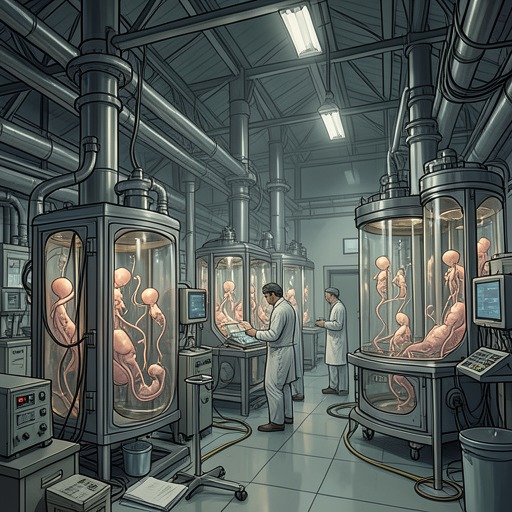
The Director guides new students through the Central [London](entity:location-recall-location-london-420923d4a60a) Hatchery and [Conditioning](entity:concept-recall-concept-conditioning-f93c7a0c18b3) Centre, showing how ova are fertilized, multiplied through [Bokanovsky's Process](entity:concept-recall-concept-bokanovsky-s-process-80a35d2804c1), and assigned to castes and occupations before birth. The tour presents human life as a system of industrial production, with social stability and uniformity treated as its overriding achievements.
In the Embryo Store, the students see how oxygen, hormones, temperature, and motion are manipulated to produce bodies suited to predetermined work. The Director explains that conditioning must make people love the fate assigned to them, turning biological manufacture into the foundation of the [World State](entity:organization-recall-organization-world-state-80b22646d96c).
A.F. 632, during the Hatchery tour
Conditioning Delta Infants
The Director demonstrates [Neo-Pavlovian conditioning](entity:concept-recall-concept-neo-pavlovian-conditi-51e2bb9d2368) by placing Delta babies among roses and illustrated books, then shocking them and frightening them with alarms. The infants learn to recoil from both books and nature, a lesson intended to prevent costly curiosity and to keep lower-caste workers focused on consumption and assigned work.
He explains that the policy has changed: Deltas must still travel into the countryside for organized sports, but those sports are designed to require equipment and generate purchases. The episode reveals how the State engineers not only conduct but economic demand.
A.F. 632, during the Hatchery tour
The Discovery of Hypnopaedia
The Director recounts how a sleeping child once repeated a radio lecture, leading to the discovery of hypnopaedia. Early attempts to teach factual knowledge during sleep failed because children could repeat words without understanding them; moral and social lessons, however, could be implanted through repetition.
He plays a lesson teaching children to accept their caste and disparage those below it. [Hypnopaedia](entity:concept-recall-concept-hypnopaedia-8bb911393f17) supplies the subtler distinctions that shocks cannot teach, shaping the mind until State suggestions become the individual's own convictions.
A.F. 632, later that afternoon
The Director's History Lesson
The Director teaches the students about the suppression of family life, romantic exclusivity, and childhood sexual restraint. Their embarrassment at words such as mother and father shows how thoroughly the [World State](entity:organization-recall-organization-world-state-80b22646d96c) has made reproduction and kinship taboo.
[Mustapha Mond](entity:character-recall-character-mustapha-mond-81dcf77e5c02) joins the tour and declares that history is bunk. He evokes the loneliness, emotional intensity, and instability of the old family system, then contrasts them with a society organized around communal life, easy pleasure, and predictable contentment.
A.F. 632, that afternoon
Lenina and Fanny's Conversation
In the women's changing room, Lenina discusses her relationship with [Henry Foster](entity:character-recall-character-f1d4b8890d73) and her reluctance to take other lovers. Fanny warns her that remaining with one man for months is improper and reminds her that everyone belongs to everyone else.
Lenina admits she has been feeling less enthusiastic about promiscuity, but agrees to make the effort. Her uncertainty marks a small personal hesitation within a culture that treats exclusive attachment as dangerous and antisocial.
A.F. 632, during the tour and changing-room scenes
The Controller's Case for Stability
[Mustapha Mond](entity:character-recall-character-mustapha-mond-81dcf77e5c02) argues that strong attachments and delayed gratification make people emotionally unstable. The [World State](entity:organization-recall-organization-world-state-80b22646d96c) has therefore shortened the distance between desire and fulfillment, using conditioning, sexual availability, and soma to prevent passion from disrupting collective life.
[Bernard Marx](entity:character-recall-character-bernard-marx-985087e96eb0) overhears [Henry Foster](entity:character-recall-character-f1d4b8890d73) and others discuss Lenina as a sexual commodity. Their easy familiarity and his own isolation intensify his resentment, exposing the personal cost of a society that suppresses private feeling in the name of stability.
A.F. 632, shortly after the opening tour
Bernard Meets Lenina on the Roof
In a crowded lift, Lenina tells [Bernard Marx](entity:character-recall-character-bernard-marx-985087e96eb0) she will go with him to the New Mexico Reservation. Bernard is embarrassed by her public frankness, while she finds his discomfort amusing and assumes their arrangement is ordinary.
On the roof, Bernard tries to share his response to the open sky and the beauty of the afternoon. Lenina hurries away to meet [Henry Foster](entity:character-recall-character-f1d4b8890d73), leaving Bernard hurt by the contrast between his wish for private intimacy and her uncomplicated expectation of recreation and sex.
A.F. 632, immediately after Lenina leaves
Bernard's Social Insecurity
Bernard broods over his small stature and the contempt he expects from both lower-caste workers and his Alpha peers. Because his physique resembles that of a lower caste, he feels that others measure his social standing by his body, and his fear of humiliation makes him defensive and solitary.
He flies to visit [Helmholtz Watson](entity:character-recall-character-helmholtz-watson-3cbf8b3e4884), whose exceptional intellectual ability has also begun to estrange him from society. Their differences are substantial, but both men recognize an uncomfortable sense of being individuals rather than interchangeable members of a group.
A.F. 632, during Bernard's visit
Helmholtz's Unused Power
Helmholtz tells Bernard that his work as an Emotional Engineer feels inadequate. He can invent striking slogans, but he senses that he has a greater force within him and wants something meaningful enough to write about with intensity.
He describes words as capable of piercing like X-rays, yet finds little depth in writing about consumer pleasures and communal activities. His dissatisfaction foreshadows the conflict between genuine artistic expression and a society that permits only useful, harmless entertainment.
A.F. 632, the same evening
Lenina's Ordinary Evening
Lenina and Henry play Obstacle Golf, eat with friends, take soma, and attend a cabaret where sensory music and a communal song promise endless contentment. Their evening is frictionless by design: pleasure arrives on schedule, and neither is encouraged to question what the spectacle excludes.
They return together, and Lenina carefully follows contraceptive regulations. The sequence presents the routine pleasures through which the [World State](entity:organization-recall-organization-world-state-80b22646d96c) reinforces consumerism, sexual availability, and emotional sedation.
A.F. 632, on an alternate Thursday
Bernard's Failed Solidarity Service
Bernard attends a [Solidarity Service](entity:concept-recall-concept-solidarity-service-60aef8f155d4) at the [Fordson Community Singery](entity:location-recall-location-5889df00ed39), where twelve participants sing hymns, share soma, and seek to dissolve their separate identities in a communal ecstasy. He performs the expected gestures but cannot experience the promised spiritual union.
His attention remains fixed on Morgana Rothschild's joined eyebrow, and he leaves feeling more isolated than before. The ritual reveals how collective devotion reproduces conformity while deepening Bernard's awareness that he cannot simply merge with the group.
A.F. 632, in the weeks before the trip
Lenina Agrees to the Reservation
Lenina weighs a familiar holiday against the novelty of visiting the Savage Reservation. Although Bernard's behavior unsettles her, the chance to see a place few people know ultimately persuades her to keep their plan.
Their differing expectations are already clear: Lenina imagines a holiday with familiar comforts, while Bernard hopes for privacy and conversation. Her acceptance sets in motion the encounter that will bring the [World State](entity:organization-recall-organization-world-state-80b22646d96c)'s assumptions face to face with another way of life.
During the journey to the Reservation
Bernard Rejects Social Noise at Sea
On their return across the Channel, Bernard stops the aircraft above the rough sea and switches off the radio. He says the solitude makes him feel more fully himself, less like a cell in the social body, and asks Lenina whether she wishes she could be free from conditioning.
Lenina is frightened by the landscape and insists that she is already free because she can enjoy herself. Bernard's attempt to imagine a different kind of happiness falters; they return to [London](entity:location-recall-location-london-420923d4a60a), where he takes soma and resumes the expected pattern of intimacy.
Before the Reservation trip
The Director Threatens Bernard
Bernard brings his travel permit to the Director, who recognizes New Mexico as the place where he once lost a Beta-Minus companion during a storm. He recounts that she never returned, admits he still dreams about searching for her, then angrily rebukes Bernard for unconventional behavior and threatens to transfer him to [Iceland](entity:location-recall-location-f867f3147359).
Bernard leaves believing he has been strengthened by standing against authority, though he does not truly expect the threat to be carried out. The Director's confession, and his fear of exposure, foreshadow the revelation that will overturn his authority.
A.F. 632, the day the holiday begins
The Journey to New Mexico
Bernard and Lenina travel by rocket to Santa Fe, where Lenina delights in the hotel's familiar conveniences. Bernard warns her that the Reservation will lack comforts, but she insists that she wants to go.
At the Warden's office, they learn that the Reservation is fenced off, home to people who still marry, raise children, and practice traditions the [World State](entity:organization-recall-organization-world-state-80b22646d96c) has suppressed. Lenina listens to the lecture under the influence of soma, while Bernard grows increasingly impatient and worried about a cologne tap he has left running.
During the Reservation visit, before entering Malpais
Bernard Learns of Iceland
After leaving the warden, [Bernard Marx](entity:character-recall-character-bernard-marx-985087e96eb0) called up Huxley Watson and learned that the director had already publicly begun to look for someone to replace him, and again proposed to transfer him to [Iceland](entity:location-recall-location-f867f3147359). What had once seemed only an exciting threat now seemed real, and Bernard Marx was suffocated by
The next day, in the New Mexico Reservation
The Malpais Approach
[Bernard Marx](entity:character-recall-character-bernard-marx-985087e96eb0) and Lenina Crow arrived at Marpess. This Pueblo village is built on a plateau above a dusty valley. Lenina Crow dislikes the rugged paths, the guide, and various smells, but the drum sounds from the village lead them upward, toward a strange ceremony
On arriving at Malpais
Lenina Encounters Age and Birth
In the Pueblo village, Lenina Crow saw an old man whose body was clearly in a state of decay due to aging. [Bernard Marx](entity:character-recall-character-bernard-marx-985087e96eb0) explained that the World Congress uses medical means to keep people young until death. This system allows citizens to avoid the usual process of aging, yet leaves them unprepared
That afternoon at Malpais
The Snake Dance and Whipping
[Bernard Marx](entity:character-recall-character-bernard-marx-985087e96eb0) and Lenina Cron watched a ceremony featuring images of snakes, eagles, and Christ. Dancers performed around the square, and then a young man named Palochetva was whipped and sacrificed. The crowd shouted with each whip. The ceremony ended with the boy bleeding and unable to
After the ceremony, at Malpais
John's Origins Revealed
[John](entity:character-recall-character-john-6bc68dc682c3) told [Bernard Marx](entity:character-recall-character-bernard-marx-985087e96eb0) that his mother [Linda](entity:character-recall-character-linda-d0962a858d4f) came here with a man from another place. After Linda was injured in the mountains, the man abandoned her. She stayed on the reservation and gave birth to John there; the man's name was Tomakin, and Bernard Marx recognized this as the name of the
John's childhood, recounted after the ceremony
Linda's Life in Malpais
[Bernard Marx](entity:character-recall-character-bernard-marx-985087e96eb0) and [John](entity:character-recall-character-john-6bc68dc682c3) went to visit [Linda](entity:character-recall-character-linda-d0962a858d4f). Her aged, sickly and disheveled appearance made Leninna Klang feel repulsed. Linda spoke with yearning about the clothes of civilized society and a comfortable life, then described her years in Marpess: local women rejected her because
During John's childhood in Malpais
John's Painful Childhood
[John](entity:character-recall-character-john-6bc68dc682c3) remembered that a man came to find [Linda](entity:character-recall-character-linda-d0962a858d4f), and he also remembered that local women humiliated and beat her. When he tried to protect Linda, he was also beaten; afterward, Linda sometimes blamed him for being a burden that hindered her return to civilized society, and at other times, she
Around John's twelfth birthday
John Discovers Shakespeare
Pop gave [Linda](entity:character-recall-character-linda-d0962a858d4f) an old edition of the Complete Works of [William Shakespeare](entity:character-recall-character-6b0c4dbf0919). [John](entity:character-recall-character-john-6bc68dc682c3) began to read. The language in the book allowed him to express feelings he had always found difficult to understand, especially his hatred toward Pop and his confusion about his relationship with Linda
During John's adolescence
John Attacks Pope
[John](entity:character-recall-character-john-6bc68dc682c3) found [Linda](entity:character-recall-character-linda-d0962a858d4f) and Pop sleeping together. Under the impact of jealousy and Shakespearean language, he picked up a knife and attacked Pop. Pop grabbed his wrist and stopped him; Linda woke up, saw the blood, and cried. John had to face his anger and helplessness
When John is fifteen
Mitsima Teaches John Craft
Mizima taught [John](entity:character-recall-character-john-6bc68dc682c3) to make pottery and promised to teach him how to make bows. John was eager to master the craft that required patience, skill, and physical strength; in [Linda](entity:character-recall-character-linda-d0962a858d4f)'s description of a life of easy convenience, there was hardly any such experience. This craft briefly gave him a sense
When John is sixteen
John Loses Kiakime
[John](entity:character-recall-character-john-6bc68dc682c3) watched the wedding ceremony of Kea Kime and Koslu, realizing that the girl he had long admired no longer belonged to him. [Linda](entity:character-recall-character-linda-d0962a858d4f) called the ceremony a pointless hassle, but John ran away, experiencing the loss as a private and complete sorrow
When John is a young man, before the visit from London
John Is Excluded from Initiation
At the Kameari coming-of-age ceremony, the men refused to let [John](entity:character-recall-character-john-6bc68dc682c3) participate in the boy's coming-of-age ceremony because of his white hair and his mother's reputation. They insulted him, threw stones at him, and drove him away, leaving him alone sitting on the platform under the
After John and Bernard meet at Malpais
John Accepts the Invitation
[John](entity:character-recall-character-john-6bc68dc682c3) told [Bernard Marx](entity:character-recall-character-bernard-marx-985087e96eb0) that he had always dreamed of seeing another place. Bernard Marx invited him to [London](entity:location-recall-location-london-420923d4a60a); after hearing that [Linda](entity:character-recall-character-linda-d0962a858d4f) might also be joining, John happily agreed. Linda's story and Shakespeare's language shaped his expectations: he imagined the civilized world as beautiful and full of wonders, and for a
The morning after the Malpais visit
Bernard Secures the Return
Lenina Crow is still sleeping in the Somewhere holiday, while [Bernard Marx](entity:character-recall-character-bernard-marx-985087e96eb0) flies to San Francisco and calls Mustafa Mond. The World Controller approves him to take [John](entity:character-recall-character-john-6bc68dc682c3) and [Linda](entity:character-recall-character-linda-d0962a858d4f) back to [London](entity:location-recall-location-london-420923d4a60a), and the Warden then provides the necessary documents and transportation arrangements
Soon after Bernard's return to London
The Director Is Exposed
after returning to bloomington center, the director publicly announced that bernard marx would be fired and transferred to iceland, citing his unconventional behavior. bernard marx interrupted the announcement and brought in linda. linda recognized the director as tomakin and revealed their past relationship in front of everyone
The weeks after the return to London
Linda's Soma Holiday
[Linda](entity:character-recall-character-linda-d0962a858d4f) locked herself in the room, increasing the dose of soma continuously, using almost nonstop drug holidays to escape memories. Dr. warned that this dose would shorten her life, but also argued that soma could let her spend long hours in imagined time and happiness. [John](entity:character-recall-character-john-6bc68dc682c3) opposed, saying the drug
The weeks after John's arrival
Bernard's Sudden Celebrity
The upper class in [London](entity:location-recall-location-london-420923d4a60a) vie to meet [John](entity:character-recall-character-john-6bc68dc682c3), and Bernard, as his guardian, becomes fashionable as a result. Those who once mocked Bernard now flatter him; he enjoys the invitations, admiration, and sexual opportunities that come with his fame
During John's first weeks in London
John Sees the Factory
Bernard takes [John](entity:character-recall-character-john-6bc68dc682c3) to a factory where workers are grouped into identical Bokanovsky groups and assigned specific jobs. Seeing mass-produced people engaged in routine labor, John feels physically ill, although the manager assures the workers that they are satisfied
During John's first weeks in London
The Eton Visit
At [Eton College](entity:location-recall-location-a15cb602abe5), [John](entity:character-recall-character-john-6bc68dc682c3) learned that the school only admits children from the upper class who are developed from a single embryo, while most citizens are mass-produced. He saw students mocking their religious penitents being whipped, and could not understand why pain could be funny
An evening during John's London visit
Lenina and John Attend a Feelie
Lenina takes [John](entity:character-recall-character-john-6bc68dc682c3) to a sensuous movie, where the erotic scenes and tactile effects leave the audience thoroughly enchanted. John feels uneasy about the movie's reduction of intimacy to artificially designed sensory stimulation, while Lenina thinks they will both enjoy the movie together and go back together. After watching, she approaches
Soon after the feelie
Bernard's Party Collapses
Bernard arranged a party with celebrities in attendance, hoping that [John](entity:character-recall-character-john-6bc68dc682c3) would attend to enhance his status. John refused to attend, and the guests, misled by Bernard, turned on him. The Canterbury Chronicler, the storyteller of the Canterbury Tales, publicly urged him to reform, and then left with
After Bernard's party
Helmholtz Writes of Solitude
Helmholtz told Bernard that he had been punished for reciting a poem describing loneliness to his students. This work expressed absence and private experience, concepts that contradict the state's repeated warnings against solitude. [John](entity:character-recall-character-john-6bc68dc682c3) then read aloud from Shakespeare's works. Helmholz was moved by the words
During their meetings after the party
John and Helmholtz Find Common Ground
[John](entity:character-recall-character-john-6bc68dc682c3) and Hume quickly established a intellectual resonance through poetry. Hume saw Shakespeare's ability to create powerful language, though he still found the social relations behind the drama absurd and ridiculous
Several weeks after John's arrival
Lenina's Unreturned Love
Lenina grew more attached to [John](entity:character-recall-character-john-6bc68dc682c3), refused [Henry Foster](entity:character-recall-character-f1d4b8890d73)'s invitation, and confessed to Fanny that no other man could satisfy her. Fanny advised her to find other partners or simply take John, viewing his resistance as an obstacle to overcome. It was precisely because John did not follow the casual sexual
That evening, after Lenina visits John's room
John Rejects Lenina's Advance
Lenina took a small dose of soma and went to [John](entity:character-recall-character-john-6bc68dc682c3)'s room, directly asking him if he loved her. John said he did love her, but said he had intended to prove himself worthy of her through a rigorous examination; he also imagined Shakespeare's works and the marriage vows and sacrifices taught to
Shortly after John's confrontation with Lenina
Linda Dies at the Hospital
[John](entity:character-recall-character-john-6bc68dc682c3) arrived at the hospital for the dying on Parker Street, finding [Linda](entity:character-recall-character-linda-d0962a858d4f) immersed in television, synthesized music, perfume, and morphine. A group of identical children came to receive the death reflex training, staring at her aged body; when one child mocked her, John protected her and protested the nurses'
Immediately after Linda's death
John Destroys the Soma Ration
At the hospital's morphine dispensing counter, [John](entity:character-recall-character-john-6bc68dc682c3) saw Delta workers lining up to receive their daily ration. He denounced morphine as poison. He advised them to refuse taking it, then began throwing the pill boxes out the window, claiming he was coming to give them freedom
After the hospital riot
The Three Men Face Mond
Mustafa Mond questioned [John](entity:character-recall-character-john-6bc68dc682c3), Bernard, and Huxley in the study. John opposed the shallow entertainment of [World State](entity:organization-recall-organization-world-state-80b22646d96c), questioning why people could not access Shakespeare's works; Mond explained that tragedy requires social upheaval, and the state had chosen comfort and predictable happiness. Mond argued that class distinctions were
During Mond's questioning
Bernard and Helmholtz Are Exiled
Mond reveals that Helmholtz will be sent to the [Falkland Islands](entity:location-recall-location-8c8ec3b8f173), where the more harsh climate might provide him with the environment needed for his creation. These islands accommodate those who are too independent or think differently, making it difficult for them to fit into ordinary society
During the same interrogation
Mond Defends the Price of Happiness
Mond explained that he once faced exile for engaging in prohibited scientific research, but ultimately chose to stay with the [World Controller Committee](entity:organization-recall-organization-b9dec8710e12). He sacrificed truth and intellectual freedom to manage a stable society, though he acknowledged that guarding happiness when it belongs to others is not an easy task
At the end of Mond's interrogation
John Claims the Right to Suffer
Alone with Mond, [John](entity:character-recall-character-john-6bc68dc682c3) asks about God, religion, and the need to endure pain. Mond argues that youth, soma, and constant pleasure have made religious consolation unnecessary; John answers that suffering, self-denial, chastity, and danger give life moral meaning.
Mond describes soma as [Christianity without tears](entity:expression-recall-expression-christianity-witho-d094a3d9bf43), a drug that makes ordinary people patient and content without effort. John rejects comfort and claims the right to be unhappy, accepting the hardships that Mond lists as the price of that freedom.
The next day
John Chooses the Lighthouse
[John](entity:character-recall-character-john-6bc68dc682c3) asks Mond to let him accompany Helmholtz to an island, but Mond refuses because he wants to continue observing the experiment. John decides to leave [London](entity:location-recall-location-london-420923d4a60a) and be alone rather than remain an object of public and official attention.
He settles in an abandoned lighthouse in the countryside, where he hopes to grow food, make tools, and live by his own labor. The setting offers solitude and natural beauty, but its comfort troubles him; he responds with prayer, fasting, and self-imposed pain to earn what he believes he has not deserved.
The first days at the lighthouse
John Begins His Atonement
[John](entity:character-recall-character-john-6bc68dc682c3) makes a bow, prepares a garden, and takes pleasure in work that requires skill and patience. When he realizes he has been singing happily, he feels he has forgotten [Linda](entity:character-recall-character-linda-d0962a858d4f) and his duty to repent for his treatment of her.
He begins to whip himself, turning private remorse into a visible act of penance. Passing workers see him, and reports of the spectacle soon reach the press, undermining the solitude he had sought.
A few days after John settles at the lighthouse
The Reporters Discover John
Reporters arrive seeking comments about [John](entity:character-recall-character-john-6bc68dc682c3), his retreat, and his self-punishment. He answers one in Zuni and kicks him, then drives away others who question his rejection of soma and his belief that pain is real.
John tries to return to gardening, but the press has made his privacy a public attraction. His retreat is already being turned into entertainment, the very spectacle he hoped to escape.
Twelve days after the first reporter's visit
The Savage Becomes a Feelie
Darwin Bonaparte secretly films [John](entity:character-recall-character-john-6bc68dc682c3) whipping himself and turns the footage into a sensational feelie. The release draws enormous attention, and crowds of helicopters descend on the lighthouse as spectators demand that John perform the whipping stunt.
John's effort to discipline his desires is converted into mass entertainment. The crowd's appetite for pain and spectacle overwhelms the solitude that had given his retreat its meaning.
The day after the feelie's release
Lenina Arrives at the Lighthouse
A vast crowd surrounds [John](entity:character-recall-character-john-6bc68dc682c3) and chants for the whip. Lenina arrives with [Henry Foster](entity:character-recall-character-f1d4b8890d73), presses her hands to her side, and reaches toward John through the shouting; her expression suggests longing and distress.
John sees her as the source of temptation and betrayal, but the spectacle and the crowd's demand overwhelm the distinction between private feeling and public performance. He rushes at her with the whip, and the spectators surge toward them, fascinated by the violence.
That night
The Lighthouse Orgy
[John](entity:character-recall-character-john-6bc68dc682c3)'s whipping of Lenina becomes the center of a crowd frenzy. The spectators imitate his blows and then join in the chant and dance of "[Orgy-porgy](entity:expression-recall-expression-orgy-porgy-34630dfe664c)," transforming his attempt at purification into a communal sexual ritual.
[Soma](entity:object-recall-object-soma-214227e9ae7a) and collective excitement carry the gathering through the night. John wakes the next morning horrified by what he has done, but the spectacle has already been reported widely and draws an even larger crowd back to the lighthouse.
The morning after the lighthouse orgy
John's Suicide
The crowd returns to the lighthouse, but [John](entity:character-recall-character-john-6bc68dc682c3) does not answer. Inside, they find his body hanging beneath the arch, and his feet turn slowly as the onlookers discover him.
The ending completes the destruction of the solitude and moral self-command John sought. His final retreat has been absorbed into the same spectacle culture he rejected, leaving no escape from the [World State](entity:organization-recall-organization-world-state-80b22646d96c)'s gaze.