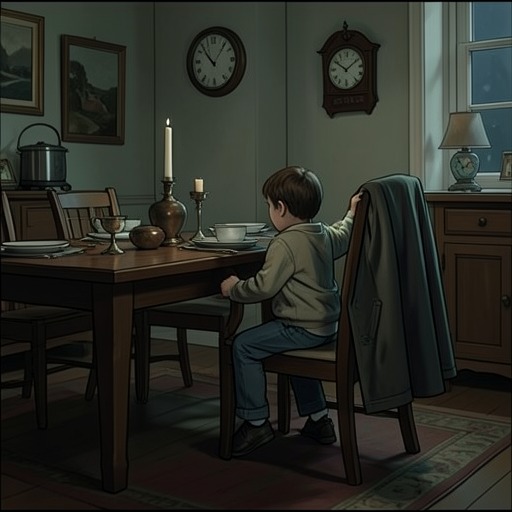
Buddenbrook Christmas Eve traditions
BuddenbrooksThe Buddenbrook Christmas Eve traditions turn a domestic gathering into a public expression of family identity: worship, music, gifts, and hospitality place successive generations within a shared order. Their most elaborate form, maintained by Elisabeth Buddenbrook, joins religious observance to care for servants and the poor; after her death, the rites continue in reduced form, exposing how much their former coherence depended on her.
The Household and Its Inherited Order
The traditions take place chiefly in the landscape room and adjoining spaces of the old house on Meng Strasse. The room’s eighteenth-century pastoral wall coverings, yellow furnishings, harmonium, and carefully arranged furniture provide a setting at once intimate and ceremonially composed. The family’s records and inherited objects connect this domestic space to a longer history: the family chronicle preserves births, illnesses, and other events in successive hands, while the older Buddenbrook’s framed business maxim is later placed above portraits of the firm’s four owners. Christmas Eve belongs to this same culture of transmission, in which family practices give history a recurring shape.
Elisabeth Buddenbrook is the observance’s principal guardian. On the Christmas Eve described in detail, she moves restlessly between the columned hall, dining room, corridor, and landscape room, ensuring that the choirboys, tree, gifts, and gathering proceed according to the ceremony established by her late husband. Her attention extends beyond the household: the poor are invited to share in the distribution of presents, and the servants take part in the evening’s progression. The ritual is therefore not simply a private celebration but a structured act of family hospitality, with Elisabeth responsible for preserving its form.
The Ceremony’s Sequence
The evening begins in an atmosphere of restraint. Choirboys from St. Mary’s sing before the assembled family, and their treble voices give the gathering a moment of collective inwardness. Hanno, who has been waiting for the Christmas tree and his hoped-for puppet theatre, is deeply affected by the singing. The music brings together the formal religious occasion and a child’s private anticipation, while the closed folding doors keep the promised spectacle of the decorated dining room out of sight.
After the choir’s final song, Elisabeth opens the large, timeworn Bible and reads the Christmas story. The family then sings “Silent night, holy night”; the voices are imperfectly matched, but the song’s emotional force does not depend on musical polish. Elisabeth’s daughter, Antonie “Tony” Buddenbrook, is moved by the carol, which recalls both a difficult life and the brief peace of the gathering. Elisabeth next takes her grandson Johann and great-granddaughter Elisabeth by the hand. The assembled relatives, younger family members, servants, and poor join in “O, Tannenbaum” and move through the open doors into the brilliantly lit room, where the great tree, smaller decorated trees, candles, and arranged gifts make the anticipated celebration visible.
The ceremonial sequence continues at dinner in the columned hall. Elisabeth says the traditional grace and closes it with an admonition to remember those less fortunate than the Buddenbrooks. The meal begins with carp in drawn butter and vintage Rhenish wine. A custom of placing fish scales in a wallet for prosperity gives the senator a small personal observance within the larger family ritual, while the gathering’s conversation includes relatives who are absent and former husbands who remain, in some sense, part of the family. Before the meal ends, Elisabeth again interprets the family’s mixed fortunes through religious faith, urging gratitude for its blessings and trust in God’s guidance. The toast that follows is directed toward the children and the family’s future.
Remembrance, Faith, and Continuity
The Christmas ceremony makes the family’s idea of continuity visible through both repetition and succession. The family chronicle records each generation’s events with reverent attention; Antonie “Tony” Buddenbrook reads her own birth, illnesses, schooling, and confirmation as part of a providential family history, and adds her engagement to Bendix Grünlich to the record. The annual celebration gives that written continuity a living counterpart: younger and older relatives gather in the same rooms, repeat familiar songs, and pass from the religious reading to the shared meal and exchange of gifts.
Yet the ritual’s confidence in the future coexists with evidence of strain. At one Christmas Eve gathering, the senator is surprised to realize that he had nearly forgotten the date; the ceremony’s solemnity draws him back into participation. His brother Christian’s awkwardness, the family’s awareness of absent members, and the contrast between the children’s promise and the older generation’s recollections complicate the hope expressed in Elisabeth’s toast. The ceremony does not erase conflict or disappointment. Instead, its prayers and repeated forms give the family a language for placing hardship within a larger story of providence and inheritance.
Commemoration also acquires a less reassuring edge when the firm’s centenary approaches. The family marks its founding in 1768 with a plaque bearing portraits of its four owners and the inherited maxim about conducting business in a way that permits a peaceful night’s sleep. The motto sounds within the same world of ritual and family instruction as the Christmas observance, but the senator’s response is subdued, and his private fear about the harvest deal sits uneasily beside the public display of continuity. Family memory can preserve an ideal even when present events threaten it.
The Reduced Celebration After Elisabeth’s Death
The first Christmas Eve after Elisabeth’s death shows the tradition changing. Thomas Buddenbrook holds the gathering at his own home, but the old “children’s day” is over: the Ladies Buddenbrook from Breite Strasse and the old Krögers are not invited, and the circle is markedly smaller. The poor who had come to Meng Strasse for shoes and woollens are absent, as are the choirboys. These omissions distinguish the new observance from the expansive ceremony Elisabeth had supervised.
Some elements remain. The reduced company sings “Silent night, holy night” in the salon, and Therese Weichbrodt reads the Christmas story in place of Gerda, who does not particularly enjoy the custom. They sing the first verse of “O, Tannenbaum” in subdued voices before moving into the grand hall. But the gathering lacks its former public generosity and celebratory energy. Conversation turns to Elisabeth, the sale of the old house, and the uncertain future of Hugo Weinschenk; Hanno plays pieces he has practiced and accompanies his mother in a Mozart sonata, though his recent illness has left him pale and tired. The familiar forms survive, now carried by different people and under altered circumstances.
The Buddenbrook Christmas Eve traditions thus function both as a practice of belonging and as a record of change. Their songs, Bible reading, meal, gifts, and charitable customs bind family memory to a recurring household ceremony. When Elisabeth is gone, the ceremony continues, but the smaller guest list and missing acts of hospitality show that repetition alone cannot restore what she organized. Christmas Eve preserves the family’s claim to continuity while revealing, year by year, the differences between inherited form and the living community able to sustain it.