The school demerit system
BuddenbrooksThe school demerit system is the Old School’s formal mechanism for recording misconduct and unsatisfactory performance, but in practice it does more than regulate behavior: it turns a teacher’s judgment into an official mark, then into a lasting educational consequence. Through Hanno Buddenbrook’s experience, the system appears as a daily ritual of exposure in which classmates watch one another succeed, fail, or fall under suspicion, while Hanno experiences its authority as another pressure of a school life poorly suited to him.
Recording and Consequence
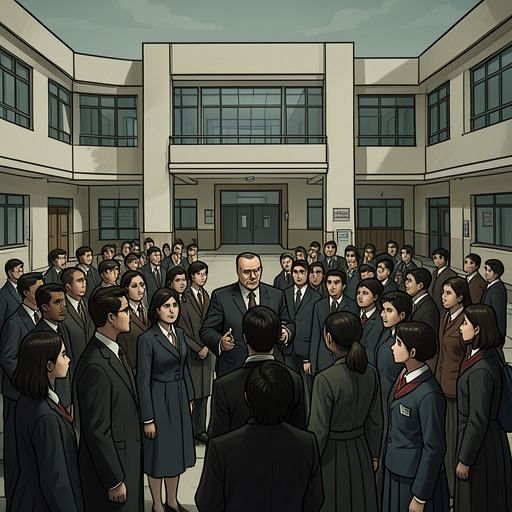
The system is made tangible by the attendance book. When Dr. Mantelsack decides that Petersen has attempted to cheat, he calls for the book and enters a demerit beside Petersen’s name. The mark is not a passing rebuke: it seals Petersen’s prospects, and he will be held back at Easter. His neighbor edges away; the class regards him with disgust, pity, and horror. The pupils accept the teacher’s verdict as readily as they accept other outcomes in the classroom, and Petersen himself offers no resistance. The entry in the book thus becomes both a practical sanction and a public classification, dividing the boy who has been caught from his classmates.
The episode exposes how the penalty acquires force through collective recognition. Petersen is not merely told that he has done wrong; his humiliation is witnessed, absorbed into the class’s shared judgment, and attached to a future academic consequence. The narrator contrasts boys who take the established order as natural with Hanno, whose eyes register contempt, rebellion, and fear. The same disciplinary scene that confirms the system’s authority therefore reveals Hanno’s inward refusal to regard its judgments as simply just or inevitable.
Hanno’s Exposure to School Discipline
The threat of school failure begins before a mark is entered. Hanno dislikes the Old School, a former convent with cloisters and Gothic-vaulted classrooms, and performs poorly in its subjects. Illness keeps him absent, while his thoughts wander toward harmonic relationships and the music he has heard his mother and Herr Pfühl play. His difficulty is not presented as a simple lack of capacity: the curriculum competes with a sustained musical attention that the school does not recognize as achievement. He is also quiet and socially distant, with Kai Mölln his one close school friend.
On a Monday morning, Hanno wakes late after putting off the work he should have done. He calculates that he may be called on in Latin and chemistry, then clings to the possibility that the order of questioning might spare him. The school’s arbitrary-seeming sequence gives him something to gamble on, but the gamble does not remove the pressure: he falls asleep again, wakes at seven, and faces the prospect of arriving at school with the work undone. The scene places discipline inside the ordinary hours of a child’s life, where dread and avoidance consume the time that preparation requires.
That day, the rule becomes imminent when Dr. Mantelsack marks a demerit beside poor Mumme’s name and turns to check the proper order of recitation. Hanno understands what the teacher is doing before his own name is called. He sits frozen, unable at first to believe that he has been summoned, while the sound of his name seems to echo in his ears. The system reaches him not only through a penalty already imposed but through the anticipation that another student’s failure may redirect the teacher’s scrutiny toward him.
Authority, Performance, and Unequal Judgment
The classroom scenes show discipline operating through more than the written mark. A surprise inspection by Director Wulicke turns Herr Modersohn’s English lesson into an examination of both teacher and pupils. Modersohn is expected to demonstrate what his sophomores have learned; instead, the class struggles to recite The Monkey and translate Ivanhoe. Hanno cannot get beyond the first line. Wulicke then enters demerits beside the names of six or seven students whose performance is unsatisfactory, including Hanno’s, and threatens to destroy their careers. Modersohn himself cannot be given a demerit, but he is left pale and broken by the inspection.
The scene makes the mark part of a wider hierarchy of observation and evaluation. The director arrives without warning, watches from beside the platform, and records the result after the bell; the teacher, who ordinarily wields authority over his pupils, is himself exposed to judgment. Yet the consequences fall on the students as well as on their instructor. Hanno leaves weary-eyed and rubs his bad molar, convinced that he will be held back at Easter. Kai puts an arm around him and apologizes for translating rather than remaining silent and sharing the demerit. Hanno answers by referring to his correct response in another lesson and telling Kai that it does not matter. Their exchange offers friendship and consolation, but it does not undo the recorded mark or the expected academic consequence.
Modersohn’s ordinary treatment of Hanno makes the personal edge of school authority still clearer. Because Hanno is quiet, the teacher knows his name and repeatedly uses it to call him to order and assign extra homework. Hanno sees the unfairness of this pattern: he does not join other pupils in tormenting Modersohn, yet his gentleness leaves him open to the teacher’s power. When a classmate’s joke makes him laugh, Modersohn immediately threatens an extra assignment and a demerit if he laughs again. The episode shows how conduct can be policed through discretionary warnings as well as through the official record; Hanno’s laughter is brief, but the teacher’s response places it under the same threat of formal punishment.
Lessons, Exams, and the Reach of the Rule
The system’s logic extends beyond recitation and classroom behavior into written examination. In a geography test on Hesse-Nassau, Hanno knows little and tries to look at Adolf Todtenhaupt’s bluebook. Dr. Mühsam notices and warns that closing the examination book might do Hanno a favor, then tells him to continue. Hanno produces an almost blank paper. The incident does not establish that a demerit is entered, but it shows the same institutional imbalance: a pupil who is unprepared is made visible to an adult authority, while the teacher’s ironic remark interprets the act of continuing as a kind of punishment in itself.
Across these episodes, the mark links different forms of school judgment: a cheating attempt, a failed recitation, an unsatisfactory demonstration lesson, and the threat attached to a moment of laughter. The outcomes are not identical, and the book does not suggest that every difficulty automatically produces a demerit. Rather, the attendance book gives formal weight to selected judgments, while teachers’ control over calling on pupils, assigning extra work, and evaluating performance shapes the conditions under which a mark may follow. The system’s reach is therefore both procedural and personal: students must answer within an order they do not control, under adults who decide when failure becomes an official record.
Significance
For Hanno, the demerit system embodies the distance between what the school values and what sustains his attention. Music occupies his thoughts, while the Old School demands recitation, examination, and readiness on command. His frailty, frequent illness, and anxiety make those demands harder to meet, but the formal procedure translates difficulty into a record of failure rather than accommodating it. The demerit does not create every obstacle in his school life; it concentrates them into a visible sanction with consequences for advancement.
The system also frames discipline as a social performance. A marked name is entered before witnesses; classmates react, withdraw, pity, or accept the verdict, and the affected pupil is left to inhabit the judgment. Hanno’s troubled response to Petersen’s humiliation and his own exhausted walk after Wulicke’s inspection distinguish him from those who take the school’s order for granted. The rule’s significance lies in this double effect: it administers a concrete penalty, while making the classroom a place where institutional authority teaches students how to read failure, status, and one another.