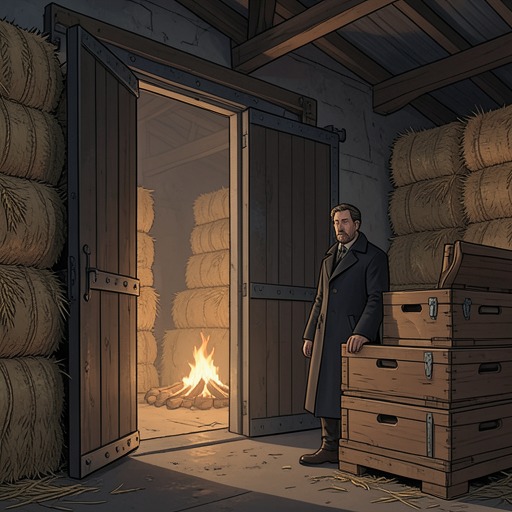
Buddenbrook house on Meng Strasse
BuddenbrooksThe Buddenbrook house on Meng Strasse is the family’s spacious residence and a central domestic setting in which private life repeatedly meets public reputation and commercial responsibility. Its rooms frame the family’s ceremonies, arguments, meals, and records; over time, the house’s social vitality changes, and its shifting use makes the family’s generational history tangible.
Setting and Interior
The house had been purchased by the Johann Buddenbrook firm shortly before the family took up residence. Among its rooms was the second-floor landscape room, an ample space finished in coordinated, pale colors: thick wall coverings depicted pastoral scenes, while yellow upholstery and curtains echoed the landscapes’ sunset tones. The furniture was sparse for the room’s size. A round table stood opposite a small harmonium, a flute case rested on the instrument, and a secretary crowded with ornaments faced a sofa. A glass door opened the view toward a dim, columned hall; folding doors led to the dining room, while a stove occupied a recessed niche.
This arrangement joined cultivated domestic display to everyday family use. The landscape room could hold visitors and musical objects, but it also became a place for private consultation: when a letter from Gotthold arrived during a gathering, the younger master drew his mother aside there to discuss how to tell the family patriarch. Elsewhere, the house’s dining spaces accommodated both household meals and large social occasions. Its rooms therefore served not simply as a backdrop but as the practical setting where family decisions and public sociability took form.
Family Records and Inheritance
The house contained the family’s large gilt-edged notebook, a material link between domestic space and inherited identity. In the breakfast room, the consul read its old pages, including a genealogy tracing the Buddenbrooks from an ancestor in Parchim through merchants and civic officeholders to the family’s establishment of its grain business. The record preserved not only marriages and descendants but illness, accidents, travel, and the family maxim advising descendants to conduct business in a way that allowed peaceful sleep.
The notebook also recorded the consul’s children and ordinary family events, treating births, childhood illnesses, and other modest facts as part of a continuous history. Later, Tony read the entries in the house and understood herself as one link in that sequence, with a responsibility to shape its future through her choices. The residence thus housed more than the family in the immediate sense: it held the written means by which the family interpreted its past and imagined succession.
Business and inheritance disputes also entered its rooms directly. When the consul weighed whether his father should compensate Gotthold for a share in the house, he set the proposed payment against the firm’s finances and the risk that a concession would invite further claims on the inheritance. The house was therefore both a home and an asset bound up with the family’s capital, ownership, and future control of the business.
Ritual, Hospitality, and Social Standing
The family used the house to enact its place in Lübeck society. At Tony’s wedding, the dining room and corridor were prepared for a large celebration: guests danced through both spaces, and the corridor’s flagstones were used for the traditional breaking of pottery for good luck. The gathering brought together relatives, friends, and members of the town’s commercial and professional circles, turning the house into a visible setting for family alliance and social recognition.
Religious routine became increasingly prominent in the household. Grace had long been said at meals, but in later years the family and servants assembled in the breakfast room morning and evening to hear scripture read by the consul. Clergy and missionaries visited more often, and the residence acquired a reputation as a welcoming spiritual center, known as much for its hospitality as for religious conversation and contributions to charitable purposes. Tony, unlike her brother Thomas, openly mocked the visiting preachers, exposing a generational difference within the same domestic setting.
The house’s standing was also expressed through formal entertaining. After Johann’s death, his widow’s life on Meng Strasse grew socially quiet, with family members gathering on Thursday evenings and occasional clergy visiting. Thomas and Gerda, by contrast, hosted a large dinner for business and professional families in their own household, with guests spread across the dining and sitting rooms. Thomas described such hospitality as a worthwhile investment: the domestic table could strengthen the relationships on which commercial respectability depended.
Changes in the Household
The residence’s use changed with the family’s circumstances. In Thomas’s later household routine, business activity kept the ground floor busy, but the upper floors were described as deserted and lonely. Erika was away at boarding school, Klothilde had moved to a modest room elsewhere, the butler had left for Thomas and Gerda’s home, and the older household’s occupants were often reduced to Elisabeth and Ida Jungmann. With Johann’s death, the old house’s ordinary social life had diminished; it no longer hosted the former circle of visitors beyond occasional clergy and family gatherings.
The contrast between the older house and Thomas and Gerda’s active entertaining suggests a change in how the family’s social presence was maintained. One household had become quiet and depleted, while the younger couple cultivated connections through formal meals. The distinction is not simply between generations: it shows how a family’s social identity could persist through deliberate hospitality even as the traditional center of family life lost occupants and activity.
The House in the Family’s Decline
The house’s history is bound to the family’s unstable balance between continuity and change. It is where the family’s records are read and preserved, where business calculations shape inheritance decisions, and where marriage and religious customs are performed. Yet the same household that once gathered relatives and guests becomes markedly emptier as people leave, die, or establish separate lives.
This transformation gives the residence a structural role in the family narrative. Its rooms make abstract matters—capital, lineage, social position, and succession—visible in everyday arrangements: who gathers at the table, who is absent, which floors are occupied, and what kinds of visitors still cross the threshold. As the family’s domestic life contracts, the house registers the distance between the lasting authority of its traditions and the weakening social world that once sustained them.