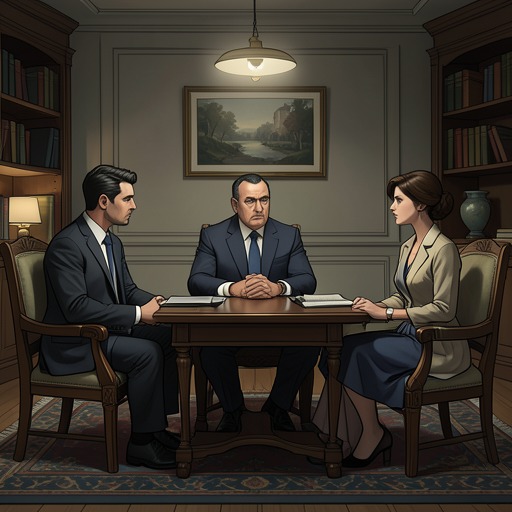
Erika and Hugo Weinschenk’s marriage and separation
BuddenbrooksErika and Hugo Weinschenk’s marriage and separation trace the passage from social respectability into public disgrace and an unresolved private abandonment. Hugo’s prosecution for insurance fraud turns the marriage into a family crisis: Erika is left to manage fear, financial insecurity, and loyalty to a husband whose conduct at home grows increasingly harsh. His early release does not restore their life together. Instead, he retreats from his family, departs alone for London, and ceases all contact, leaving Erika and their daughter in her mother’s care.
Marriage Under the Shadow of Prosecution
At a Christmas Eve gathering, Erika is the youngest person in the assembled family, but there is little lightness in her situation. Her husband, Hugo, stands beside the sofa with his greying temples and small moustache; whenever Erika’s pale blue eyes turn toward him, she sighs deeply. Her thoughts are fixed on legal procedure—accounting, witnesses, prosecutors, defence lawyers, judges—and his presence makes the family celebration feel strange and unnatural. He is under indictment for an offence against civil order and commercial rectitude, one that may bring shame and imprisonment.
The crisis does not remain outside the home. When Erika’s mother, Tony, later tells Thomas what is happening, she admits that doubts about Hugo’s innocence have troubled her for a long time. Erika herself has cried over his conduct. At home, Hugo has become rougher and more demanding, insisting that Erika be cheerful and distract him from his worries; he smashes dishes when she appears too serious. He also shuts himself in with his papers late at night, leaping up and shouting when someone knocks. The domestic atmosphere gives the legal danger a daily, intimate form: Erika is expected to manage her husband’s distress even as his behaviour intensifies her own.
Tony’s account makes the strain on Erika visible while also showing the limits of the family’s knowledge. She and her mother have not spoken openly to Hugo about the situation, and Erika’s distress reaches Thomas only through Tony. Tony nevertheless pleads for compassion, arguing that even if Hugo is guilty, he did not commit the crime simply to enrich himself; he married into the family and, in her view, must not be treated as a stranger. Her appeal joins kinship to the practical fear of what prosecution will do to Erika and her child.
Financial Fear and Family Intervention
The threatened sentence carries immediate material consequences. Erika’s dowry has been spent on her trousseau, furniture, and paintings; selling those possessions would recover scarcely a quarter of their value. The family has been living on Hugo’s salary, and he has saved nothing. Tony fears that she, Erika, and the child will have to move back in with her, and that even Hugo’s eventual release may bring them no secure future. She expresses this prospect through the family’s image of being left to sit on the stones, a figure for destitution and social fall.
Thomas responds to Tony’s plea with both consolation and practical help. He tells her that Hugo has not yet been convicted, offers hope that the case may turn out well, and promises to provide bail. His offer does not erase the family’s anxiety, but it establishes that Hugo’s legal predicament draws his wife’s relatives into the matter. The marriage is thus caught between public judgment and private obligation: the family fears the shame and hardship associated with the charge, while Tony insists that marriage has made Hugo one of their own.
That tension remains present after Hugo’s conviction and imprisonment. During a later family Christmas, relatives speak not only of the dead, the sale of the family house, and their altered circumstances, but also of what will happen when Hugo is free again. Erika has visited him in prison on the day of a later family dinner; afterward she feels tired and out of sorts and stays home. Her absence registers the continuing personal cost of the imprisonment, even when the family discusses his future in the measured language of a possible pardon.
Release and an Uncertain Reunion
In early 1873, the Senate grants Hugo a pardon, releasing him six months before his sentence is due to end. The decision is not welcomed with uncomplicated relief. Tony has found a peaceful life with Erika and her granddaughter in their apartment on Linden Platz, and she would rather that everything remain as it is. She asks Erika whether she loves Hugo enough to take the child and follow him wherever he chooses to go, adding that he cannot remain there. Her question makes the return itself a test of the marriage: reunion is imagined not as a restoration of the household, but as a possible departure from it.
Erika breaks into tears and gives the dutiful answer her mother expects, much as Tony herself had once done when questioned about a marriage under family pressure. The tears do not clarify whether Erika wishes to follow Hugo or is only performing the answer demanded of her. The resemblance between mother and daughter links their marital histories without making them identical: Tony recognizes in Erika’s response the old pattern of compliance, but the future remains unsettled.
The day Tony collects Hugo from prison in a closed carriage is nearly as dreadful as the day of his arrest. At the apartment on Linden Platz, he greets Erika and their child in a dazed, helpless manner, then withdraws to a room prepared for him. He smokes cigars from morning until night, rarely joins his family for meals, and does not dare appear in public. His physical health remains strong, but the verdict and imprisonment have left him morally broken. Before his conviction he had defended his business practices as customary and beneficial to the insurance company as well as himself; the court’s judgment and the force of the state have shattered his confidence. His former swagger, appetite for conversation, and self-assurance have disappeared, replaced by despondency and diminished self-respect.
Departure and Lasting Separation
After eight to ten days spent smoking, Hugo begins to read newspapers and write letters. Another eight or ten days later, he announces indirectly that a new position may be open for him in London and that he intends to go there alone to arrange matters. He says that once everything is in order he will send for Erika and their child. The plan presents separation as temporary and practical, but the narrative supplies no evidence that a stable reunion is ever prepared.
Erika accompanies him in a closed carriage to the railway station. Hugo leaves without seeing any of his other in-laws. Several days later, a letter arrives from Hamburg addressed to Erika: he has decided not to have his wife and child join him, or even hear from him, until he can offer them a home worthy of them. The letter is the last sign of life from him. His promise to make contact when circumstances improve therefore turns into silence, not a new household.
Tony makes several efforts to locate Hugo, intending to establish wilful desertion as grounds for Erika’s divorce. She is experienced, energetic, and circumspect, but Hugo remains missing, and the evidence does not describe a completed divorce. Erika and little Elisabeth continue living with Tony in the bright apartment on Linden Platz. The marriage’s ending is consequently not a formal resolution but an enduring separation: Hugo’s disappearance leaves Erika without an explanation or a confirmed future, while her mother provides the household and support he has withdrawn from.
Significance of the Marriage
The relationship is shaped by the collision of commercial reputation, legal judgment, and family solidarity. Hugo maintains that his insurance practices belonged to ordinary business life and had benefited the company; the court treats them as fraud. That divide matters to the marriage because Hugo returns from prison physically intact but unable to recover the self-confidence on which his former public and domestic manner depended. Release ends confinement without undoing disgrace.
Erika’s predicament is shown chiefly through her visible distress, her mother’s account, and the practical arrangements made around her: the spent dowry, the lost salary, the child, the prepared room, and the carriage to the station. Her tears at the question of following Hugo do not settle what she wants, and the later narrative does not offer a reconciliation. Instead, the marriage’s decisive movement is from public crisis to private absence. Family care sustains Erika and Elisabeth, but it cannot compel Hugo’s return or convert his promise into contact.