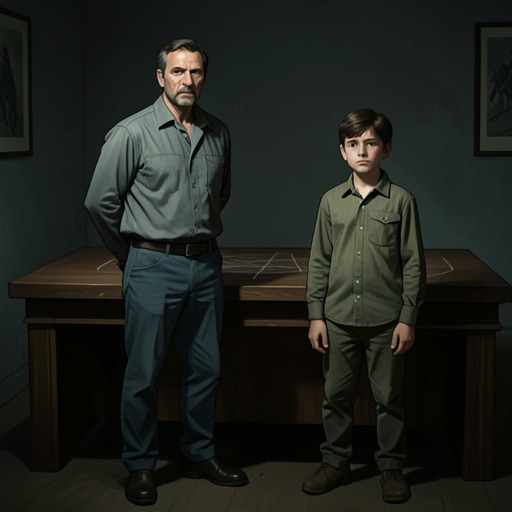
Thomas and Hanno Buddenbrook’s father–son relationship
BuddenbrooksThomas and Hanno Buddenbrook’s father–son relationship brings the family’s hope of continuity into conflict with the very qualities that make Hanno unlike his father. Thomas looks to his only son for the renewal of the family’s business and name; Hanno, frail and drawn to music, stories, and inward experience, does not naturally answer that inheritance. Their bond contains real tenderness, but Thomas’s efforts to prepare Hanno for a prescribed future often reveal how little he understands the boy’s difference.
A father’s hope for the family’s future
Thomas’s expectation of Hanno is bound to an inherited sense of family. He takes an interest in the Buddenbrook past, but he also looks forward, encouraged by the expectation that his friends, relatives, and the Ladies Buddenbrook from Breite Strasse place in his son. Although Thomas feels his own life to be thwarted, he can imagine Hanno’s future in triumphant terms: practical competence, hard work, achievement, wealth, and honor. Caring for and hoping for his son provides warmth in a life otherwise marked by exhaustion and artificiality.
This hope extends beyond Hanno’s immediate prospects. Thomas allows himself to picture a future in which, as an old man, he might see a renewal of the old days associated with Hanno’s grandfather. He does not regard the boy merely as a child to be guided; he sees him as the possible continuation of a family story. The expectation is therefore both intimate and institutional: Hanno is loved as a son, but also imagined as the heir who could restore the family’s earlier strength.
Training for a commercial inheritance
At eleven, Hanno has reached the fourth grade with difficulty, passing only after two additional examinations in arithmetic and geography. His father has him assigned to modern, scientific classes because he is expected to become a merchant and eventually take over the firm. When Thomas asks whether Hanno is excited by this profession, the boy gives a shy, simple yes, but offers no fuller enthusiasm despite his father’s attempts to draw one out. Thomas interprets Hanno’s poor concentration, dreaminess, and delicate health as reasons to choose a curriculum he considers more manageable, while also hoping to strengthen the boy physically and mentally.
Thomas tries to make business tangible by bringing Hanno to the harbor. He takes him along on business visits, where Hanno stands beside him as he speaks with dockworkers in Danish and Plattdeutsch, confers with warehouse managers, and directs men moving grain sacks. Thomas explains the family’s connections to the workers, including the names shared with Hanno’s grandfather, and points out that the firm gives them a yearly gift. He also marks the boundary between the family and its competitors, telling Hanno that they will pass one warehouse without speaking to its workers. Thomas’s chosen world is one of ships, warehouses, trade, and family obligation; he wants his son to feel its interest and continuity as he does.
The same lesson appears in Thomas’s domestic encouragement. When Hanno asks for a second helping of dessert or more coffee, Thomas treats his appetite as evidence that he is growing into a future merchant, and links eating well with working hard and earning money. On occasions when Hanno imitates the family’s teasing manner toward Klothilde, Thomas responds with a hearty, encouraging laugh. He is pleased by any sign that his son can act with the ease and confidence he associates with practical life—even when the behavior conflicts with scruples Thomas himself has previously expressed.
Public conduct and private perception
Thomas also tries to teach Hanno how to inhabit the family’s social standing. On days of obligatory calls, he invites his son to accompany him in the carriage. Hanno sits silently in drawing rooms, watching his father adapt his tone and manner to different hosts, including Colonel Herr von Rinnlingen. Thomas’s careful compliments, tact, and charm make a visible impression on the people he visits, and he hopes that his son will learn from this example.
Hanno, however, notices the cost beneath the polished performance. He sees his father become silent and pale after a visit, close his reddened eyes in the carriage, and then recover a spring in his step as they approach the next household. To the boy, the shift from fatigue to practiced sociability makes the public manner look like a mask rather than a natural expression of shared interests. He understands that he too is expected to appear in public one day and to prepare each word and gesture under other people’s scrutiny. The prospect fills him with fear and aversion. Thomas intends to pass on poise and practical confidence; Hanno instead learns how arduous and artificial the performance can be.
That difference unsettles the father’s project without extinguishing his affection. Thomas’s laughter at Hanno’s teasing of Klothilde, and his delight in any apparent readiness for adult life, show how eagerly he searches for signs of the character he wants his son to acquire. His hope is genuine, but it repeatedly mistakes compliance or imitation for an inner commitment to the future he has planned.
Music, frailty, and the limits of discipline
Music is the clearest challenge to Thomas’s plan. Hanno’s unnoted piano improvisations reveal remarkable talent, although he has made little extraordinary progress in ordinary lessons with Herr Pfühl. Thomas attributes the boy’s musical inclination to Gerda’s influence and decides that the time has come for a father to counterbalance it by drawing Hanno toward himself and toward practical, masculine models. The conflict is not simply between music and commerce: it is between Hanno’s spontaneous inward gift and Thomas’s belief that the family’s future requires disciplined preparation for work.
Thomas and Dr. Langhals attempt to address Hanno’s delicacy through diet, medicine, and exercise. Cod-liver oil and castor oil are meant to help, but Thomas believes they cannot by themselves make the boy sturdy; Hanno must also take part in weekly summer gymnastics at Castle Yard. He meets these exercises with silent, distant aversion. Thomas worries that his son has little contact with boys his age and regards Hanno’s friendship with Kai Mölln as an unsuitable preparation for the future. Yet Hanno’s social and physical reserve is not overcome by exhortation. His weak health, school difficulties, and retreat toward music and stories make the gap between paternal expectation and the child’s inclinations increasingly evident.
An heir expected, a future unsettled
Thomas’s plan for Hanno is part of a larger family chronology. The Buddenbrook records carefully preserve births, illnesses, schooling, and the succession of generations; Tony reads them as a chain in which each person has a responsibility to shape the family’s history. In that framework, Hanno’s name and future carry more than a father’s private hopes. He is the only son and the anticipated successor to a business whose resources and standing have been shaped by earlier inheritances, family settlements, and commercial losses.
That expectation becomes especially stark after Thomas’s death. His testament directs that the firm be liquidated and dissolved within a year, rather than preserved for Hanno. Tony is deeply hurt that her brother has not kept the business going for his son and sole heir, but comforts herself with the possibility that Hanno may someday begin a new enterprise and bring the family to a second flowering. The liquidation itself goes badly: contracts and grain are sold hurriedly, opportunities are missed, and the estate’s paper valuation of 650,000 marks proves unreliable. Thus the future Thomas had tried to prepare through Hanno’s education and exposure to commerce is not secured by inheritance. Their relationship stands at the intersection of loving hope and family decline: Thomas imagines his son as the means of renewal, while the firm’s dissolution leaves that imagined succession without its original commercial foundation.