Hanno’s musical improvisation
BuddenbrooksHanno’s musical improvisation is the clearest expression of a musical nature that ordinary instruction, family expectations, and the prospect of adult work cannot contain. It develops from the harmony lessons Edmund Pfühl gives him into a private practice of transforming small musical fragments through suspense, recurrence, and release. Improvisation offers Hanno a way to make feeling audible, but the pleasure is bound up with exhaustion and distress: he says he cannot stop himself, even when the music makes everything worse.
Musical Education and Understanding
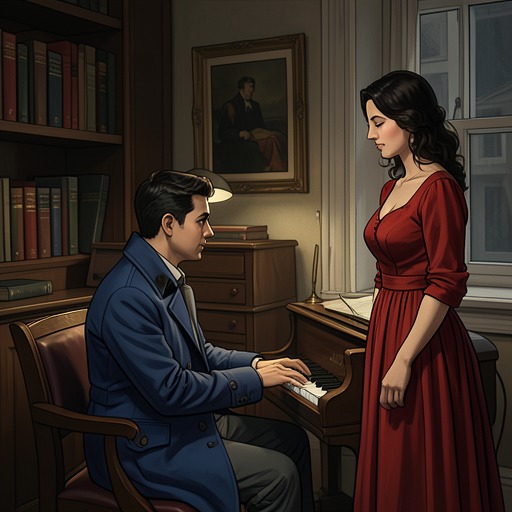
Hanno’s improvisation grows from instruction unusually attentive to understanding rather than routine performance. After hearing Gerda Buddenbrook and Pfühl play, Gerda asks the organist to teach her son. She values the piano because its range can reproduce complex harmonies and hopes that Pfühl will teach Hanno to comprehend music, not simply train him on an instrument. Pfühl accepts, and on Monday afternoons begins lessons with the boy in the living room, with Gerda present.
Pfühl quickly moves beyond elementary exercises to music theory, demonstrating the basics of harmony at the keyboard. Hanno understands the principles not as new information so much as a confirmation of what he has already sensed. His teacher adapts the lessons to that eager response: scales are not treated as their ultimate purpose, and Pfühl seeks instead to give him a clear grasp of keys and their relations, so that he can recognize combinations and develop an intuitive command of the keyboard. Choral progressions, in which one chord leads logically to another, offer a more serious musical language than banal songs. This approach gives Hanno a foundation for improvisation that is at once intellectual and imaginative.
A Family Performance
At a birthday gathering for Hanno, music makes his private sensitivity briefly visible to the family. Pale with excitement, he has barely eaten; seated at the piano in his sailor suit, he plays a short melodic fantasia while Gerda accompanies him on the violin. Its materials are elementary, but his treatment gives them unusual weight. The passage is more harmonic than rhythmic, and his expressive emphasis makes its modest resources sound momentous.
Hanno marks changes in harmony with movements of his head and body, leaning toward the edge of the seat and using the pedal to give each chord emotional force. Rather than relying on a wealth of notes, he alters the perceived significance of simple progressions through hesitation and emphasis. The finale makes that principle especially clear: he sustains an E-minor tremolo, intensifies a dissonant C-sharp, and delays its resolution back into B major. The withheld resolution turns a small harmonic turn into an experience of longing and release. When Gerda plays the treble melody and a variation, ending in rapid notes, Hanno repeats his part; afterward, delighted, he kisses her. The family audience hears a performance that is also an intimate exchange between mother and son.
The Private Language of Improvisation
In a later conversation with Kai, Hanno describes the conflict between music and the life expected of him. Since his father’s death, Stephan Kistenmaker and Pastor Pringsheim have asked him what he wants to become, but he has no answer and says he is afraid of the whole idea of choosing a vocation. Kai points to music, but Hanno doubts that it can become a profession: he cannot imagine being allowed to tour or being good enough to perform publicly. He says he can do little beyond improvising when alone, and even that possibility does not reassure him.
Hanno distinguishes improvising from the formal work he believes he ought to do. He expects to practise études and sonatas, yet says he will probably improvise because he cannot seem not to, though it makes matters worse. When Kai tells him he knows what Hanno is thinking during those improvisations, Hanno does not explain further. The exchange leaves the music as a private, partly unspoken activity: Kai recognizes something in it, but the scene does not translate that recognition into a clear account of what the music means to Hanno.
An Improvisation in Solitude
One afternoon, after Gerda ends their Beethoven sonata session because her violin is out of tune, Hanno remains alone in the salon. He draws the cream-coloured curtains across the glass door, darkening the room, then approaches the piano and sits down to improvise. The enclosure marks a shift from music shared with his mother to an inward performance without an audience.
The improvisation begins with a fragment only a bar and a half long. First sounded in the bass, it has an unexpectedly forceful, almost declarative character; repeated and harmonized in the treble, it becomes a painful descent from one key to another. The fragment does not acquire significance through complexity alone. Hanno’s treatment surrounds it with restless runs, syncopations, and recurring cries that gather into a plaintive woodwind-like melody and then a subdued chorale, ending in a churchly cadence. Silence follows, but the initial theme returns, carrying the piece into another surge of motion.
The music’s shape repeatedly converts uncertainty into temporary order. A more assertive, hunting-song-like theme emerges, but its defiance remains entangled with fear; the first fragment continues to haunt the episodes, which seem to unfold beyond Hanno’s conscious control. The performance gathers toward a climactic resolution, then turns back to its opening theme. In the final passage, the motif is celebrated across registers and changing colours, its apparent triumph mingling religious restraint with insatiable desire. It dwindles through exhaustion and revulsion into a minor arpeggio, modulates upward, resolves to the major, hesitates, and dies away wistfully.
Release, Exhaustion, and Limits
The solitary performance gives improvisation a structure of desire: an unresolved musical tension is prolonged until release can no longer be withheld. Yet resolution does not simply close the experience. After the final chord, Hanno sits motionless, chin on his chest and hands in his lap; pale, weak-kneed, and burning-eyed, he closes the keyboard and lies for a long time on a chaise longue. The aftermath makes the music’s force bodily, and its completion leaves him depleted rather than newly secure.
That night he plays the improvisation again silently in his mind at the harmonium, because noise is not permitted after midnight. He intends to rise at half past five to finish pressing homework, and the return of the music therefore sits beside the demands of the school day rather than replacing them. Across these episodes, improvisation is neither a straightforward career path nor an uncomplicated escape. It permits Hanno to shape experience through harmony, delay, and recurrence, but it cannot settle his fear of the future or free him from the obligations surrounding him. Its private intensity is both his most distinctive expressive resource and a sign of how difficult it is for him to inhabit the ordinary roles being proposed for him.