Belief in reunion after death
BuddenbrooksBelief in reunion after death is the hope that the dead will be encountered again, and the novel's final scene gives that hope a starkly divided form. Tony names the family members she has lost and admits that faith sometimes fails under the weight of life; Friederike affirms reunion, while Sesame Weichbrodt turns belief into a bodily, public act of resistance. The ending neither resolves grief nor lets doubt have the last word: its final assertion stands as faith's answer to the family's visible extinction.
A family history ordered by faith
The belief belongs to a world in which family history and religious providence are closely joined. The Buddenbrook family chronicle records even modest events with reverence, treating the facts of births, illnesses, schooling, and family milestones as part of a history guided by God. Tony reads the entries not as a bare register but as evidence that each generation inherits a place and a duty in the family chain. That sense of continuity gives the hope of reunion a family dimension: the dead are not merely remembered as individuals but understood as part of a line whose story is meant to continue.
The chronicle's record of ancestors also brings mortality into view. It traces the family's earlier generations and records the fortunes and losses through which the line persisted. Against that long perspective, reunion after death can appear as a spiritual counterpart to genealogical continuity: where the family record preserves names and events, religious hope imagines a bond that survives death. Yet the family's material history offers no guarantee of such continuity. The estate inherited after Johann's death is substantial, but the figures also register losses, divided inheritances, and the pressures on the firm. The distance between a carefully preserved past and an uncertain future makes the promise of reunion emotionally significant without making it certain.
Continuity under pressure
The belief is repeatedly set against the Buddenbrooks' practical concern with inheritance and succession. The family records celebrate successive generations, and the firm's centenary is approaching; Tony, who guards the records, treats the approaching anniversary as an important family fact. But when Thomas's will directs that the firm be liquidated within a year, she is deeply hurt that he has not preserved it for Hanno, his only son and heir. She tries to console herself with the idea that the family can continue through a new enterprise and that Hanno may bring the name to renewed prominence. Her hope transfers continuity from the firm to the next generation, but the final scene shows how fragile that expectation was.
The novel's ending gathers this conflict into Tony's grief. After Hanno's death, she cries that she loved him deeply and names him alongside Tom, Father, Grandfather, and the others who are gone. The sequence links a child's death to the accumulated losses of the family, turning private mourning into recognition that the generations she had regarded as a chain have disappeared. Her question about where they have gone is not answered by the family chronicle or by the business legacy; it opens onto the possibility of reunion, and the difficulty of believing in it.
Doubt and affirmation at the ending
Friederike Buddenbrook answers Tony's distress with the assurance that the family will see its dead again. Tony does not accept that assurance as steady comfort. She says that there are times when it offers none, and that life's blows have shaken her faith in justice and goodness. Her doubt is specific to the losses surrounding her: reunion is exactly what she wants to believe, but the scale of bereavement makes the promise feel uncertain. The scene allows grief to test belief rather than treating religious conviction as an easy remedy.
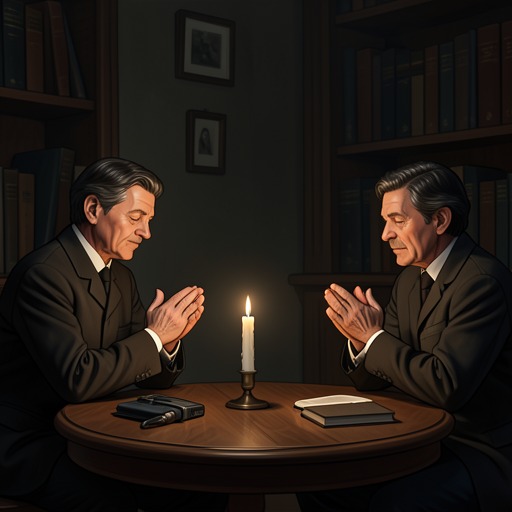
Sesame Weichbrodt responds differently. She rises as high as she can at the table, stands on tiptoe, cranes her neck, and raps on the tabletop before declaring, "It is so!" Her small stature and trembling certainty contrast with the force of her assertion. The narrator presents her as victorious in a lifelong struggle against reason's challenges, an image that makes conviction at once vulnerable and resolute. She does not produce evidence that can settle Tony's doubts; instead, the physical effort and emphatic speech make faith itself the scene's decisive action.
Meaning within the novel's conclusion
The belief in reunion carries particular weight because the novel has repeatedly treated family continuity as a matter of records, names, inheritance, and work. Those structures can preserve the past, but they cannot prevent the firm's dissolution or the deaths of the people who embody its history. Tony's appeal to reunion answers that failure at the level of spiritual hope, while her uncertainty prevents the answer from becoming uncomplicated consolation.
The final exchange preserves both sides of the conflict. Tony's grief acknowledges how death can make faith falter; Sesame's declaration refuses to let doubt close the question. Her certainty is the last spoken affirmation before the novel ends, but the conclusion does not show the dead returning or otherwise confirm the promise as an event. Reunion remains a belief, offered as a form of hope amid loss. The book closes on the force of that hope and on the human need to assert it, even when suffering has made assurance difficult.