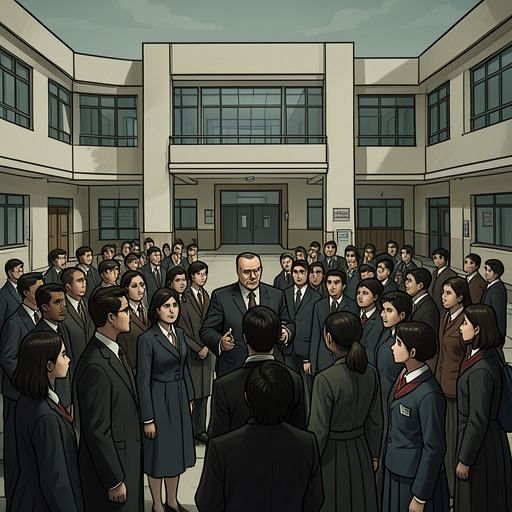
Hanno’s school (Old School)
BuddenbrooksHanno’s school, the Old School, is both a newly modernized educational institution and an increasingly authoritarian world. Its bright classrooms and efficient facilities promise comfort and progress, but under Director Wulicke its governing ideals have shifted from humane, leisurely classical learning toward discipline, service, and advancement. For Hanno Buddenbrook, the school’s neat order does not make it reassuring: its corridors can become a landscape of dread, and even an ordinary lesson may hold the threat of public humiliation.
Building and Setting
The school occupies a new, airy building erected after the grey, dilapidated wall of the former convent school was razed. The change is not simply cosmetic. Gothic arches still span the corridors and arcades, preserving an older architectural style, while the interior offers the latest comforts: better lighting and heating, spacious classrooms, comfortable teachers’ lounges, and well-equipped lecture halls and laboratories for chemistry, physics, and drawing. Modernization has transformed the material conditions of the institution without resolving whether the new order is an improvement in human terms.
The building’s public spaces and Hanno’s classroom acquire their force through contrast. When he reaches the school at the end of the bell for Monday-morning prayers, the students and teachers are already moving toward the gym. The front of the building remains silent; Hanno climbs the wide staircase cautiously and slips into his empty homeroom on the second floor. Three rows of light-wood desks, closed curtains, gas lamps, green shades, maps, and a teacher’s platform establish a room built for instruction and control. The practical warmth of the gas lamps and incoming heated air briefly eases Hanno’s cold, exhausted body, but does not make the room welcoming. He finds momentary safety in a hard seat while anticipating the dangers of the morning ahead.
The School’s Changing Ideals
The Old School’s institutional character changes with the arrival of Director Wulicke. He succeeds the jovial, warmhearted headmaster who had overseen the school when Hanno’s father and uncle were students and who died early in 1871. Wulicke had been a professor at a Prussian secondary school; with his appointment, the school adopts a new spirit. The earlier ideal treated classical learning as a joyful end in itself, pursued with calm, cheerful idealism. Under Wulicke, authority, duty, power, service, and career take precedence. In his official speeches he invokes what he calls the categorical imperative of the philosopher Kant.
The school accordingly comes to resemble a state within the state. Teachers and students think of themselves as civil servants, focused on advancement and on remaining in good standing with those who hold power. Renovation and modernization proceed according to contemporary hygienic and aesthetic standards, and the work is completed successfully. Yet the physical improvements sharpen rather than settle the question of what the institution has lost. The narrator weighs the new comfort against the old school’s greater kindness, sentiment, serenity, benevolence, and good cheer: the building may be brighter and more efficient, but whether it has become a better place remains uncertain.
Wulicke and Institutional Power
Wulicke’s authority is made visible in his moods and in the fear he inspires. His smile can be as terrible as his anger, and his behavior is unpredictable: he may tell a joke and then turn furiously on anyone who laughs. Teachers under him cannot be sure how to act. They abase themselves in the hope that displays of submission will protect them from his wrath. His power reaches beyond the classroom as a constant pressure to anticipate the reactions of those above them.
A courtyard episode condenses this atmosphere. Wulicke strides across the red bricks, points at a running pump, and watches students hurry to turn off the tap. Even after they have acted, they stand distraught, looking between the pump and the director. He turns to the red-faced Dr. Goldener and addresses him in an excited, hollow voice that breaks into mumblings and snarls. The immediate problem is a running tap, but the students’ alarm makes the scene about more than correcting a mistake: under Wulicke, an everyday lapse can become a test of obedience before an unpredictable authority.
Hanno, Kai, and the “Pedagogic Body”
Hanno and Kai Mölln distinguish themselves from their classmates not by open rebellion or simple revenge, but through private irony. They are careful not to let other students overhear the nickname Kai has devised for Wulicke, because they know the director’s fixed, cold look of incomprehension. They also reject the familiar, cheap nicknames students use for teachers. Instead, Kai adds the formal title Herr to teachers’ surnames—Herr Ballerstedt, Herr Mantelsack, Herr Hückopp—turning deferential address into a cool, mocking condescension.
Their phrase “pedagogic body” turns the school’s staff into a grotesque imagined monster, and they use “the institution” as a deliberately chilling name for the school. Their humor is a small, shared refusal to accept the school’s official language at face value. It does not free them from the institution’s authority, but gives them a private vocabulary in which to observe and judge it. When Kai bows exaggeratedly to teachers, his adoration is a performance of contempt; the joke depends on how thoroughly the school demands outward signs of respect from people who have little real power.
Lessons, Anxiety, and Unequal Judgment
The Old School’s authority is also experienced through the suspense of recitation and the distribution of approval. In Dr. Mantelsack’s class, Hanno sits bent forward, wringing his hands beneath the desk as the teacher turns pages in his notebook. The alphabetical turn has reached the B’s. Hanno expects his name to be called; he fears standing up unable to recite a line and causing a loud catastrophe. The delay becomes part of the ordeal, extending his anxiety before the teacher speaks.
Mantelsack instead calls Edgar, a favorite whose surname, Lüders, places him among the L’s, not the B’s. The deviation is no accident of the lesson’s order: the teacher is in such a good mood that he has chosen a favored student without regard for whose turn it is. Elsewhere, his grading likewise reflects favoritism. He marks the favored pupils’ mistakes with light, delicate checks, leaving even error-filled work looking tidy; other tests receive broad, angry strokes of red ink. Since he judges by the amount of red ink rather than by counting mistakes, favorites have an advantage. Students who might protest risk losing the possibility of being addressed by their first names—a privilege they continue to hope for.
The school thus joins efficient modern organization to arbitrary personal power. Its well-equipped rooms and carefully ordered routines cannot guarantee fairness: a student’s security may depend on a director’s temper, a teacher’s preference, or the hope of receiving a familiar form of address. For Hanno, the institution’s decisive meaning lies in that tension. Its polished exterior belongs to a modern school; beneath it, fear and dependence govern everyday experience.