El Dorado’s Prohibition on Emigration
CandideEl Dorado’s Prohibition on Emigration is the condition that, according to the kingdom’s history, has preserved its inhabitants’ innocence and happiness. It makes the apparent utopia more complicated than a simple refuge: the people’s protection from European greed rests on remaining within a country whose own people do not leave, even as its King insists that outsiders are free to go.
Establishment and Purpose
The elderly man who explains El Dorado’s past says that princes of the Inca family stayed in their native country and, with the consent of the whole nation, ordained that no inhabitant should be permitted to leave. In his account, this decision preserved the people’s innocence and happiness. The rule is therefore presented not simply as a boundary imposed by a ruler, but as an arrangement made with national consent and maintained across generations.
The country’s isolation also protects it from outsiders. The elderly man says that Europeans have an extraordinary appetite for the land’s pebbles and dirt and would kill its inhabitants to obtain them. He recalls that the Spanish had only a confused notion of the country and that Sir Walter Raleigh came close to it about a century earlier, but inaccessible rocks and precipices had sheltered it from European rapacity. The emigration rule and the natural barriers thus belong to the same protective order: one keeps the inhabitants at home, while the other has kept acquisitive powers at a distance.
The King’s Permission and Its Limits
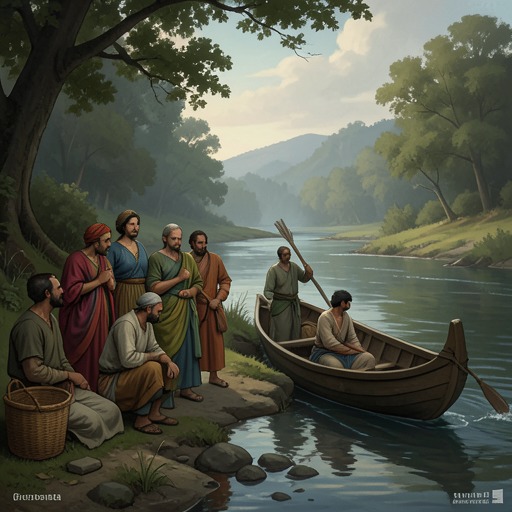
When Candide and Cacambo ask to leave, the King calls their wish foolish but says he has no right to detain strangers. He regards such detention as tyranny, contrary to the kingdom’s manners and laws, and affirms that all people are free to go. His answer qualifies the prohibition: it governs the inhabitants’ departure, but it does not authorize the King to imprison foreign visitors who want to leave.
Freedom to depart does not make departure easy. The King explains that the rapid river by which the travelers arrived cannot be ascended, while the surrounding mountains rise ten thousand feet, extend more than ten leagues in breadth, and are steep as walls. Their only descent is by precipices. Since Candide and Cacambo persist, he orders his engineers to build a machine to carry them safely over the mountains. His subjects, however, cannot accompany them: they have vowed never to leave the kingdom and are too wise, in the King’s view, to break that vow. The visitors receive practical assistance, while the inhabitants remain bound by their own collective commitment.
The Rule in the Story’s Argument
Before learning the country’s name, Candide and Cacambo wonder whether they have found the place where all is well, while recalling that things often went badly in Westphalia. That expectation echoes Pangloss’s teaching that the existing order must be for the best. El Dorado gives that optimism an unusually concrete setting, but its security depends on a stringent condition: its people’s happiness is linked to their separation from the wider world.
The departure exposes a tension within that apparent perfection. The King can describe the inhabitants’ vow as wise and the country as a place where people should remain comfortably settled, but Candide and Cacambo still choose to leave. In a tale written to ridicule the notion that this is the best of all possible worlds, El Dorado’s rule offers a protected alternative without making it a universal answer: the kingdom’s well-being is real within the account, yet it is preserved by limits that its visitors do not accept for themselves.