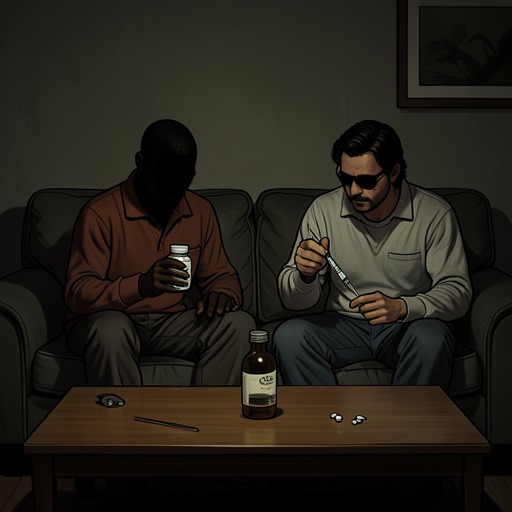
Heroin Overdose and Emergency Rescue
CherryHeroin Overdose and Emergency Rescue depicts a domestic heroin-use routine becoming a near-fatal crisis. The narrator prepares an injection while Emily is expected downstairs and Black is present; after the narrator injects, an unusually powerful taste and rush give way to collapse. Emily’s improvised effort to revive him leaves both the physical danger and the strain of their shared drug use exposed.
Preparation in the Kitchen
The scene begins with heroin divided into two portions and the narrator laying out clean spoons, one for himself and one for Emily. He fills a glass with water, draws some into the syringe, and forcefully expels it to clear any clot that might block the needle. He draws more water and pours it into a spoon. As Emily comes downstairs and greets Black, the narrator dissolves the heroin and moves to the gas stove. He directs Emily to her portion on the counter, and she thanks him.
The preparation is precise and practiced: the low burner heats the spoon until its contents begin to hiss, then the narrator removes it from the flame. Emily has already prepared a piece of cotton, anticipating his haste. Her hair is still wet. The cotton darkens and swells in the heated mixture; he draws liquid through it into the syringe and pushes out the air. What remains in the syringe looks quite dark. These details make the crisis emerge from an ordinary sequence of shared preparation rather than from a sudden external interruption.
Emily asks whether the narrator is going to take the whole amount immediately, then questions whether that is sensible. He reassures her that it will be all right, adding that if he cannot get more soon, it hardly matters. His reply makes the urgency of the next dose part of the scene before the injection has even begun. The exchange also places Emily in the role of a concerned observer: she knows what he is doing, helps prepare the dose, and still voices doubt about his decision.
The Injection and Collapse
The needle is dull, which makes the injection more painful and could make a vein harder to find. The narrator nevertheless locates one without difficulty and treats that ease as a good sign, reading it as evidence that the day may bring him luck. That brief confidence is overturned almost at once. He injects, first registering the taste and then the onset of the rush, as warmth spreads through him. The taste grows stronger than usual, however, and becomes sickening. In that moment he understands that he has been dead; his ears are ringing.
The account moves sharply from expectation to bodily emergency. Finding a vein without difficulty had seemed to promise good fortune; instead, the strength of the sensation signals that something has gone badly wrong. The narrator’s account then locates him on the kitchen floor, with his testicles icy cold. The abrupt change in position and sensation makes the collapse concrete without explaining its medical mechanism. The floor, rather than the stove or counter where the dose was prepared, becomes the scene’s decisive location.
Emily’s Attempt to Revive Him
Emily is above the narrator when he comes to awareness on the floor. His trousers are undone, and ice cubes are in his underwear. He asks whether she put them there. Emily explains that she thought he was going to die. The improvised measure is described through its startling physical result, not through a detailed account of how she decided on it or whether it worked by any particular medical process. What the scene establishes is that she believed his life was in immediate danger and acted in response.
The rescue is also an intimate encounter between two people already sharing the preparations for drug use. Emily has helped ready the cotton and watched the injection; after the collapse, she is the one positioned over him and trying to bring him back. Her fear appears in the narrator’s observation that she is on the verge of tears. The scene therefore does not separate practical participation in drug use from care: Emily is present in both, and the emergency makes the cost of that closeness visible.
Aftermath and Significance
The narrator responds to Emily’s fear with a joke that the day has only just begun, then apologizes when he sees how close she is to crying. He tells her that she has no reason to feel embarrassed and that she did the right thing. The reassurance shifts attention from his own recovery to her reaction: he recognizes that she has been frightened and tries to remove any shame attached to what she did. Emily answers with anger, a response that punctures the narrator’s attempt to turn the episode back into banter.
The scene’s force lies in the contrast between procedure and consequence. The syringe is cleared, the spoon heated, the cotton used, and the air expelled with practiced attention; none of that control prevents the narrator from collapsing. His earlier confidence that finding a vein is a lucky sign is answered by the unexpectedly sickening rush and the icy sensation on the kitchen floor. Emily’s wet hair, the prepared cotton, and the ice in his underwear keep the danger grounded in the home they share. The episode presents overdose not as an abstract risk but as a rupture in an intimate routine, followed by fear, improvised rescue, apology, and anger.