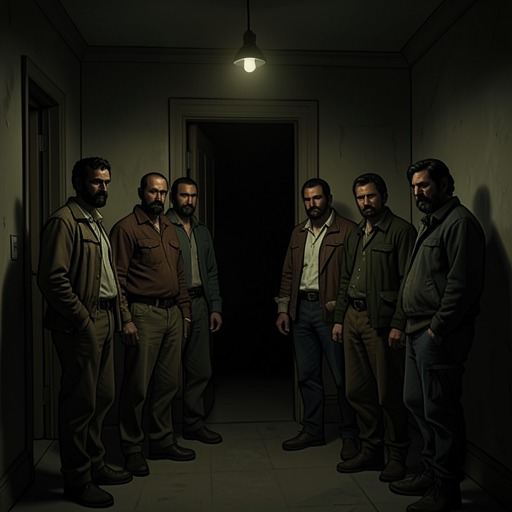
The Failed Chagrin Boulevard Bank Robbery After Raul Backs Out
CherryThe failed Chagrin Boulevard bank robbery after Raul backs out is a carefully planned crime that never becomes a robbery. The narrator and Raul arrange their roles around a bank’s double-door entrance, and James Lightfoot is given a separate approach to avoid drawing attention. But when the narrator enters, Raul is nowhere beside him. The narrator faces the employees alone, leaves without taking anything, and finds Raul back in the car. The plan’s decisive failure is not a police intervention or a problem with the bank’s security: it is the sudden absence of one of its participants.
Causes and Selection
The plan takes shape after Rider says he needs to go to Severance. Back at the car, James Lightfoot asks whether the group is going to do anything. The narrator proposes robbing a bank on Chagrin Boulevard, and James agrees. Those in the group who are using drugs take a fix before they leave, and the others drive Rider to his destination. The narrator is glad to be rid of him, then turns attention to the proposed robbery.
On Chagrin Boulevard, they inspect two different branches before choosing one in a shopping center. It is a recently opened branch, and the narrator expects it to have a double-door vestibule. That feature shapes the plan: the doors could trap the robbers between them as they tried to get out, so the narrator and Raul discuss how they will keep the doors open during their exit. The location is selected not simply as a target but as a place whose architecture seems to demand a particular solution.
Roles and Preparation
The narrator assigns Raul responsibility for the outer door while the narrator holds the inner one. Once Raul has the outer door open, the narrator explains, they can leave together. Raul says he understands. The escape route is rehearsed verbally before the group reaches the bank, with the doors treated as the most immediate practical danger.
James Lightfoot is assigned a different role. The narrator tells him to walk onto the sidewalk and enter the parking lot separately, so that he will not be noticed before the robbery is over. They make one last drive past the bank in both directions while smoking a final cigarette. James then stops at the curb and the narrator and Raul get out. The plan depends on separation during the approach and coordination at the exit: each person has a defined part, and the narrator’s instructions assume that Raul will remain beside him.
The weather is only six or seven degrees outside, not cold enough to explain the group’s heavy winter clothing. The narrator wears James Lightfoot’s overcoat, ski hat marked with Shaker High School, and scarf. Raul wears a parka and a balaclava that hides his entire face, making him look like a ninja. They cross half the parking lot together. When the narrator asks if everything is all right, a muffled affirmative comes back. At the entrance, the narrator has pulled the scarf up over the lower part of his face.
The Attempt and Its Collapse
The narrator makes what he imagines as a Pacino-style entrance, shouting the repeated Attica chant. The performance is meant to announce a robbery, but it immediately exposes the missing participant. Raul says nothing. The narrator looks over one shoulder and then the other; Raul is not there. The planned division of labor has vanished at the moment it is needed, and with it the narrator’s expectation that the two of them will control the entrance and exit together.
The narrator turns toward the employees, who are watching, and asks them not to tell anyone. No demand for money or completed taking of the bank’s funds is described. Instead, the narrator turns around and walks back out. Raul is on the back seat of the car, while James Lightfoot has waited for him. The entrance, intended to initiate a robbery, ends as an abrupt retreat witnessed by the bank staff.
Aftermath and Significance
Once the car reaches Chagrin Boulevard, the narrator confronts Raul about what he has done and says the episode was embarrassing. James Lightfoot responds with a brief expression of dismay. The account does not give Raul’s reason for withdrawing, nor does it describe an argument or any further attempt at the branch. Its immediate aftermath is therefore defined by the discrepancy between the elaborate plan and the small, visible outcome: the narrator has entered, shouted, asked the employees for silence, and left empty-handed.
The episode makes the robbery plan’s procedural confidence look fragile. The narrator has considered the vestibule, assigned the doors, separated James Lightfoot’s approach, and prepared a disguise; none of that preparation can compensate for Raul’s absence. The shouted film reference adds another kind of failure: a dramatic gesture cannot make the situation proceed as intended. What remains is not a successful criminal operation but a brief, awkward encounter, remembered through the narrator’s embarrassment and the blunt reactions in the car.