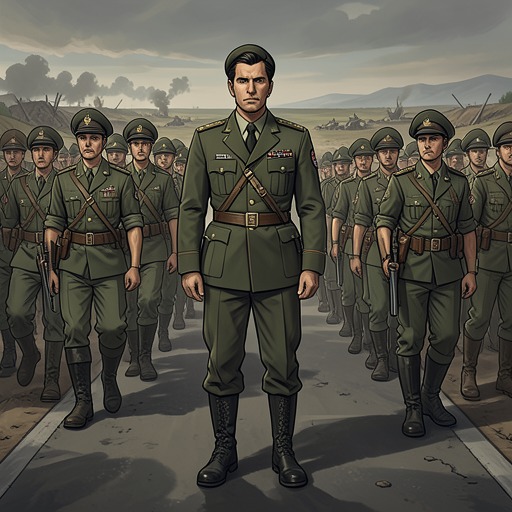
The Iraq Curfew
CherryThe Iraq Curfew is presented through a roadside encounter in which a patrol enforces a nighttime restriction on two civilians while itself moving through a confused, dangerous return journey. The episode makes the curfew concrete not through a stated schedule or penalty, but through the questions asked, the decision to release the men, and the warning that being outside could put them in danger.
Setting and Circumstances
The patrol, with the narrator and Sergeant North in the lead Humvee, had visited an Iraqi army base on a mission described as an effort to win hearts and minds. The soldiers ate falafel and drank Zamzam Cola with Iraqi military personnel; after the patrol leader finished a conversation, the group set out for its own base. By then, it was after curfew. The account gives no precise hour or explanation of how the restriction was established, so its operation is shown in this particular encounter rather than laid out as a general regulation.
The return trip was already disordered. The patrol took a wrong turn, became lost, and ended up on the wrong side of a river from its forward operating base. The soldiers could see the base but did not know how to cross back. They drove quickly along a narrow road without headlights, a practice the narrator says was routine. The curfew therefore enters a scene where the patrol is navigating by its own military procedures and uncertainty, not simply administering a settled, orderly system.
The Roadside Stop
A white sedan appeared around a bend. North called over the radio, and the last Humvee turned across the road to block it. The narrator reasoned that the sedan would have been shot had it tried to get around the vehicle; it did not attempt to pass. North and the narrator got out and approached. Two men stood on the road with their hands raised while soldiers searched them. The stop turned the abstract restriction into an immediate demand to account for being out at night.
The patrol leader asked the older, mustached man why he was there so late, where he had come from, and where he was going. An interpreter conveyed the questions. Soldiers searched the car, but found nothing hidden in it. The account does not describe an arrest, a charge, or any other formal consequence for the men. Instead, the radio ordered the patrol to let them go, making release—not detention—the encounter’s outcome.
Warning and Release
Before the men departed, the patrol leader instructed the interpreter to tell them that they needed to observe the curfew from then on. He explained the restriction as protection: they could have been hurt there that night, and the soldiers did not want that to happen. The warning thus combines a command with a stated concern for civilian safety. It is the clearest account of the rule’s rationale in the scene, but it remains the patrol leader’s explanation; the narrative supplies no independent account of the curfew’s purpose or legal authority.
The interpreter said something to the men, and the soldiers had to trust that he had translated the warning. The narrator’s brief acknowledgment of that dependence leaves a practical limit visible: the patrol can stop, search, question, and issue instructions, but communication rests on an intermediary whose words the soldiers cannot verify. The sedan then drove south-southwest, while the patrol resumed its route north-northwest. The two parties separate without a further confrontation.
Narrative Function
The episode places the curfew between civilian movement and military control. The men are required to explain their presence on the road after curfew, while the armed patrol decides whether to hold or release them. Yet the patrol is also lost, traveling without lights, and unsure how to return to its base. The contrast does not make the situations equivalent: the soldiers control the stop and the release, while the civilians face the immediate scrutiny. It does show how the restriction is encountered amid the patrol’s own uncertainty rather than as an impersonal rule administered from a distance.
The account’s emphasis on the empty search and the order to let the men go matters as much as the warning. The curfew is enforced here through an armed interception, questioning, and a spoken instruction, but the episode does not establish a penalty or show what would happen in another case. Its significance lies in that bounded encounter: a rule invoked to protect people from nighttime danger is also exercised through military power, with the patrol’s judgment determining when the encounter ends.