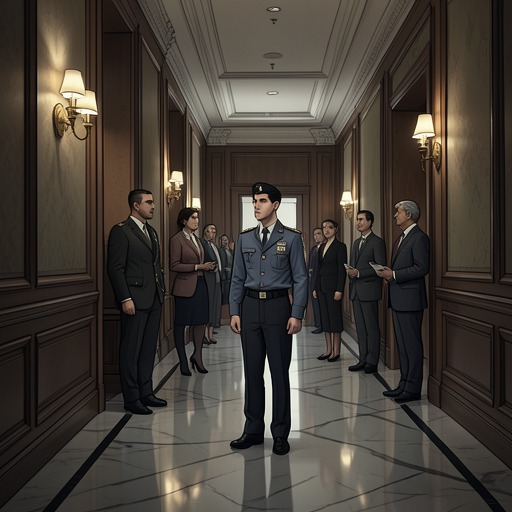
Hotel Shahjahan's 24-Hour Operating Practice
ChowringheeHotel Shahjahan's 24-hour operating practice makes the hotel a workplace without a true closing hour: its schedule turns around the needs of guests, not the ordinary divisions of day and night. The calendar may advance while staff continue working, and the hotel’s lights remain on; this continuity governs both routine service and exceptional occasions, while leaving employees to absorb the strain.
A Different Clock
Sata Bose explains the hotel day through a sequence of services: tea in bed, breakfast, lunch, afternoon tea, and dinner. The names differ from the world outside, where people call the middle of the day noon, but the hotel's timetable is organized around what guests are served. Dinner does not end the working day. The date may change, Bose says, without the hotel’s work changing with it.
The principle is bluntly restated when the narrator asks Mathura Singh what time the hotel closes. Mathura replies that the sun may sometimes set on the British Empire, but a hotel's lights never go out. Nothing there closes. Since no one has told the new employee what time his work ends, Mathura observes that he could leave; the exchange makes clear how little an ordinary closing time defines hotel work.
Continuous Service and Its Demands
The work follows the meal cycle even in its paperwork. Employees type breakfast, lunch, and dinner menus every day, put them on every table, then return them to storage after the meals. There they gather dust for a year, until Salvation Army volunteers collect the old papers in a truck. The repeated task turns each day's service into another set of materials to prepare, circulate, and clear away.
At reception, the workload rises after breakfast, leaving little time for idle conversation. Guests descend from their rooms to relax in the lounge, and as they pass the counter, greetings become a practiced exchange. Sata Bose responds to each guest with the fluent courtesy of a professional, calling people by name or asking whether they slept well. The routine requires not just presence at the desk but the steady performance of attentiveness.
That performance extends to complaints. When a guest objects to the color of the bed linen against the curtains, she calls the manager in distress. Marco Polo hurries to the room, but answers her anger with composure: he apologizes, offers three sets of sheets for her to choose from, and explains that the color had been prepared for American tourists. The incident shows how the hotel's uninterrupted service depends on staff treating even a highly personal and minor dissatisfaction as a matter requiring immediate attention from the top.
Night Work and Hotel Hierarchy
The rule applies as much to major functions as to everyday service. At a charity banquet, the Hotel Shahjahan's reception and staff must accommodate a large formal gathering, with guests welcomed by Agarwalla and other organizers. Sata Bose points out that the same social guests move from one hotel, club, or private house to another; the hotel’s work is part of a recurring circuit of public hospitality whose polished appearance conceals what has actually happened inside.
The cabaret makes the demands of the schedule visible in another way. During Connie's performance, the lights are extinguished between acts to preserve her modesty, then raised again as the show continues. The carefully managed transition belongs to the spectacle, but it is also a task carried out by hotel workers around a live performance. Service, performance, and stage management all continue within the same working night.
The Cost of a Hotel That Never Closes
The night shift can stretch into the early hours. The farewell for Sata Bose at Little Shahjahan begins at midnight because the hotel offers no break in its work. The waiters at Little Shahjahan do not want to stay up late, so Shahjahan employees take responsibility for serving the banquet themselves. The employees have collected four annas each, as much as they can afford, to honor a colleague who fought with the management, gave them free tea, and sometimes used his own money to help them see good doctors. Their tribute takes place on the clock of the institution they are honoring: even a farewell must be fitted around hotel work.
The practice therefore means more than keeping the lights on. It folds meals, paperwork, reception, complaints, entertainment, and staff ceremonies into a cycle with no reliable boundary at nightfall. Its order is sustained by workers who keep serving after the day's ordinary measure of time has run out.