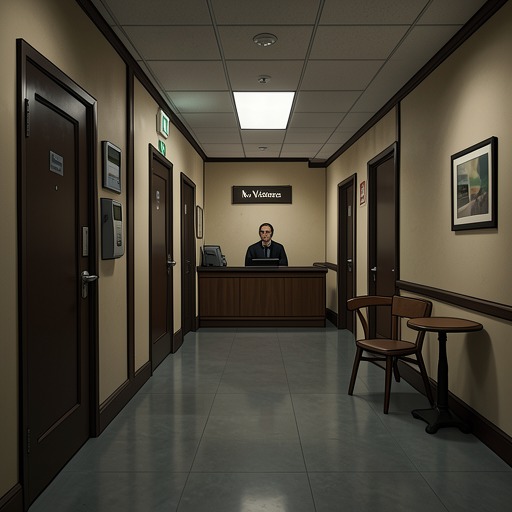
The Practice of Requiring Hotel Secretaries to Live On-Site
ChowringheeThe Practice of Requiring Hotel Secretaries to Live On-Site is shown at the Hotel Shahjahan through a specific precedent: Rosie, the narrator’s predecessor, lived in the hotel at management’s request, and Marco Polo urges the narrator to do the same. The arrangement joins accommodation to work, making a secretary’s presence available beyond ordinary office hours; Rosie’s night of urgent typing shows both the service it enabled and the personal commitment on which that service depended.
The arrangement and its precedent
Marco Polo presents Rosie’s residence as an established feature of the secretary’s position, not as a new idea devised for the narrator. He says that Rosie used to live there at management’s request, then describes the professional benefits of having her on-site: he did not need to hurry to finish everything by five, and important letters were answered immediately. The account connects a place to live with the hotel’s ability to respond quickly to guests’ needs.
The evidence does not set out a written rule or establish that every secretary at the hotel must reside there. It identifies Rosie’s arrangement and shows Marco Polo treating it as a precedent relevant to her successor. His wording makes the move a decision for the narrator, even as he presses for it: the example is offered as a reason to accept the position’s residential expectations, not as proof of a formally universal requirement.
Rosie’s work beyond office hours
Marco Polo’s praise of Rosie is grounded in both skill and manner. Her fingers moved rapidly over the typewriter, and he recalls that she never lost her smile. He describes her as wholly committed and says she was never unhappy because of the work. These details make the hotel’s account of the arrangement personal: its efficiency rests not only on Rosie being nearby, but on the speed and composure with which she met demands.
The clearest instance came when a guest needed a letter typed at about eleven at night. He was leaving for London early the next morning, wanted the letter sent immediately to Karachi, and had neither a typewriter nor the ability to type. Marco Polo initially wondered where a typist could be found at that hour. The guest insisted that Calcutta was a large city where nothing was impossible if one tried; Marco Polo’s solution was to call on Rosie, who lived in the hotel.
Rosie typed until nearly three in the morning. Marco Polo says that he set her to work and then went to bed; she did not complain to him the following morning. Later, a letter from England praised the secretary for having saved the guest that night and for finishing the work without showing irritation before greeting him in the morning. Her residence made an urgent response possible, but the story also exposes the cost in hours: the task continued deep into the night, while the manager who assigned it went to sleep. The glowing testimonial confirms the service’s success without removing that imbalance from the episode.
The narrator’s proposed move
After recounting Rosie’s service, Marco Polo tells the narrator that he should move into the hotel as well. He leaves without waiting for the narrator’s consent and says that he has already informed Jimmy, who should have arranged everything. He directs the narrator to come to him if any problem arises. The sequence gives the proposal practical force: accommodation is not merely described as an abstract advantage but treated as an arrangement already being put in motion.
The narrator is not immediately at ease with the change. When the subject comes up again, he has reservations and admits that he is nervous. The response distinguishes his situation from Rosie’s remembered example: Marco Polo can praise the benefits of living on-site, but the narrator still has to contemplate making his home part of his workplace. The move is subsequently described as permanent. An associate, reporting what Jimmy has said, welcomes the news, confirming that the proposed residence has become an expected part of the narrator’s position.
Work, availability, and the boundary of home
Rosie’s story frames on-site residence as a practical means of keeping the hotel’s correspondence moving. The important distinction is between the usual rhythm of work and sudden demands that cannot wait for the next working day: an overnight guest, an early departure, and a letter that must be dispatched to Karachi. The hotel benefits from a secretary close at hand, while the guest receives a prompt service that earns the hotel gratitude and praise.
At the same time, the episode does not portray residence as a benefit alone. Rosie’s late-night labor, her lack of complaint, and Marco Polo’s pride in her performance reveal how an employee’s reliability can make exceptional work appear effortless. His suggestion that the narrator live there carries that precedent forward. The practice therefore marks a porous boundary between employment and private life: the hotel can call on the secretary’s time because the secretary lives within its premises. The account establishes this pressure through two linked cases—Rosie’s demonstrated availability and the narrator’s permanent move—without specifying a contract, hours of duty, or a rule applying to all hotel secretaries.