The Practice of Not Disturbing Sleeping Guests
ChowringheeThe Practice of Not Disturbing Sleeping Guests is a Hotel Shahjahan service custom that places a sleeping guest’s privacy ahead of a caller’s demand for immediate contact. When someone phones for Karabi Guha, Sata Bose declines to wake her and offers instead to ensure that a message reaches her when she is awake. The exchange shows the rule in action: courtesy does not mean granting access without regard for the guest’s rest or the hotel’s procedures.
The rule in practice
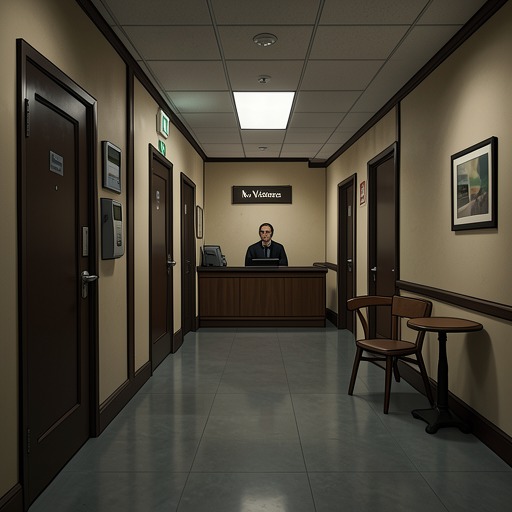
At the reception desk, Sata Bose identifies himself as working in the Hotel Shahjahan’s reception and tells the caller that Karabi cannot speak by telephone at that time. He offers to pass along any message as soon as she wakes. The caller appears dissatisfied, but Bose maintains the hotel’s usual practice of not disturbing guests who are asleep unless other instructions have been received.
Bose also treats identification as part of handling the call. He asks for the caller’s full name, address, and telephone number, while making clear that supplying the information is the caller’s choice. The caller gives only the name ABC; Bose says he will inform Karabi that Mr. ABC has called. The attempt to reach her therefore ends not with an interruption, but with a message whose sender is only partially identified.
Privacy and hotel procedure
The scene presents the custom as an established operating principle rather than a personal refusal by Bose. He explains that the hotel does not normally disturb sleeping guests, and follows that principle even as the caller’s displeasure becomes apparent. His manner combines restraint with service: he does not simply dismiss the call, but offers a route for the guest to respond later and requests the details needed to record it.
The practice belongs to a hotel that must also manage conspicuous public events. The Hotel Shahjahan hosts a banquet for the international philanthropic organization Sociedad Filantrópica, while Sata Bose observes that newspaper accounts of such occasions may be prepared before the event and omit what actually happens. During Connie’s performance, the lights are extinguished and then a spotlight searches the stage; after the first act, the lights go out again while she retreats backstage. These scenes establish the hotel’s busy public setting, against which the call to Karabi demonstrates a separate obligation: a guest’s sleep is not to be sacrificed simply because someone outside the room wants immediate attention.
Significance
The rule draws a practical boundary between access to the hotel and access to an individual guest. A telephone call can reach the reception desk, but it does not automatically entitle the caller to wake someone or bypass the hotel’s procedures. Bose’s offer to take a message keeps communication possible while preserving the guest’s choice about when to respond.
The exchange also gives the custom a small but revealing human measure. The caller’s identity remains uncertain, and the caller’s impatience does not change the response. What the hotel can promise is limited but concrete: Karabi will be told that someone called, and she will receive the message once she is awake.