Simpson's Night-Round Rules
ChowringheeSimpson’s Night-Round Rules turn the Shahjahan Hotel’s ordinary demands for vigilance and economy into a form of authority that appears to survive its original enforcer. Simpson, the hotel’s first owner, was remembered for patrolling from the ground floor to the roof and punishing sleeping workers by taking their belts. Gurberia’s account carries that discipline beyond Simpson’s life: a night attendant warns the narrator about wasteful lights, then describes a ghostly visit in which the old rule is enforced once more.
Authority and Scope
The rules emerge in a conversation between the narrator and Gurberia, a night worker who asks him not to leave the lights burning. Waste is not a private matter, Gurberia explains: Simpson dislikes it, and a lit room can mean trouble for both the guest and the attendant responsible for it. The warning makes a small act of comfort—leaving a light on—part of the hotel’s system of accountability.
Simpson’s authority is described as pervasive. Night-shift workers fear him because he inspects throughout the night, moving from the lowest floor to the roof. His patrol is not limited to a single post or a scheduled check; the account presents him as a presence able to appear wherever a worker might let his attention lapse. Gurberia’s description of him as strict and merciless conveys the staff’s sense that the night offers no dependable interval of rest.
The account also gives that authority a history. Simpson was the hotel’s first owner, and Gurberia says everyone knew him by the way he dragged his right foot. His former habits are therefore not an anonymous workplace legend: the ghost is identified with a particular proprietor, remembered through a distinctive gait and a familiar routine of inspection.
The Belt as Discipline
The belt is the concrete instrument of Simpson’s enforcement. Gurberia recalls that when Simpson was alive, he would take the belt from anyone he caught sleeping. The punishment continued into the next day: a worker had to pay a deposit to recover the garment, because turning up for work without a belt was not permitted. The belt is at once something a worker must wear and something management can withhold, making the penalty material as well as humiliating.
This detail clarifies why a night patrol can govern more than the moment of inspection. The threat does not end when Simpson leaves a room; the worker may face a financial cost and a problem reporting for duty the following day. Even so, the episode does not suggest that the rules are enforced through a written code or a formal hearing. Their force lies in a known custom, the possibility of being caught, and the practical consequences attached to the missing belt.
Gurberia’s Encounter
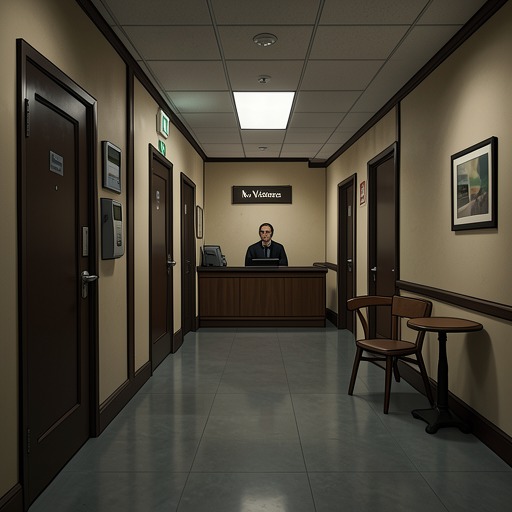
Gurberia presents the supernatural encounter as an extension of the established routine. At about two in the morning, after finishing his work, he sits on a stool and nods off. The guests are asleep, the doors are locked from within, the corridors are dark, and the hotel is quiet. Gurberia says he has not felt well, but the brief rest does not protect him: as soon as he closes his eyes, he feels someone taking his belt.
He grabs it in surprise and recognizes Simpson. Gurberia tries to fall at the apparition’s feet, then breaks into tears and pleads that he is new and will not do it again. Simpson does not respond to the appeal. He takes the belt and disappears, leaving it in a dark corner on the second floor. The encounter follows the old procedure closely enough to make it recognizable as discipline, yet its setting and the inaccessible figure transform an ordinary inspection into a haunting.
The narrator is half asleep and nearly laughs at the story. Gurberia objects and urges him to ask Blackey, insisting that everyone at the hotel knows how Simpson behaved when alive. That appeal to shared knowledge complicates the tale without proving the apparition’s reality: Gurberia grounds the ghost story in a remembered workplace practice, while the narrator’s drowsiness leaves his reaction short of either belief or investigation.
Institutional Memory and Meaning
The rules depend on memory passed among workers: the old owner’s gait, his endless rounds, the belt he took, and the deposit required to get it back. In Gurberia’s telling, Simpson’s death does not release the night staff from his supervision. The ghost is frightening not because it invents a new punishment, but because it repeats a familiar one when the hotel is dark and its human management is absent from the scene.
The episode also places the narrator within the same chain of responsibility. Gurberia warns him directly about the lights, apologizes neither for the rule nor for enforcing its warning, and asks him not to mention more as he leaves. The small exchange makes clear that hotel discipline travels between workers as well as downward from an owner: Gurberia carries the caution to the narrator, just as Simpson’s remembered patrol continues to shape Gurberia’s conduct. The result is a workplace where even a moment of fatigue, or a light left burning, can feel answerable to an authority that never quite goes off duty.