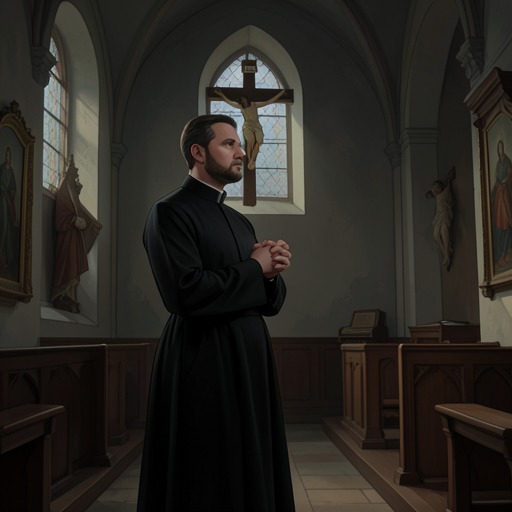
Lomeli's crisis of prayer
ConclaveLomeli’s crisis of prayer is the growing inability of Jacopo Baldassare Lomeli to find the communion with the Holy Spirit that had once come naturally to him. It begins before the Pope’s death, deepens under the demands of the conclave, and unsettles the distinction between his public competence and private spiritual desolation. Even when he feels close to God again after speaking at Mass, that nearness proves fleeting: prayer remains a struggle rather than a settled recovery.
Background and the loss of communion
During the year before the conclave, Lomeli’s prayers had increasingly become words without meaning. He described the experience as spiritual insomnia and noisy interference: the more earnestly he wanted meaningful prayer, the more elusive it became. This was not simply a doubt about doctrine but a loss of the inward connection through which he had once prayed with ease.
At their final meeting, Lomeli told the Pope about the crisis and asked permission to leave Rome, resign as Dean, and withdraw to a religious order. At seventy-five, he was retirement age, and the request offered a way out of duties he no longer felt equal to carrying. The Pope refused. He distinguished between shepherds and those needed to manage the farm, telling Lomeli that he was a manager and was needed in Rome; he also assured him that God would return to him. Lomeli was hurt by being defined in administrative rather than pastoral terms. Their parting was cold, and it was the last time he saw the Pope.
The refusal turns the crisis into more than a private matter of devotion. Lomeli must continue in the office he hoped to leave, while wondering whether the work itself has carried him away from God. His prayerful life and his institutional duties no longer seem to reinforce one another; the very role he is required to perform becomes the setting in which that distance is most sharply felt.
The burden of office and self-doubt
After the Pope’s death, Lomeli recognizes that, as Dean, he must organize the election. He had expected to die before the Pope, having been diagnosed with prostate cancer several years earlier and believing himself only a temporary occupant of office. Now he must guide the cardinals through a conclave in exceptionally difficult circumstances. His instinct is to pray for wisdom and to insist on impartiality, but duty arrives alongside the sense that prayer does not reliably answer him.
The preparation for his public role exposes the same divide. The draft homily for the televised Mass at St Peter’s Basilica is enough to give him stomach cramps. He has held high ecclesiastical titles and taken an active part in preaching, celebrating Mass, and hearing confessions, yet he feels he lacks the most basic abilities of an ordinary parish priest. His career as a professor of canon law, diplomat, and briefly Secretary of State seems, in retrospect, to have led him away from God as he climbed higher in the Church.
This sense of inadequacy is bound to the particular work before him: he must help his fellow cardinals choose the holder of the Keys of St Peter while doubting his own spiritual fitness to guide them. His motto, “Servus fidelis,” means “A faithful servant,” but the plainness of the words matches his fear that he is a manager rather than a shepherd. The crisis therefore places the office’s visible authority beside an inward uncertainty that authority cannot dispel.
Seclusion and the failure of stillness
The conclave’s enforced isolation gives Lomeli fewer distractions from the crisis without giving him the stillness he needs. The cardinals are sequestered from the outside world; the windows are sealed, and the televisions and radios have been removed. In the late Pope’s abandoned suite, whose door is bound with red ribbon and Camerlengo’s wax seals, Lomeli kneels with his rosary and tries to pray. His thoughts return instead to his final conversation with the Pope and the resignation he had been refused.
At night he reads Romano Guardini’s reflections on stillness before the liturgy. The passage describes attentive silence as a condition in which God’s word can take root. Lomeli cannot find a way into that condition. As the hours pass, the noise in his mind grows shriller, and the Gospel paradox of a savior who cannot save himself becomes a jeering accusation: he celebrates Mass but cannot achieve communion himself.
The crisis takes on an almost visionary form as he imagines cacophonous darkness descending upon him, filled with taunting voices. In despair he hurls the book against the wall. The noise briefly interrupts the snoring in the room, but the snoring resumes; neither the violent gesture nor the text he hoped might guide him brings lasting quiet. At 6:30 the alarm sounds. He has slept no more than an hour or two, and the demands of the coming day strike him with nausea. Instead of following his usual routine of meditation and morning prayer, he goes straight to a shower.
A brief return, then renewed absence
At the Mass, Lomeli sets aside the prepared homily and speaks from what is in his heart. Afterward he hands the undelivered text to Monsignor Epifano, uncertain even about what should happen to a sermon that was not given. During the traditional minute and a half of silence, he cannot tell how the cardinals have received his words. He nevertheless feels closer to God than he has for many months, perhaps closer than ever, and prays in thanks for the courage and strength to speak.
When the silence ends, he begins the Credo. His voice is firmer, and the spiritual energy he feels carries him through the sung parts of the Eucharist, which had previously filled him with trepidation. He senses the presence of the Holy Spirit throughout the rite, while distributing Communion to selected members of the congregation and noticing astonishment from his fellow cardinals. The reliable lawyer and diplomat has done something they did not expect, and he himself had not expected it either. The moment offers a real change in his experience, but not a permanent answer to the crisis.
Soon afterward, Bellini accuses Lomeli of harboring ambition. Lomeli examines his conscience and concludes that Bellini is wrong, as far as he can tell. Yet the accusation raises a different and more alarming possibility: perhaps God has a plan for him, and perhaps the words at Mass came through him as a manifestation of the Holy Spirit. When he tries to pray for guidance, however, the God who had seemed close minutes earlier has vanished again. The sudden alternation between presence and absence is the crisis in miniature: an intense religious moment can be genuine without giving Lomeli lasting certainty about its meaning.
Significance in Lomeli’s arc
The crisis of prayer accompanies Lomeli’s movement from a hoped-for resignation into responsibility for the conclave. It does not prevent him from acting: he accepts the work, seeks impartiality, celebrates Mass, and continues to test his conscience. But it denies him the assurance that might make those actions feel spiritually secure. His public role requires decisions and ceremony, while inwardly he faces silence, distraction, and the fear that he has mistaken competence for vocation.
That tension also shapes the brief recovery after the homily. Lomeli’s closeness to God arrives not through the prepared text that had frightened him, but after he abandons it and speaks honestly; yet the experience does not establish that he is divinely chosen, or make prayer easy thereafter. The narrative keeps the two possibilities—human uncertainty and spiritual guidance—open together. His crisis is therefore not a simple loss followed by restoration, but an unsettled passage in which responsibility continues even when communion cannot be summoned at will.