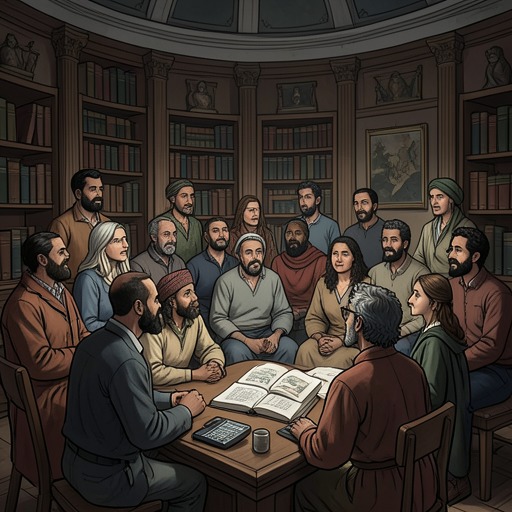
Threat of schism in the Catholic Church
ConclaveThe Threat of schism in the Catholic Church is both a political fear and a theological test during the conclave. As Jacopo Baldassare Lomeli warns that a prolonged election could bring division, Joshua Adeyemi questions whether institutional unity is worth the violation of a sacred oath. Their disagreement reveals how the crisis of choosing a pope is also a struggle over what the Church’s unity means and what it may demand of those who serve it.
The fear of division
Lomeli sees the threat as a consequence of an election that cannot reach agreement. He warns Adeyemi that twelve days of secret balloting and discussion, with the world’s media gathered in Rome, would make the Church appear unable to choose a leader. In his view, that appearance would strengthen those seeking to return the Church to an earlier era and could herald the schism he believes has threatened it for nearly sixty years.
The prospect is intensified by the Church’s existing divisions. The late Pope’s reformist pontificate had drawn opposition within the Curia: his demands for financial transparency and independent scrutiny met resistance, while Goffredo Tedesco and his supporters attacked positions they considered doctrinally unacceptable. Aldo Bellini describes the result as a cruel paradox: the late Pope was loved by the outside world but became increasingly isolated within the Holy See. This institutional mistrust forms part of the background against which the conclave’s deadlock raises the prospect of a more formal rupture.
Unity, conscience, and divine will
Lomeli approaches unity as a sacred good. He tells Adeyemi that his life’s work has been devoted to the divine gift of the single Universal Church. Adeyemi answers that his faith is in God alone, and refuses to treat either a long conclave or even schism as necessarily contrary to God’s will. He suggests that the election’s intractability might itself have a divine meaning.
Their exchange turns on the cost of preserving unity. Adeyemi asks whether the unity of an institution is worth maintaining at the price of breaking a sacred oath. Lomeli rejects the reduction of the Church to an institution, describing it instead as the living embodiment of the Holy Spirit. Adeyemi counters by locating that embodiment elsewhere: among women subjected to mass rape as a policy of war in the civil conflicts of central Africa. The disagreement makes the schism question more than a dispute about electoral procedure; it asks whether loyalty to the institution can conflict with moral responsibility beyond it.
Crisis inside and outside the conclave
The conclave’s divisions unfold amid public unrest and acute security concerns. Before the cardinals enter Casa Santa Marta, Lomeli hears a jumble of protests over religious, social, and political issues and thinks of the Church as an ark surrounded by a rising flood of discord. The security briefing describes a serious and imminent terrorist threat, with police and military personnel deployed around the Vatican. These pressures make the election’s internal disagreement appear inseparable from the wider conflicts surrounding the Church.
When coordinated attacks occur, the danger becomes immediate. O’Malley reports a suicide bomber and a car bomb in Piazza del Risorgimento, a place crowded with pilgrims near Vatican City, and a shooting at San Marco Evangelista during Mass. Witnesses report that the bomber shouted “Allahu Akbar.” Lomeli warns against allowing the attacks to be framed as the beginning of a religious war, while Tedesco later invokes the deaths and the attack’s proximity to the Church to argue that Catholic leaders have been dangerously weak. The event sharpens the contest over how the crisis should be understood: as a reason for restraint and clarity, or as proof that the Church must adopt a harder political posture.
A threatened unity, not a settled outcome
The text presents schism as a looming possibility rather than a completed rupture. Lomeli fears that deadlock could make division more likely, while Adeyemi refuses to assume that unity is always God’s will or that division must be avoided at any cost. Tedesco’s rhetoric after the attacks further exposes how external violence can be recruited into internal arguments about doctrine, leadership, and the Church’s response to other faiths.
The threat therefore gathers several tensions into one question: whether the Church can remain one without suppressing conscience, and whether unity serves its spiritual purpose when leaders defend it as an institutional necessity. The conclave does not resolve that question simply by continuing its work; the possibility of division remains a measure of the stakes and of the competing meanings attached to the Church’s unity.