Ideological division within the Church
ConclaveIdeological division within the Church is the political and spiritual fault line running through the election of a new Pope. It brings traditionalists and reformers into conflict over doctrine, language, governance, and the Church’s relation to a changing world; yet the divisions are neither tidy nor merely theoretical. They shape rival candidacies, expose the limits of institutional unity, and leave Dean Jacopo Baldassare Lomeli responsible for guiding an election in which procedure itself becomes part of the struggle.
Factions and the succession contest
The division becomes visible at the outset in the three principal candidacies. Aldo Bellini is the liberal intellectual hope, a former rector of the Gregorian University and Archbishop of Milan. Joseph Tremblay combines the office of Camerlengo with leadership of the Congregation for the Evangelisation of Peoples, giving him links to the developing world while appearing American without actually being so. Joshua Adeyemi carries the possibility, compelling to the media, of becoming the first black Pope. Each candidate represents a different route to influence within the Church, and each has supporters among the electors.
Goffredo Tedesco’s position makes the conflict sharper. As the most savage critic of the late Pope, he had attacked the Pope and Bellini so forcefully that some thought he was pushing the Church toward schism; excommunication had even been discussed. Yet Tedesco’s traditionalist following makes him a prominent contender for the succession. Lomeli recognizes the contradiction: the man whose attacks had threatened the Church’s unity cannot simply be excluded from consideration without ignoring the strength of the constituency he represents.
The disagreement is not confined to the established European divide. Lomeli expects the thirteen African cardinals to vote as a bloc for Adeyemi, whose influence among them appears considerable. But Adeyemi’s prospects depend on winning support beyond Africa and the developing world. His denunciations of global capitalism and homosexuality could attract votes in Africa while alienating electors in America and Europe. With fifty-six European cardinals, and Lomeli’s own knowledge and friendships concentrated among them, demographic change does not erase the established weight of the European electorate.
Language, tradition, and competing visions of unity
At dinner, Tedesco turns the arrangement of the cardinals into an argument about the Church. The Italian speakers sit near the kitchens, the Spanish speakers elsewhere, and the English speakers closer to reception. He contrasts this visible separation with the days when Latin served as a common language among cardinals at a conclave. In his view, abandoning Latin in 1962, in the name of easier communication, has instead made communication harder. Lomeli concedes that the point may apply within a conclave but rejects its extension to the mission of the universal Church.
Tedesco’s deeper claim is that language forms thought, philosophy, and culture, so a Church speaking in many languages risks becoming a confederation rather than a universal body. He argues that Catholic identity in Europe no longer means what it means in Africa, Asia, or South America. His proposed remedy is bound to the past: he would impose Latin even if the electors could not understand his speech, because the gesture would make his point. Lomeli thinks the argument preposterous but keeps his response neutral, unwilling to be drawn into a dispute whose seriousness is difficult to gauge.
For Tedesco, the linguistic divide leads to a question of location and power. He warns that the abandonment of Latin will lead to the abandonment of Rome, and argues that the Pope could preside from anywhere because neither doctrine nor Scripture requires him to remain in Rome. He sets the Philippines’ three cardinal-electors against Italy’s twenty-six, despite Italy’s smaller Catholic population, and insists that another decade of the previous direction would leave the Church unrecognizable. His conclusion is explicit: the next Pope must be Italian, and the papacy must be recovered to save the Roman Church. The case for tradition thus merges with a claim about national and institutional primacy.
Bellini defines his position against Tedesco’s. He rejects a return to Latin liturgy, Mass celebrated with the priest’s back to the congregation, and the social conditions he associates with an older, repressive Church. He stands instead for respect toward other faiths, tolerance of differing views within Catholicism, greater authority for bishops, and a larger role for women in the Curia. His ally Giulio Sabbadin immediately warns that discussion of women could give Tedesco an opening to misrepresent Bellini as supporting women’s ordination. Bellini accepts that female ordination is closed for his lifetime and perhaps longer; Sabbadin insists it is closed for all time. Their exchange shows how reformist positions are negotiated not only against traditionalists but within their own camp, where strategic caution and doctrinal boundaries constrain what can be said.
The Church as institution and lived community
The divisions are also embedded in the composition of the electors. Thirteen Asian archbishops have come from cities including Jakarta, Cebu, Bangkok, Manila, Seoul, Tokyo, Ho Chi Minh City, and Hong Kong; another thirteen have come from Africa. Alongside them are European prelates whose histories and reputations resist easy classification: two liberal theologians, a patriarch reluctant to extinguish his cigar, an archbishop still limping from torture by Czech secret police, a prelate investigated for money-laundering, and another who had been excommunicated as a follower of Marcel-François Lefebvre. The assembly contains theological, regional, and personal differences that cannot be reduced to a single progressive-traditionalist axis.
The Roman Curia forms a further internal group. Its roughly two dozen members live in Rome and run the Church’s major departments; many are Italian and have apartments within the Vatican. Their long familiarity with the institution gives them a different bearing from electors who have travelled from across the world. Lomeli notices that the Curial officials seem knowing and blasé, lacking the awe he sees in the visitors. He recognizes the same spiritual disfigurement in himself and remembers the late Pope’s warning against the courtiers’ habits of vanity, intrigue, malice, and gossip. The division therefore has an inward dimension: not only disagreement about policy, but the danger that proximity to power will erode the capacity for wonder and service.
The late Pope’s record complicates any simple account of the factions. He appointed the Curial officials, including people who disappointed the hopes placed in them. The liberal camp had expected Simo Guttuso to become a second Pope John XXIII and to give bishops greater autonomy; once installed in the Congregation for the Doctrine of the Faith, Guttuso proved authoritarian, though lazier than his predecessors. The Pope’s own appointments thus failed to map cleanly onto the reformist hopes associated with his public image. When Bellini told Lomeli that the Pope had lost faith in the Church, Lomeli could not stop wondering whether the Curial bureaucrats were the people the Pope had meant.
That question is intensified by the contrast between the Pope’s reforming programme and his isolation. Bellini recalls that the pontificate began with a refusal of full papal regalia and a decision to live at Casa Santa Marta rather than the Apostolic Palace. At an early meeting with the prefects, the Pope demanded financial transparency: proper books, disclosed accounts, outside tenders for building work, and receipts. He brought in accountants and management consultants to examine the files and housed them on the first floor of Casa Santa Marta. The scrutiny provoked hostility not only from the old guard but from others in the Curia. Leaks and public embarrassments followed, including reports that associates such as Tutino were diverting money intended for the poor toward apartment renovations and first-class travel. Meanwhile, Tedesco and his allies attacked the Pope over statements concerning gay people, divorced couples, and the promotion of women. Bellini describes the result as a cruel paradox: the more the outside world loved the Pope, the more isolated he became within the Holy See, until he scarcely trusted anyone.
Institutional rules under pressure
The succession does not suspend the Church’s internal divisions; it gives them a legally defined arena. After the late Pope’s death on 19 October, the funeral and almost daily congregations of the College of Cardinals occupy the rest of October and the beginning of November. The congregations discuss the Church’s future, and the familiar split between progressives and traditionalists emerges occasionally, though those private meetings pass without controversy. When the electors assemble for the conclave, disagreement enters a process governed by exact rules and rituals.
The secret appointment of Vincent Benítez tests the boundary between the Pope’s authority and the electors’ rules. Lomeli learns that the late Pope revised canon law on appointments in pectore shortly before his death. The ancient provision allows a Pope to create a cardinal without disclosing the person’s name, even to close associates; Lomeli recalls that an earlier such appointment had remained unknown after the Pope’s death. When a colleague questions the new appointment, Lomeli invokes paragraph thirty-nine of the Apostolic Constitution: a cardinal-elector who arrives re integra, before a new Pope has been elected, may participate at whatever stage the election has reached. The dispute shows that institutional unity depends not on avoiding disagreement but on deciding who may interpret the rules and whether a contested appointment is legally binding.
The voting rite makes each elector’s responsibility visible. Lomeli reads the prescribed procedure: each cardinal folds and displays his ballot, carries it to the altar, swears that his vote is given to the person he believes before God should be elected, places the ballot in the receptacle, and returns to his seat. He writes Bellini’s name. In the first count, more than a quarter of the conclave—thirty-four cardinals—receive at least one vote, an unusually scattered result. The tally initially offers no clear leader; the main contenders emerge as Tedesco, Bellini, Tremblay, and Adeyemi, while Lomeli himself receives several votes. The procedure imposes common form on an assembly whose political and theological loyalties remain divided.
The Church’s division also becomes a dispute over the meaning of spiritual authority. In a later address, Vittorio Scavizzi rebukes Lomeli’s use of St Paul to make a case for doubt. He argues that the Church needs unity in faith and knowledge of Christ, comparing it to the Barque of St Peter in a storm. He names atheism, nationalism, agnosticism, Marxism, liberalism, individualism, feminism, and capitalism as forces seeking to divert the Church from its course. His answer to modern plurality is firm direction: the electors should choose a captain who will hold the rudder fast, reject relativism, and lead the Church back to knowledge of Christ. He calls not for a Church that moves with the world, but for one that moves the world. The speech transforms policy disagreements into a contest over whether unity is preserved through accommodation or through resistance.
Crisis, deliberation, and the limits of consensus
The debate over unity becomes most concrete when bombs strike in Rome while the conclave is under way. Lomeli sees a public image of impotence in black smoke from the Roman piazza and black smoke from the Sistine Chapel chimney, beside shattered windows. Suspending the election might show respect for the victims, but would prolong the leadership vacuum; accelerating it would violate the Apostolic Constitution and risk producing a Pope whose authority could be challenged from the first day. The crisis makes the divisions inseparable from institutional legitimacy: neither urgency nor solidarity can erase the consequences of breaking the rules.
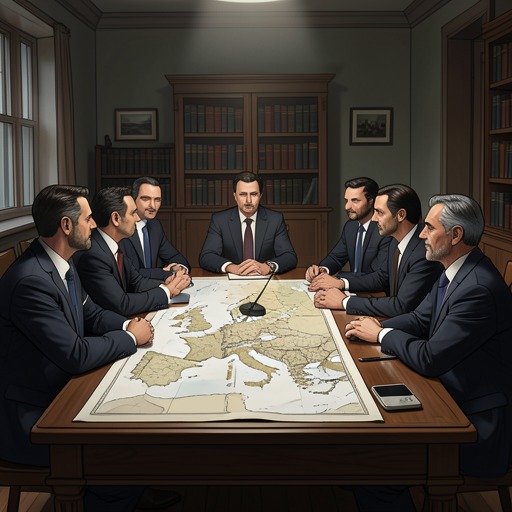
Lomeli therefore seeks the assembly’s authority before presenting what has happened. He invokes paragraphs five and six of the Apostolic Constitution, which permit certain matters to be discussed in special circumstances if a majority of the assembled cardinals agrees. As he waits for the cardinals to gather, he notices that they have returned to the language-based seating pattern of the first night: Italians by the kitchens, Spanish speakers in the centre, and English speakers near reception. At the hour of crisis, the old divisions reappear in the room’s physical arrangement.
When Tedesco tries to interrupt, Lomeli puts the question to a vote rather than allowing one faction to control whether the assembly hears the information. Scores raise their hands in favour; Tedesco, Krasinski, Tutino, and perhaps a dozen others oppose. Lomeli declares the motion carried and makes clear that anyone unwilling to hear him may leave. Nobody does. The episode offers no final reconciliation among the factions, but it shows how their conflict can be channelled through collective procedure. The Church’s unity remains contested; for the moment, it is maintained by a vote, a rule, and the willingness of the divided assembly to remain in the room.