Seagrave's Fatal Crash at Harlington
CrashSeagrave's Fatal Crash at Harlington is both a fatal road accident and a grotesque substitute performance. On the Harlington clearway, a collision kills Seagrave while he is dressed in Elizabeth Taylor's wig and costume, making the wreck appear to Robert Vaughan as the completion of a death ritual he had reserved for the actress and, ultimately, for himself. The event changes the meaning of the surrounding crashes: accident, spectacle, sexual fantasy, celebrity image, and self-destruction become inseparable.
Causes and Anticipation
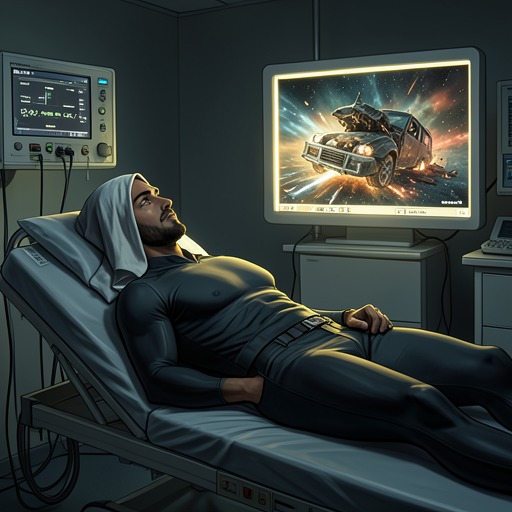
The crash occurs after Vaughan has become increasingly disordered in his fixation on the crashed car and on the “sex-death” he had devised for Elizabeth Taylor. During the final days with Vaughan, the narrator observes that Vaughan's frustration grows when the actress's hoped-for death fails to occur. They sit for hours in a deserted parking lot behind the narrator's apartment house in Drayton Park, listening to police and ambulance broadcasts while Vaughan worries at an ashtray crowded with reefer stubs and an old sanitary tampon. The narrator already regards Vaughan's death as an approaching reality, and identifies the Harlington collision as the crash most feared after that anticipated death.
The first radio reports mention multiple injuries to Elizabeth Taylor, then withdraw them. That brief, garbled report convinces the narrator that the anticipated death ordeal is beginning. Vaughan drives west in the Lincoln toward the site, steadily raising the volume of the police broadcast as though he wants the final confirmation at its highest possible intensity. The journey therefore carries an expectation of celebrity death, but the result is a reversal: the actress survives, while another body enters the role designed for her.
Course of the Collision
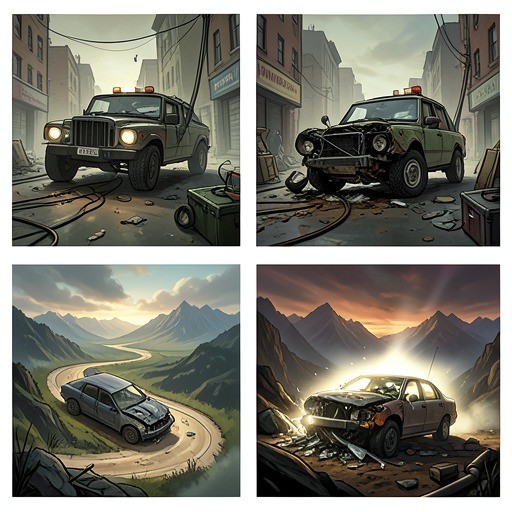
The narrator and Vaughan reach Harlington half an hour after the report and park on the grass verge beneath the overpass. Three cars have collided at the centre of a high-speed intersection. A customized fibreglass sports car and a silver Mercedes coupe meet in a right-angle impact, ripping away their nearside wheels and crushing their engine compartments. The sports car is then struck from behind by a chauffeur-driven government saloon. Its young woman driver, wearing a green uniform, is shaken but uninjured and is helped from the saloon, whose bonnet has buried itself in the sports car's rear. Fragments of fibreglass lie around the crushed vehicle like abandoned design exercises.
Seagrave is dead in the cockpit of the sports car. Firemen and a police constable work to free him from the buckled overhang of the instrument panel. He is wearing a leopard-skin coat that belongs to Elizabeth Taylor's costume; the coat has been torn back, exposing his crushed chest. His white platinum hair remains neatly held by a nylon hair-net, while a black wig lies on the adjacent seat. Shattered safety glass covers his exhausted face, turning his body into a glittering, almost mineral object. The details make the death look less like an accidental interruption than the completed image of a staged collision.
Only a few feet away, the woman in the silver Mercedes lies sideways beneath the broken windshield. Spectators press around the vehicles and nearly topple the ambulance attendants trying to remove her. She is a former television presenter, still appearing occasionally on panel games and late-night talk shows, but the familiar public face has been drained into the pallor of an old woman. Dried blood hangs from her chin like a dark bib, and the crowd respectfully studies the injuries to her thighs and lower abdomen as she is carried to the ambulance.
Vaughan's Reaction and the Reversal of the Fantasy
Vaughan pushes through the spectators and takes hold of an ambulance handle already held by an attendant, sweeping alongside the stretcher as the injured woman is loaded into the vehicle. His agitation is so extreme that the narrator fears he may try to force his penis into the woman's blood-filled mouth passage. The attendants initially mistake him for a relative, but a policeman who recognizes him strikes him in the chest and orders him away. Vaughan ignores the constable for a moment, then swerves into the crowd with his bearings lost.
He returns to the fibreglass sports car and grips its windshield pillar while looking down at Seagrave's body. The narrator follows him around the Mercedes, where Vaughan examines the blood on the seat and instrument panel and traces in the air the trajectories of the internal impacts: Seagrave's collision with the Mercedes and the television personality's subsequent impact with her own car. Vaughan is not merely inspecting mechanical evidence. He is trying to read the accident as a sequence of bodily and symbolic contacts.
The narrator later understands that Seagrave's death itself is not what has most disturbed Vaughan. What shocks him is that Seagrave, still wearing Elizabeth Taylor's wig and costume, has pre-empted the real death Vaughan had reserved for the actress. In Vaughan's imagination, Elizabeth Taylor has therefore already died. The remaining task is only to supply the proper time and place for a death whose symbolic marriage to Vaughan has already been celebrated across the bloodied car. The collision shifts from failed prediction to accomplished substitution: Seagrave becomes the body through which Vaughan's fantasy has taken form.
Context of Accident Spectacle
The Harlington crash belongs to the wider pattern through which Vaughan and the narrator pursue collisions along the express highways around the airport. They listen to police broadcasts, travel from one accident to the next, and watch rescue workers cut victims from wrecked vehicles. At earlier scenes, Vaughan fights ambulance attendants for access to his cameras, while the narrator experiences the formal gestures of rescue as part of a stylized theatre of violence. At the Road Research Laboratory, the engineers' simulated crash produces a comparable spectacle: a motorcycle strikes a saloon car, mannequins are smashed, and sections of the cyclist's body are gathered as if they were fragments of a corpse. The real Harlington event consequently repeats a technological ritual already rehearsed by machines and mannequins.
The spectators also convert the collision into a collective performance. At another Western Avenue crash, children are lifted onto their parents' shoulders, and the crowd studies the displacement of radiator grilles, the distortion of body frames, and the frosting patterns on shattered windshields with calm, almost expert attention. In the sexual fantasies attached to the wreck, the broken compartment becomes a grotesque altar where violence and desire generate imagined futures. Harlington intensifies this pattern by adding a public celebrity, a costume, and a dead stunt performer whose body occupies the place of the anticipated star.
Consequences and Narrative Significance
After the collision, Vaughan tells the narrator to drive him to Ashford Hospital, where Seagrave will be taken once the firemen have cut him free. The instruction marks the immediate practical consequence of the crash, but its deeper consequence is psychological. Vaughan's fantasy has ceased to be an imagined scenario and has acquired a corpse, a location, and a precise material arrangement of costume, glass, blood, and crushed metal. The accident supplies the formal proof that his desired death can be realized through automotive technology.
The event also foreshadows Vaughan's final crash. Later, the narrator and Catherine reach the accident site below the flyover and find a vast crowd gathered because Elizabeth Taylor has narrowly escaped death. The narrator sees his own car beside the crushed coach, while Vaughan's earlier attempt to launch himself from the flyover at maximum speed becomes part of the same landscape of anticipated destruction. The spectators focus less on the human victims than on the deformed vehicles, and the actress stands apart as a living figure shielding herself from the death image she has narrowly avoided. Seagrave's death has made that image strangely present even though its intended subject survives.
The crash therefore produces a value reversal at every level. Vaughan expects the actress's death and receives Seagrave's; he seeks a spectacle that will confirm his private design and instead encounters the design's fatal reproduction in another man's body; he imagines himself as the author of the collision but discovers that the event has already consumed the role he meant to play. In the novel's car-bound world, the wreck is simultaneously an industrial test, a public gathering, a sexualized tableau, and a secular rite of death. Seagrave's Fatal Crash at Harlington is decisive because it converts fantasy into precedent: after Seagrave has died as Elizabeth Taylor's double, Vaughan's own final collision appears less like an isolated act than the inevitable next performance in the same ceremony.