Vaughan's Final Crash
CrashVaughan's Final Crash is the decisive terminal event in Robert Vaughan's campaign to turn automobile accidents into rehearsals for death, erotic ceremonies, and acts of authorship. Pursuing Elizabeth Taylor and driving the narrator's stolen car at maximum speed, Vaughan attempts to launch himself from the London Airport flyover into the limousine carrying the film actress. The car jumps the rails, falls through the roof of an airline coach filled with passengers, and kills Vaughan; the actress survives, while the wreck becomes an immense public stage on which private fantasy, mass spectatorship, and mechanical violence converge.
Causes and Preparation
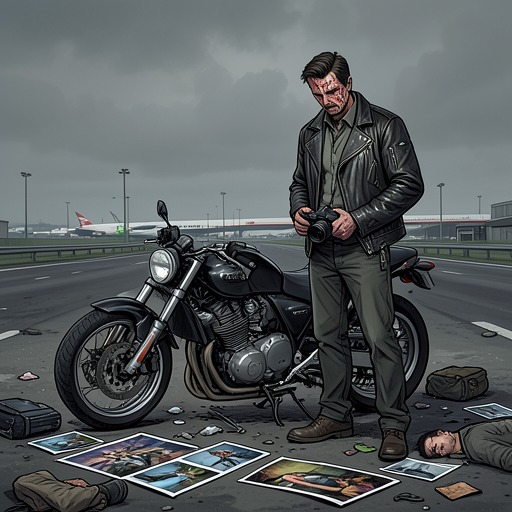
Vaughan's death is presented as the culmination of a project rather than an unforeseen mishap. During his friendship with James Ballard, he repeatedly rehearsed his own death in crashes, although the final collision is described as his only genuine accident. In the last weeks of his life, he thinks of little besides Elizabeth Taylor's death, imagining it as a coronation of wounds that he has meticulously staged. His apartment near Shepperton Studios is covered with photographs taken through a zoom lens as she leaves her London hotel, crosses pedestrian bridges above westbound motorways, and moves through the multi-storey car park at the studios.
The photographs reduce the actress's body to magnified fragments: knees, hands, the inner surfaces of her thighs, and the left apex of her mouth. James Ballard reproduces packages of these prints on the copying machine in his office and hands them to Vaughan with the uneasy sense that they are instalments of a death warrant. Vaughan then compares the photographed details of Elizabeth Taylor's body with grotesque wounds in a textbook of plastic surgery. The projected crash therefore joins surveillance, anatomical study, and technical planning before any vehicle moves toward the flyover.
Vaughan's imagined collision is explicitly organized around repeated impacts and matched injuries. He pictures the chromium of the two cars dying as their collapsing bulkheads meet head-on in endlessly repeated slow motion; windshield glass frosts around the actress's face as she breaks through it; their thighs suffer compound fractures against the handbrake mountings; and the manufacturer's medallion becomes a weapon against her uterus. His own semen is imagined emptying over the luminous instruments that permanently register the engine's last temperature and fuel levels. The final crash is thus designed as a fusion of bodily damage, sexual climax, mechanical measurement, and death.
Course of the Crash
Ten days before the fatal collision, Vaughan steals James Ballard's car from the garage of Ballard's apartment house and drives it away like an ugly machine sprung from a trap. The theft gives Vaughan both the means and the symbolic vehicle for his last attempt. When Ballard later examines Vaughan's abandoned Lincoln, the car appears to have served as a temporary dwelling: its seats are covered with oil and grime, the rear contains the remains of a torn tartan blanket and a greasy pillow, and broken bottles and food cans litter the floor. Vaughan has also slashed the instrument panel, leaving dials and the upper lip of the binnacle battered, with torn plastic housings and chrome strips hanging over the light toggles.
At dawn, while James Ballard and Catherine Ballard are near the garage, Ballard's polished silver car suddenly roars up the ramp. It swerves around them and plunges through the sliding gravel into the street, its engine sounding like a cry of pain. The escape confirms that Vaughan is still using the stolen vehicle and that the final act is already in motion. The car is not merely transport: its damaged controls, violated interior, and subsequent flight make it an extension of Vaughan's body and of the violence he has been rehearsing.
Vaughan drives along the open deck of the London Airport flyover at maximum speed, aiming toward Elizabeth Taylor's limousine. The car jumps the rails and plunges through the roof of a bus filled with airline passengers. The impact crushes the coach and disfigures Vaughan's body so completely that the police first identify the corpse as James Ballard's. At the scene, the crushed bodies of package tourists lie across the vinyl seats, while Elizabeth Taylor stands apart beneath revolving ambulance lights, holding the arm of her chauffeur and touching a gloved hand to her throat.
The physical destruction makes Vaughan's imagined geometry literal. His broken legs and arms, together with the bloody geometry of his face and the blood-engorged groin over which Ballard looks for the last time, seem to parody the crash-injury photographs that covered his apartment walls. Vaughan had dreamed of dying at the moment of Elizabeth Taylor's orgasm, but the actress survives and the intended private consummation becomes an interrupted public disaster. The result is a value reversal: the death Vaughan sought as an erotic completion becomes his own annihilation, while the woman he intended to incorporate into the scene remains alive as its horrified witness.
Rescue, Investigation, and Responsibility
The crash is absorbed into a chain of institutional procedures. Police engineers and ambulance workers enter the wreckage, identify bodies, cut through vehicles, and manage the remains. The narrator's earlier rescue from a collision shows how such procedures are experienced inside the damaged car: firemen wrench doors from their hinges, an ambulance attendant cuts away his sleeve, and a hypodermic needle is inserted into his arm before he is taken toward the hospital in an uneasy euphoria. The rescue scene makes violence look ritualized, its gestures formalized into a coded repertory of hands, tools, injections, and bodily access.
The aftermath also separates legal classification from the event's evident intention. In the earlier collision involving James Ballard and Dr Hamilton's husband, the coroner returns a verdict of accidental death and the police bring no charges of manslaughter or negligent driving. Catherine is told that the car is a complete wreck and that the dead man is Dr Hamilton's husband; later, at the inquest, the official process again treats the fatality as accidental. Against this language stands the deliberate structure of Vaughan's final act: he steals the car, follows the film actress, and drives at maximum speed in an attempt to create the collision he has imagined for months.
Before the final crash, Vera Seagrave reports that Vaughan is following his film actress, that the police are pursuing him, and that an American serviceman has been killed on the Northolt overpass. She also says that she was with him in the car. These reports place the final event within a widening sequence of pursuit, rehearsal, and fatal impact rather than as an isolated outburst. The police response attempts to contain the consequences, but the event exceeds ordinary responsibility: Vaughan is both perpetrator and victim, while the coach passengers and the threatened actress are drawn into a spectacle they did not design.
Public Spectacle and Visual Culture
The crash becomes a scene of collective looking. At least five hundred people gather on the verges and parapets around the flyover after news spreads that Elizabeth Taylor narrowly escaped death. Spectators stand three deep along the descent ramp, while police cars and ambulances cluster beneath the high deck and the crushed roof of the airline coach rises above the crowd. The flyover forms a proscenium arch visible for miles above the surrounding traffic, turning the accident into a stage whose audience arrives from Northolt apartment blocks, Western Avenue supermarkets, side streets, pedestrian precincts, and the silent concourses of the airport.
The spectators' attention is directed less toward the human victims than toward the deformed vehicles at the centre of the scene. Their response recalls the detached interest of buyers inspecting a bloodstock sale: they study the displaced limousine grille, the distorted taxi frame, and the patterns of frosting on shattered windshields. The crash therefore produces a visual economy in which technical damage is made legible, admired, and consumed. Vaughan's own practice of photographing wrecks has become a mass social behavior, and the public completes the act of observation that his camera began.
The event also repeats and magnifies earlier crash imagery. A motorcycle striking a saloon car at the Road Research Laboratory Crash Test sends a mannequin rider across the roof, leaves a family of mannequins lurching inside a crushed cabin, and scatters fibreglass body parts over the glass like silver snow. At another scene, an airline coach rams a taxi at the terminal while police and rescuers move through the resulting traffic jam. In the final crash, those rehearsals, simulations, and witnessed accidents are gathered into one catastrophic tableau involving real bodies, real passengers, and a real celebrity whose survival becomes the focus of the crowd.
Consequences and Significance
Vaughan's death leaves James Ballard with the suspicion that Vaughan may have been a projection of his own fantasies and obsessions, and that Ballard somehow failed him. This uncertainty is intensified by the police's initial identification of Vaughan's corpse as Ballard's. The crash blurs the boundary between pursuer and pursued, observer and participant, and independent person and projected desire. Vaughan's body appears to have taken Ballard's place just as Vaughan has repeatedly occupied Ballard's cars, photographs, and imaginative field.
Catherine Ballard arrives at the apartment forecourt and paces around the rusting hulk of Vaughan's Lincoln. When James Ballard takes her arm, he becomes certain for a moment that she expected him to be Vaughan, returning after his own death to console her. The final crash thus rearranges the surviving relationships as well as the vehicles. Vaughan's absence leaves Catherine looking through Ballard rather than simply at him, while Ballard remains caught between grief, identification, guilt, and the possibility that the dead man embodied desires he could not acknowledge as his own.
The Lincoln rapidly disintegrates once Vaughan is gone. Autumn leaves settle over its roof and bonnet and fall through the broken windows; the car sinks on flat tyres, while loosened panels and fenders invite passers-by to attack it. A gang of youths smashes the windshield and kicks in the headlamps. The abandoned vehicle becomes a second aftermath of the crash, a mechanical corpse whose deterioration records the disappearance of its owner. By contrast, the final wreck at the flyover attracts ever larger crowds, so that Vaughan's death is simultaneously erased as a personal history and magnified as a public image.
The crash's deepest significance lies in its conversion of death into a technological and quasi-ceremonial spectacle. Vaughan approaches the collision as if composing a final rite, complete with wounds, witnesses, chosen objects, and a desired partner; the surrounding public supplies the congregation, the wrecked cars become altar-like forms, and the revolving lights frame the scene as a performance. Yet no redemption follows. The attempted union with Elizabeth Taylor fails, the intended orgasmic death is displaced onto Vaughan alone, and the survivors are left with damaged bodies, legal formulas, photographs, and the endless traffic flowing around the site. Vaughan's final crash therefore completes the novel's recurring pattern in which the car becomes at once weapon, erotic instrument, theatre, and tomb.