autogeddon
Crashautogeddon is the narrator's name for an imagined end of the world by automobile, a vision in which the highways around London Airport cease to be ordinary infrastructure and become the stage for a technologically organized apocalypse. It condenses the novel's transformation of traffic, collision, sexuality, spectatorship, and death into one recurrent image of collective catastrophe.
Definition and First Vision
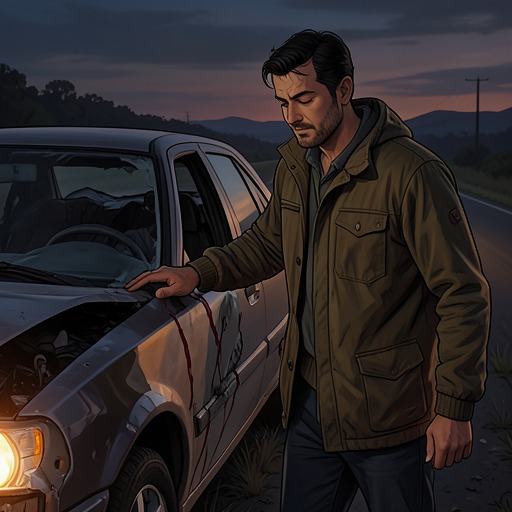
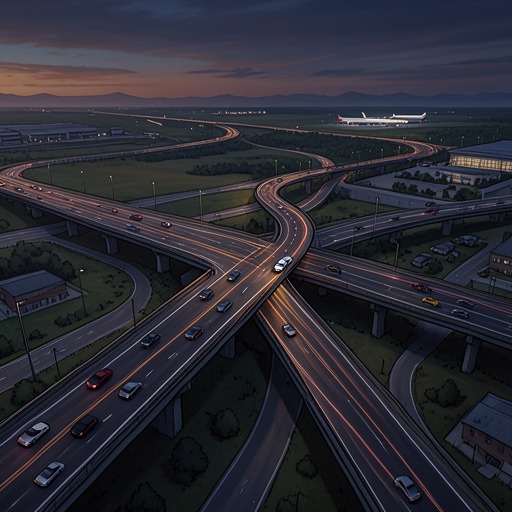
autogeddon first takes shape after the narrator's crash and convalescence. From the veranda of his apartment, he watches the traffic choking the suburban streets, the accidents on Western Avenue, the flyover, and the airliners lifting away from London Airport. The passengers appear to be fleeing a disaster area, while the surrounding traffic resembles the machinery of an approaching planetary emergency. A minor collision between a white laundry van and a saloon car carrying wedding guests becomes, in his interpretation, a rehearsal: once everyone has performed an individual part, the real event will begin.
The word therefore does not describe one recorded crash. It names a future catastrophe imagined as the cumulative result of innumerable ordinary movements. The narrator's own collision functions as a private rehearsal for this larger end of the world by automobile. His injuries become instruments of perception, tuning him to the traffic's latent signals and making the immense machine landscape appear to contain a destiny waiting to be released.
Traffic as Apocalyptic Landscape
The narrator's premonition is reinforced by the physical organization of the roads. The motorway embankments, raised parapets, access roads, and interchanges form a continuous artificial horizon around the landscape of his life, enclosing the vehicles below like the walls of a crater. In a rare moment when aircraft and traffic are both motionless, thousands of drivers appear trapped in a world that has stopped. The silence reverses the ordinary promise of mobility: the electric highway no longer carries people toward destinations but holds them inside a monumental technological enclosure.
This vision is repeatedly contrasted with the traffic's usual speed. At the hour of his accident, the narrator drives through Stanwell, around the eastern flank of London Airport, and toward the interchanges at Harlington, only to be swept into the tidal flow of Western Avenue or stalled a few feet from the exact impact point. Movement and paralysis become two forms of the same system. The highway can accelerate bodies toward catastrophe, yet it can also immobilize them in vast queues whose scale makes individual intention irrelevant.
When the narrator drives with Vaughan along the outer circular motorway, altered perception turns the road into an almost cosmic mechanism. Concrete walls rise like cliffs, lane markings writhe like white snakes, and vehicles seem stationary while the earth races beneath them. The narrator's arms, spine, and skull appear coupled to the transmission system, as though the human body has become part of the car's torque and propulsion. autogeddon is thus not merely a social disaster involving cars; it is the imagined completion of a fusion between bodies, machines, roads, and planetary motion.
Accidents as Rehearsal and Spectacle
The apocalypse is prepared through repeated scenes of collision. Vaughan and the narrator travel along the express highways north of the airport, listening to police broadcasts and moving from one accident to the next. They watch firemen and police engineers cut victims from wreckage, doctors attend dying drivers, and crowds gather beneath the arc-lights. Vaughan waits especially for head-on impacts with motorway pillars, where the crushed vehicle and the serene concrete structure form a single composition.
The accidents are public spectacles as much as emergencies. At the narrator's collision on Western Avenue, spectators gather in a silent circle, traffic jams spread along the flyover, and strangers peer through the windows at the trapped survivors. A woman carrying a tartan blanket looks into the wreck as though viewing a corpse in an open coffin. The narrator understands the scene as a grim technological theatre whose principal actors are the crushed cars, the dead man, the injured widow, and the drivers waiting with their headlamps blazing.
Later, a collision at the flyover gathers children, shoppers, motorists, and pedestrians around the damaged vehicles. The crowd studies the displaced radiator grille, distorted frame, and shattered windshield with the calm attention of informed buyers. The accident has become a shared visual language, and its spectators seem to understand the aesthetic and erotic implications of damaged metal and injured bodies. In this collective gaze, autogeddon is not imagined as sudden panic alone; it is a social ritual in which disaster produces a temporary community of viewers.
The Road Research Laboratory makes the same logic explicit through controlled simulation. A motorcycle carrying a mannequin strikes a saloon car containing a mannequin family; the vehicles are crushed, the cyclist's body is reduced to scattered sections, and fibreglass fragments speckle the glass like death confetti. The engineers reassure the crowd, while the impact can be replayed in slow motion. The simulated crash turns destruction into measurable knowledge and repeatable entertainment, revealing how technological society can rehearse catastrophe without ever exhausting its fascination.
Sexuality, Violence, and Secular Apocalypse
For Vaughan, automobile crashes and sexuality have formed a final marriage. He photographs sexual acts in abandoned cars and courts injured women while obsessing over facial injuries, genital wounds, and infectious lesions. His photographs join vulvas to instrument panels, elbows to chromium window-sills, and human bodies to radiator grilles. Through him, the narrator learns to experience collision as an erotic structure: the crash becomes a scene in which violence, technological form, and sexual possibility converge.
The narrator's own imagination follows this pattern. During rescue from the collision, he is dressed in another man's blood while the widow's urine forms rainbows around the rescuers' feet; the stylized gestures of firemen, ambulance attendants, surgeons, and victims become interchangeable with sexual gestures. An airline-coach collision at the airport interrupts a sexual encounter, and the flash of a camera illuminates the prostitute and the narrator against the machinery of the car. The surrounding accident does not cancel erotic reverie; it supplies its setting and intensifies its logic.
At the scene of the flyover crash, the narrator imagines the damaged vehicles as generating an infinite future of intercourse, violence, and reproduction. The injured bodies become contact points for possible sexual acts, while the motorway congestion turns the entire road system into a suspended field of desire. autogeddon therefore replaces traditional religious apocalypse with a technological-sexual consummation. Its imagined terminal congress joins spurting bodies and engine coolant, converting collective death into the ultimate expression of the marriage between violence and desire.
Vaughan's Private and Collective Catastrophe
Vaughan gives autogeddon its most concentrated form. He invents ideal automobile deaths for famous actors, politicians, business figures, and executives, following them with a camera from airport platforms, hotel balconies, and studio car-parks. His fantasies transform public figures into targets for carefully designed crashes, while his photographic practice turns anticipated death into an archive before it occurs.
After Vaughan's last attempt to kill Catherine, the narrator concludes that Vaughan has withdrawn into a private mental realm ruled by violence and technology. There, Vaughan drives forever at high speed along an empty motorway, passing deserted filling stations and waiting for one oncoming car. His ultimate fantasy is a simultaneous worldwide automobile disaster in which millions of vehicles are hurled together. This is the fullest definition of autogeddon: not an isolated accident, but a terminal convergence of traffic, bodies, engines, sexual organs, and coolant.
The narrator's relationship with Vaughan gives the apocalypse an intimate dimension. Vaughan's presence makes the narrator feel that he is waiting for a second accident, perhaps as a target vehicle in a psychological experiment. Yet Vaughan also appears to offer a key to the coming catastrophe through his photographs and his fusion of sexuality with automobile design. Their shared wounds become signs of a new community formed among the traffic-slain dead, the survivors, and the millions still imagined as future victims.
Narrative and Thematic Significance
autogeddon organizes the novel's movement from personal trauma toward a collective metaphysics of technology. The narrator repeatedly returns to the accident route, hires different cars, and imagines different deaths and injury patterns. Each repetition makes the original collision less an isolated event than a prototype whose meaning expands through recurrence. The roads around London Airport become a laboratory in which individual bodies are tested against the systems that carry them.
The expression also produces a deliberate estrangement of ordinary modern life. Traffic jams, airport concourses, emergency procedures, rental cars, crash tests, and roadside spectatorship are rendered as unfamiliar rituals. Familiar mobility appears as confinement; rescue resembles choreography; engineering becomes a theatre of mutilation; and the motorway becomes both an artificial horizon and a route toward imagined paradise. By naming this transformed landscape autogeddon, the narrator gives a single apocalyptic term to the system's underlying unity.
The concept's final force lies in its refusal to separate catastrophe from fascination. The narrator can fear the coming disaster while feeling calm at its centre; he can read wounds as signals and crushed cars as invitations; he can regard the technological landscape as both a threat and a source of erotic knowledge. autogeddon is consequently not only the destruction of the automobile world. It is the moment when that world's hidden desires become visible, when the traffic system reveals itself as a machine for organizing movement, spectatorship, injury, and death.