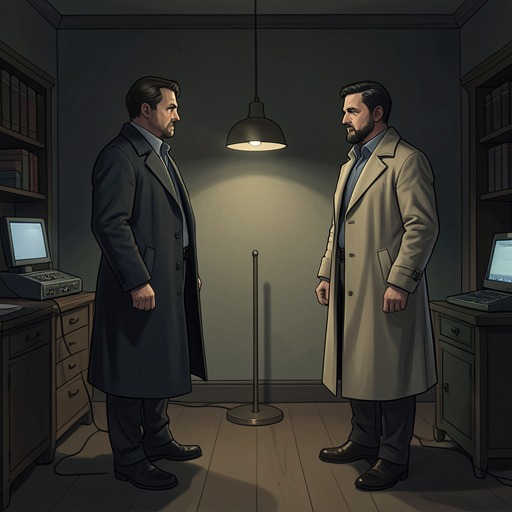
Poirot's rule: sit back and think
CurtainPoirot's rule: sit back and think is Hercule Poirot’s guiding principle for investigation: when his limbs are no longer active, he relies on an unimpaired brain, careful reasoning, and Arthur Hastings’s practical assistance. The rule is more than a response to physical limitation. It directs Hastings away from guessing at a culprit and toward identifying the structure of a crime, while the novel’s reversals show how apparently decisive observations can still be misunderstood or arranged to deceive.
The Principle and Its Division of Labor
Poirot explains that he invited Hastings to join him because, although his limbs are no longer active, his brain remains unimpaired. His established rule is to sit back and think; he says that this is the work he can still do, and indeed the only work possible to him. Hastings will undertake the more active side of the campaign. Their renewed partnership is thus organized around complementary capacities: Poirot supplies analysis, while Hastings can move about and gather information.
That division is practical rather than absolute. Poirot tells Hastings that he can follow people, speak with them, observe them unnoticed, and listen to conversations. He even suggests looking through keyholes, which Hastings hotly refuses. The exchange gives the principle a comic edge, but also makes its method concrete: thinking depends on information gathered in the world, even when Poirot himself cannot pursue every lead physically.
From Guessing at a Name to Reading a Method
When Hastings admits that he cannot identify X, Poirot redirects the problem. Hastings has read the earlier cases and may not know X’s identity, but he does know X’s technique. Poirot criticizes his tendency to play games and guess instead of working through the evidence, then defines the essential pattern: a completed crime has a motive, an opportunity, a means, and a guilty person already made to appear ready for the dock. Hastings recognizes that he should look for a potential victim who fits those requirements.
The distinction is central to Poirot’s rule. Instead of beginning with a name and bending clues around it, the investigator should identify the arrangement that makes a crime possible and ask who stands to occupy each role. Poirot’s method therefore treats motive, opportunity, means, and apparent guilt as connected elements to be examined together. It also warns that a plausible suspect may be part of the crime’s design rather than its solution.
Observation, Memory, and Misleading Evidence
The investigation repeatedly tests the gap between seeing something and understanding what was seen. Hastings recalls a day on a grassy knoll when Stephen Norton raised his bird-watching telescope to observe a speckled woodpecker, then became distressed and tried to prevent Hastings from looking through it. Hastings had assumed Norton had seen Judith Hastings and Major Allerton together because Hastings himself was preoccupied with them. When he revisits the memory, he recognizes that this assumption may have been wrong. The remembered scene becomes useful only when he separates Norton’s act of observation from his own interpretation of it.
The same problem appears at the inquest into Barbara Franklin’s death. Poirot testifies that on the morning of June 10 he was sitting outside the laboratory door and saw Barbara come out carrying a small bottle; she looked startled to see him. The coroner’s summing-up places that testimony beside the medical finding that she died from physostigmine sulphate poisoning and evidence of her melancholy and poor nervous condition. The jury is asked to decide whether the poison was taken accidentally, intentionally, or administered by someone else. Poirot’s account helps support the possibility of suicide, and the coroner notes that the bottle was not found, while allowing the possibility that it had been washed and put away. Here, testimony and medical evidence shape a formal verdict, but the circumstances still admit competing explanations.
The Rule Turned Back on the Detective
After Stephen Norton’s death, Hastings reports that it is being called suicide: the door was locked, the windows shuttered, the key in Norton’s pocket, and Hastings himself saw Norton enter and heard the door lock. The scene appears to satisfy the ordinary logic of a sealed room. Poirot’s later account makes that logic inadequate by directing attention to the keys: Poirot arrived before Norton, changed rooms after arriving, and had a duplicate key after the key to his own room disappeared. The apparent lock is therefore not conclusive proof that no one else could have entered or left.
Poirot identifies himself as Norton’s killer and explains how the mistaken identification of the man in the passage helped preserve the appearance that Norton had entered his room. Hastings had been asked whether he was sure the figure was Norton; Poirot had also drawn attention to differences in height, while concealing his own ability to walk and his disguise. The evidence included medical opinions that he was not incapable of walking, Georges’s evidence that he wore a wig, and the difference between his limp and Norton’s. The facts that had seemed separate become a pattern once Hastings applies the same rule of patient inference.
Poirot also admits that the shot itself was his weakness: he shot Norton in the exact centre of the forehead rather than through the temple. That choice, in its symmetry, should have alerted Hastings to the truth. The revelation sharpens the rule’s final irony. Careful thought can expose a fabricated appearance, but the detective who teaches the method has used disguise, keys, and staged evidence to make a locked-room death look like suicide. The rule remains a discipline of inquiry, not a guarantee that appearances—or the investigator—are innocent.