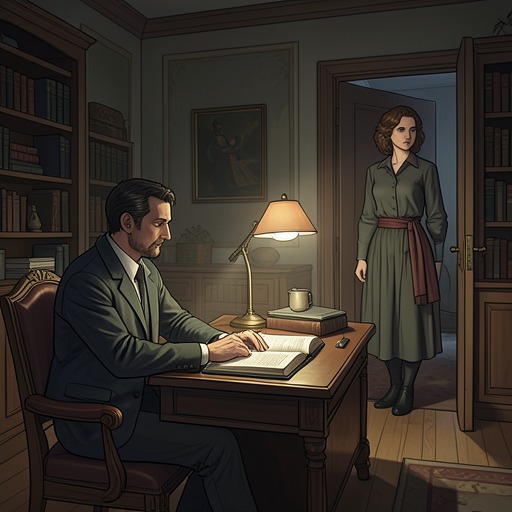
Argument after the wife discovers the notebook
DeceptionThe argument after the wife discovers the notebook turns a private writing practice into a crisis of trust. Philip Roth insists that the notebook mixes recollection with invention and that its imagined affair is part of his work; his wife reads the intimate conversations as proof of an actual woman and of his retreat from their marriage. Their struggle is not only over what happened, but over who has the authority to say what the notebook means.
Discovery and confrontation
The quarrel begins amid a marriage already strained by silence and withdrawal. The wife says that Philip comes home from his studio to dinners where she does not speak, does not respond, and looks unwell; she admits that she cannot sleep. When he asks what is upsetting her, she reveals that she found his notebook after he left it outside his briefcase. She had picked it up and read it, despite knowing she might regret opening it.
What she found did not look to her like ordinary working notes. She insists that the pages contain conversations with a woman, not just fragments for a novel, and points to the apparent knowledge and intimacy in them as evidence that the woman is real. She connects the notebook to Philip’s distraction and his months of diminished interest in her. His account that the woman is imaginary cannot settle the matter: to his wife, the written voice sounds too particular, and the attention he gives it too absorbing, to be dismissed as invention.
Her discovery also changes the status of the notebook itself. Carried between Philip’s home and studio, it had been a working object he could leave among his papers; once read, it becomes something like testimony. The wife has not merely encountered a fictional character. She has encountered Philip’s private record of speaking with that character, and the distinction between a record of actual conversation and a scene made for a novel becomes the heart of their dispute.
What the notebook contains
Philip acknowledges that the notebook preserves some real exchanges and adds material that was never spoken. He says he recorded part of a conversation with Rosalie Nichols in the hospital, where her circumstances were painful and she was bearing them bravely, then invented more around the remembered exchange. He can no longer tell exactly where accurate reporting ends and imaginative reconstruction begins. The notebook, by his account, is neither a transparent transcript nor a wholly invented story; real speech prompts an imagined continuation.
He likewise rejects the wife’s reading of the fictional entanglement with Olina. He says that he and Ivan did have lunch after Olina left and that Ivan told him what had happened, but denies that he slept with Olina or that Ivan accused him of doing so. The betrayal appears in the notebook because Philip has written himself into a more compromising position than the events, as he recounts them, warrant. For him, making himself implicated intensifies the fictional charge; for his wife, the same invention looks like concealment disguised as art.
The imagined English woman also has sources without being, in Philip’s account, a single real visitor to his studio. He says that he had lived in England and paid attention to life there, and had learned from Rosalie Nichols; the invented woman serves as a repository for that knowledge. He further suggests that the English woman’s imagined England and marriage draw on the earlier affair with Rosalie Nichols, before he met his wife. The notebook’s intimacy thus comes partly from experience, but experience has been redistributed across a constructed character and conversations Philip says he made up.
Writing as defense and accusation
Philip argues that imagining an affair is not equivalent to conducting one. He distinguishes the woman sketched through notebook conversations from the major character caught in the plot of his novel, even as he admits that he imagined himself outside the novel having an affair with a character inside it. He defends following such an imaginative impulse rather than censoring himself to satisfy what he calls prurient judgment. The defense is also an admission of how far the fantasy reaches: it is not merely a scene in the novel, but an imagined life that crosses the boundary between writer and character.
He describes the notebook as a performance of himself, a kind of impersonation or ventriloquism, and presents its falsifications as compatible with a real self beneath them. He also concedes that writing intimate conversations while his wife sleeps nearby may constitute a kind of perverse betrayal. He imagines other women as well as the English woman and understands the practice, in part, as mourning for the life he had before marriage. His work is his mitigating circumstance, but it does not erase the private cost of making a life with his wife the setting for an imaginative escape from it.
The wife answers that the question of literal existence does not remove the injury. Whether or not the woman is real, she says, the love and the desire for her to exist are real to Philip; she takes the notebook as an attempt to escape their marriage. Philip replies that the wish to escape can be an ingredient of marriage itself and says he wrote to trace the logic, or illogic, of that impulse, not to wound her. Their disagreement is therefore not resolved by establishing whether an affair occurred. It turns on whether imaginative desire can be separated from emotional betrayal when it is sustained in writing.
The argument’s wider significance
The scene makes the writer’s claim to transform lived experience inseparable from the people whose speech and circumstances supply his material. Earlier, Ivan had accused Philip of preferring other people’s stories to lived engagement, of being captivated by women struggling to tell their own lives and then distorting those lives into plots. Philip asks Ivan to explain what he does wrong as a novelist, even while rejecting the accusation that he betrayed him with Olina. The notebook dispute brings that criticism into the marriage: the wife, too, has to confront herself as a possible source or audience for a narrative whose boundaries she cannot verify.
The wife’s reading also exposes the limits of Philip’s control over interpretation. He can describe the notebook as a game, an impersonation, a mixture of invention and remembered speech, but he cannot make those explanations cancel the injury she sees in it. Conversely, her conviction that the notebook records a real lover does not make every scene factual. The argument leaves both the contents and their meaning unsettled, staging the conflict between a writer’s freedom to invent and another person’s claim not to be turned into material without consequence.
A later conversation with Rosalie Nichols sharpens that tension. Philip tells her that he could not have written about the woman in the novel as he did without her, and recalls both the actual time they shared and the imaginary life he had with her while writing. That retrospective admission does not prove the wife’s suspicions about the notebook’s other woman. It does, however, confirm the deeper intimacy between experience and invention that the quarrel cannot comfortably contain: Philip’s imaginative life may be made on the page, but it is fed by relationships that remain real outside it.