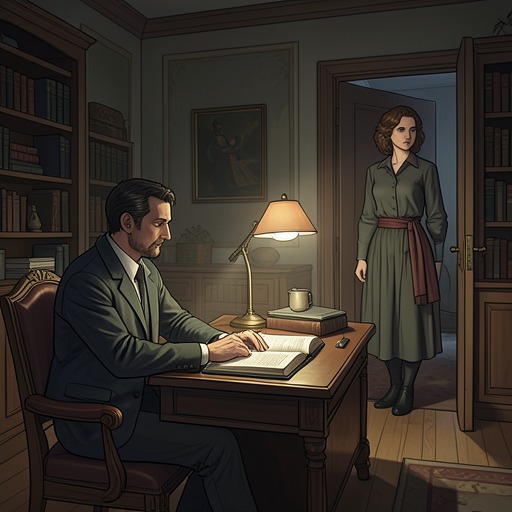
Nathan turns the affair into a published novel
DeceptionNathan turns the affair into a published novel, making a concealed relationship the material of a book and turning its aftermath into an argument about privacy, representation, and the writer’s claim to invention. The former lover recognizes herself in the published work; Nathan, meanwhile, describes the relationship as something that continued in his imagination when they were apart. The novel therefore does more than preserve an episode: it recasts their shared experience, with consequences neither secrecy nor publication can contain.
From private relationship to published book
The book enters the former lovers’ renewed conversation as an event that has already happened but whose effects are still unfolding. She tells Nathan that, since reading it, she has been unsure whether to call him and has thought repeatedly about doing so. He responds by saying he had also considered the book’s effect on his marriage. Their exchange makes publication a point of contact between them, but not a simple reconciliation: the book has prompted the call while bringing the consequences of their former intimacy back into view.
Her sense of recognition is not based only on her own reading. She recalls that two people told her they had heard her in the book. That response gives the novel a social reach beyond the private understanding of its author and subject. What Nathan made from the relationship can be recognized by others, and that recognition becomes part of the former lover’s experience of having been represented. The conversation does not establish that every detail is factual; it does establish that the character’s connection to her was apparent enough for other people to remark on it.
Experience transformed into character
The former lover is astonished by the character’s passivity and says she had not known herself in that way. Her reaction marks a distinction between being recognizable and being accurately rendered: she can hear herself in the book and still object to the shape Nathan has given the character. The novel’s representation is therefore neither a transparent record nor an identity she simply accepts. It is an account made by someone else, from material that includes their relationship but reorganizes it into a fictional role.
Nathan describes his creative method through an example involving Ivan and Olina. When Olina left Ivan, Nathan says, he and Ivan had lunch and Ivan told him what had happened; Nathan denies having betrayed Ivan with Olina or having been accused of doing so in life. Yet in his notebook he portrayed himself as implicated. He explains that merely placing a character near an event does not produce the effect he wants: making himself compromised makes the indictment more forceful. In the argument with his former lover, he treats the notebook’s invented implication as evidence of a deliberate artistic method, not a confession of an act that occurred.
That example clarifies the tension between the book’s recognizability and its invention. Nathan says he intensifies the material by including a compromising version of himself, while the former lover attends to what the resulting character implies about her and their shared past. The fictional alteration does not erase the relationship’s presence in the work; instead, it makes the boundary between experience and invention a central subject of their disagreement.
The notebook and the discovery of private writing
The published novel is not the only writing at issue. The former lover says she found Nathan’s notebook after he left it outside his briefcase, picked it up, and opened it despite knowing she should not. She regrets having read it. The distinction she insists on—between the novel and the notebook—matters because she is objecting not just to a finished public representation but to encountering private writing that she believes she was not meant to see. The notebook’s accidental exposure becomes another breach in the secrecy that had governed their relationship.
Nathan’s account of his notebook also complicates the idea that the fiction merely records events. In the passage about Ivan and Olina, he says he inserted himself into a betrayal that he denies committing, because self-implication makes the material more charged. The notebook thus reveals a process of reshaping: Nathan turns proximity into participation when that alteration serves the writing. For the former lover, however, the distinction between what happened and what the writer invents does not settle the ethical question of using another person’s life as material.
Secrecy, marriage, and the cost of publication
The former lover contrasts Nathan’s choice to publish with the secrecy he had demanded during their relationship. She recalls that their time together was distorted by efforts to keep it hidden for the sake of his wife. In her view, the book reverses the terms of that arrangement: the affair was concealed while it was being lived, yet later became recognizable in fiction. She is angry because the secrecy imposed on their shared life now seems, from her perspective, to have failed to prevent its appearance in a novel.
Nathan rejects her description of his secrecy as paranoia. He says it was meant to protect his wife from something she could not be expected to welcome, and adds that his wife believes the source of the novel’s character was Nathan’s former lover Rosalie Nichols. That explanation identifies the person Nathan says his wife suspects, but it does not resolve the former lover’s objection. Her concern is not only who his wife believes the character represents; it is why Nathan sought concealment in the relationship and then wrote a book that could be read as based on a real person.
The former lover imagines that, if she were in Nathan’s wife’s position, she would recognize that he had been emotionally absorbed by someone else for a long time. She sees this as a reversal of what he had said and as making the restrictions placed on their time together seem pointless. Her account presents publication as a retrospective change in the meaning of secrecy: what once limited the relationship did not, in her view, prevent its emotional significance from entering the book.
Authorship, intimacy, and ethical disagreement
Nathan answers the question of why he wrote the book by describing writing as his work. He also says that the former lover was essential to the portrayal: he could not have written about the character in that way without her. He acknowledges that he did not know, or may not have known, the full extent of her importance until he wrote. The relationship was constrained by necessary limits, he says, but it also involved good times; beyond their hours together, he had an imagined life with her while writing. His account makes composition a continuation of intimacy in another form, one that persisted when she was absent.
The former lover’s response to this claim is not simply that the book is recognizable. She objects to writing down exactly what people said and to taking people’s lives and putting them into fiction, especially when a famous author resents critics for saying that he does not make things up. Her objection exposes the ethical paradox at the center of Nathan’s defense: the work depends on a real person’s importance to him, while its status as fiction permits him to alter events and identities. Nathan’s self-implication in the Ivan and Olina episode demonstrates that he regards alteration as part of his craft; the former lover’s challenge insists that invention does not remove the question of whose experience has been used.
The published novel thus leaves the two former lovers with competing accounts of what writing did to their relationship. For Nathan, the imaginative life of the affair became inseparable from the work and its transformations. For her, the novel makes the old demand for secrecy newly painful, because private experience has become publicly legible without her consent to the form it takes. Their dispute does not settle whether the book is a faithful portrait. It shows instead how the act of turning intimacy into fiction can both preserve its force and alter who controls its meaning.