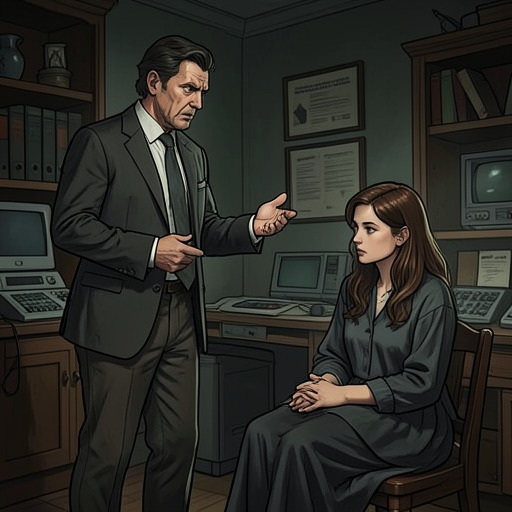
Every woman a fuck, every fuck a Scheherazade
DeceptionThe expression condenses a dispute about how a writer regards women and converts their experience into narrative. It joins sexual interest to storytelling, while its comparison with Scheherazade points to women whose stories seem compelled to continue. In the surrounding argument, that equation is not offered as a neutral description: it is an indictment of the writer’s habits of attention and of the power he exercises over other people’s stories.
The Formula and Its Logic
The speaker accuses the writer of entering life chiefly to keep conversation going, and of being driven less by erotic desire than by a boyish curiosity. The accusation sharpens when the subject turns to women: the writer is said to favor those who live intensely through their experience and are struggling to recover from trauma, with Olina, newly arrived from Prague, given as an example. Their difficulty in gaining access to their own stories is presented as part of what fascinates him. The formula names the troubling transformation at issue: women’s experience becomes both an object of sexual interest and a narrative to be elicited, shaped, and continued.
That transformation contains a tension. The women are described as unable to tell their tales easily, yet their struggle to find a way into them supplies the writer with compelling material. The comparison to Scheherazade therefore suggests more than a taste for stories; it exposes a relation in which another person’s incomplete or painful account can sustain the writer’s attention. The charge belongs to the speaker’s critique, not to an independent account of the women’s inner lives.
Criticism and the Writer’s Response
The writer’s brief reply, that his books must stink too, turns the accusation toward his work. He then asks what he does wrong as a writer and invites the speaker to criticize him directly, emphasizing that he respects the speaker’s taste and has learned from their conversations. The exchange makes the formula part of an argument about literary judgment: the question is not merely what subjects the writer chooses, but what his interest in them reveals about his way of writing and relating to people.
The Notebook and Self-Implication
The dispute becomes concrete when the speaker clarifies that the object found was not the novel but the writer’s notebook. The notebook had been left outside his briefcase; the finder says they opened it despite expecting it to be upsetting, and regretted doing so. The distinction matters because the notebook exposes a private account of events rather than a finished fictional work, intensifying the conflict between the writer’s private recording and the other person’s claim to be represented fairly.
The writer answers with the history of Ivan and Olina. When Olina left Ivan for another man, the writer says, he and Ivan had lunch, and Ivan told him what had happened without accusing him of betraying Ivan with his wife. The writer insists that no such betrayal occurred and that he was never accused of it outside the notebook. He explains that he represented himself as implicated because mere presence would not sufficiently compromise a character; implicating himself, he says, made the indictment more forceful. The notebook’s version thus blurs the boundary between reported events and invented self-involvement, making the writer’s own conduct part of the material under dispute.
Lived Relationship and Imaginative Afterlife
Later, the writer tells the woman addressed that her influence made it possible for him to write about another woman in that way. He recalls that their time together was enjoyable even in a terrible room, but stresses that the relationship continued in his imagination when she was absent: he had a life with her while writing. This admission gives the expression a personal dimension. The writer’s literary use of women is not confined to observed or recounted experience; it also draws on an imagined life built around an intimate relationship.
The expression consequently holds together the attraction and the ethical danger of narrative attention. The writer may find compelling the effort to give experience a story, but the accusation asks who controls that story once it becomes literary material. His account of self-implication acknowledges that fiction can alter the writer’s place in events; his later admission acknowledges that an intimate relationship can persist as imaginative material beyond the moments actually shared. Neither admission resolves the conflict over whose experience the resulting narrative serves.