The Lovers Dreaming About Running Away Together Questionnaire
DeceptionThe Lovers Dreaming About Running Away Together Questionnaire is a jointly improvised name for a conversational exercise that makes intimacy look at once playful and procedural. Its decisive turn comes when the questions move from teasing titles to whether marriage can still be mistaken for a love affair, drawing an account of a husband’s girlfriend and making the questionnaire a frame for disclosures about desire, deception, and storytelling.
Naming the Questionnaire
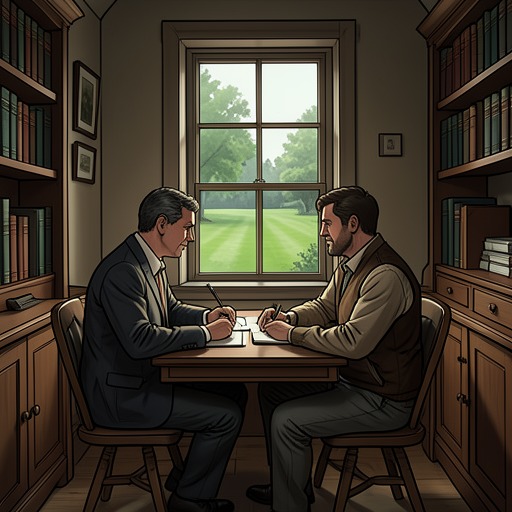
The exchange begins with one participant offering to write down the questions and inviting the other to begin. They then try out increasingly elaborate versions of the title: the first leaves out the lovers, the next inserts them and breaks the phrase into hyphenated parts, and the last adds the designation Middle-Aged. The naming is collaborative rather than settled in advance, so the questionnaire’s title becomes part of the conversation it is meant to organize.
The added age label prompts an immediate correction: one participant says the other is not middle-aged, and the reply insists on being so. The brief disagreement turns the title into a teasing negotiation over how the speakers see themselves. Its fantasy of running away together is thus qualified from the outset by self-consciousness about age and by the practical, almost administrative form of a questionnaire.
Marriage as the Final Question
The questionnaire’s stated last question asks whether the person being questioned still harbors, in any corner of the heart, the illusion that marriage is a love affair. It presents that belief not as a romantic ideal but as a possible cause of trouble. The wording brings an abstract question about marriage directly into the pressures of an actual relationship.
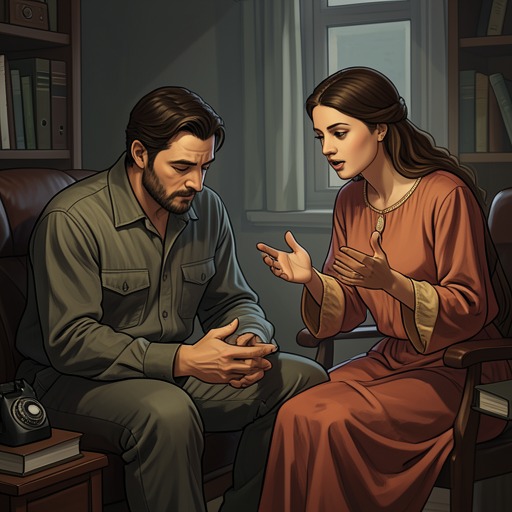
The answer turns to the Unnamed English woman’s account of a present given to her husband by his girlfriend. She describes the girlfriend as pretentious, jealous, ambitious, and drawn to high drama. The gift is a record of a well-known, beautiful piece by Schubert; she cannot recall its title, but says its liner notes make much of a great passion, a tall and thin woman described as the most interesting woman of the century, and separation by cruel fate. To her, the accompanying romantic language makes the present transparently pretentious.
The husband’s openness is central to her telling: he has admitted that his girlfriend gave him the record, when, she says, he could simply have claimed to have bought it himself. The exchange therefore places candor and concealment side by side. The questionnaire asks whether marriage is still being imagined as a love affair, while the answer examines how a third person’s theatrical gift and a husband’s disclosure unsettle that image. The conversation ends before the account’s final thought is completed, leaving the question’s emotional consequences unresolved.
Questions, Secrecy, and Disclosure
Elsewhere in the dialogue, questions expose the everyday work required to keep an affair hidden. Asked why she had said she needed to go home before her husband grew curious, the Unnamed English woman explains that lying irritates her: she wants to preserve some sense of truth without being caught and resents having to construct a hundred small red herrings. This admission gives the questionnaire’s question-and-answer form a sharper edge. Questions may invite candor, but the answers also reveal how much concealment the speakers’ circumstances demand.
The contrast is not simply between truth and lies. In the account of the record, the husband’s openness provides information that secrecy might have concealed, yet the disclosure itself intensifies the woman’s interpretation of the gift. In the account of the affair, by contrast, she describes trying to protect a limited sense of truth through deliberate evasions. Across these exchanges, intimate questioning makes truth a problem of what can be said, what must be hidden, and what another person’s words are taken to mean.
From Conversation to Fiction
The questionnaire’s staged intimacy also resonates with later disputes over how conversation becomes literature. In one exchange, a speaker asks a writer what he does wrong as a writer, only for the reply to accuse him of distorting women by forcing them into an artificial plot. The disagreement is about more than literary technique: it tests whether giving a woman a voice is enough if the writer still controls the shape and meaning of her story.
A later challenge asks how the writer knows so much about English life that an English woman who does not exist can tell him such intimate things in his studio. The answer credits living in England, paying attention, and learning something from Rosalie Nichols; it also describes the invented woman as a repository for that knowledge. In this context, the questionnaire’s intimate format carries a double possibility: it can make disclosure feel immediate, but the later argument asks whether such speech belongs to a person’s lived experience or has been arranged by a writer. The title’s promise of a lovers’ escape thus sits within a broader dialogue about the difference between intimacy as conversation and intimacy as a narrative construction.