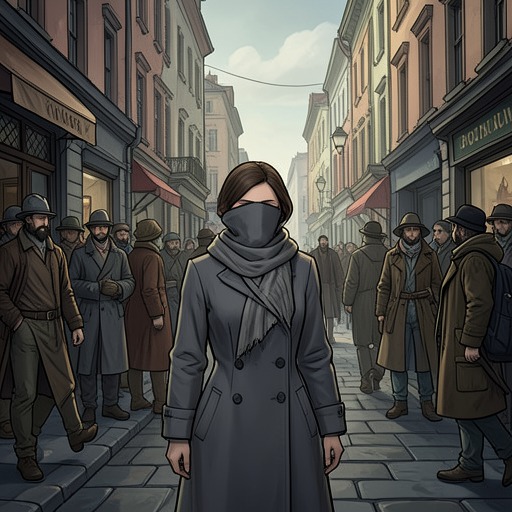
Poland
DeceptionPoland is presented through personal testimony rather than extended description of the country itself. A Polish woman explains how national identity shaped her interest in politics, recalls her father’s losses under Communist rule, and describes the religious and political divisions that affected her sense of belonging. Through these connected memories, Poland becomes a lived context of pressure and contested affiliation, not merely a national label.
Political identity and the underground
Asked whether her political interest comes from being Polish or from politics itself, the woman says it comes mostly from being Polish and from desperation about her community’s situation. She sees involvement as a way of trying to improve that situation, but says she is not very active in the underground because she cannot find a place for herself there. In her account, the Polish underground is mainly Catholic; even its Jewish members accept the Polish Church, a position she cannot share.
Her criticism of the Church is also political. She regards it as a backward force that sustains what she considers the country’s medieval mentality and contributes to Poland’s economic and political condition. The account therefore joins national commitment to disagreement with an institution she sees as influential in national life. Her wish to improve Poland does not make her comfortable within the opposition movement: belonging to the country and belonging to its underground are not the same thing.
Family history under Communist rule
Her account gives that political urgency a family history. Her father directed a coal mine in Silesia before the war and continued to have substantial interests in it afterward. Under the Communists, he lost those assets. Because he refused to join the Party, the authorities moved him to another position. He later died of a heart attack.
The recollection traces political power through specific changes in one person’s working life and property. The father’s refusal to join the Party is linked to his reassignment; the loss of his assets marks a further consequence of the new order. The woman presents these events as part of the oppression her father suffered, giving her account of Poland’s political predicament a personal and intergenerational dimension.
Religion, education, and belonging
Both of her parents were born Catholic but were not practicing believers. They nevertheless sent her to receive her first Communion. She says she left the faith while still in secondary school because it no longer interested or inspired her, describing religious observance as going to church and listening to sermons. By the time of the conversation she is thirty-three, and her separation from Catholicism helps explain why she feels out of place in an underground whose political culture she describes as predominantly Catholic.
Her education also connects her life to events in Poland. She was still in secondary school when 1968 occurred and went to university afterward, where she studied English philology, including English culture, history, and language. The recollection places a personal educational trajectory alongside political upheaval without claiming that her later activism followed a simple or direct path from it.
Poland in the narrative
Poland emerges through the woman’s account of political pressure, family dispossession, and religious difference. The country is not elaborated as a physical setting in these passages; its significance is conveyed through the institutions and choices that shape her memories. Her narrative moves between the constraints she associates with Poland and ordinary experiences in Britain, including being lost amid the rush-hour crowd at Charing Cross station. That juxtaposition gives her political history a present-tense human frame: the account of national and familial pressures belongs to a speaker also negotiating unfamiliar surroundings in everyday life.