Prague
DeceptionPrague is the setting where literary curiosity and private encounters repeatedly collide with surveillance. In Philip Roth’s account, the city first draws him in as a source of stories; later, police stop him in the street and his Czech contacts face questioning. A woman’s recollection of meeting him there adds an intimate, sharply different perspective: what began as an errand to carry books became an encounter that brought her to the attention of the authorities.
First Visits and Literary Discovery
Roth recalls arriving in Prague in 1971 after finishing a book and traveling from Vienna. Within half an hour of walking around, he felt that the city held something for him. He had a publisher there, which had brought out his first book years earlier, and visited the publishing house the next morning. Its director and staff toasted him with slivovitz at ten in the morning. At lunch, one of the editors described the director in very different terms, giving Roth an early glimpse of the tensions behind the literary welcome.
Over the years, visits in spring and encounters with Czech writers made Prague a recurring destination. Roth says he was followed by police, though the plainclothes officers he had previously noticed kept their distance and behaved politely. His account presents literary connection as inseparable from observation: meeting writers and returning to the city repeatedly made his presence legible to the authorities, even before the much more direct stop in 1975.
An Encounter at the Hotel and on the Charles Bridge
A woman remembering her youth describes coming to Roth’s hotel at ten in the morning to help him carry books. The hotel staff, she recalls, treated her as though she were a prostitute, and Roth made a scene. He then walked with her across the Charles Bridge and taught her colloquial words. They had dinner at his hotel. She says she was about twenty-one or twenty-two, had read his book, and grew fond of him, although at first she had not particularly cared for him.
Her memory also makes clear that this meeting did not remain private. After Roth left for the airport, the Secret Service summoned her and questioned her about what she had been doing at the hotel, how she had met him, and whether she had slept with him. She recalls being taken to an office after the officials showed their badges, trembling with fear during an interrogation that lasted about an hour. One questioner threatened her while another adopted a more reassuring manner. She understood later that they had taken her identity card and learned her name and address at the hotel. In her telling, an ordinary meeting over books became an occasion for official scrutiny of her sexual life and her association with a foreign writer.
The Library Job and Pressure to Cooperate
The woman also describes working for two years at the American Library. A professor had helped her get the job, which initially seemed an ideal fit for someone who had studied literature: she expected to work among books, and for a time found the position enjoyable. She says the library job nevertheless brought her under pressure because she became popular with Americans while being watched by a Czech organization that she later understood to be a branch of the Secret Service.
After two years, officials called her in and said they expected her to cooperate with them. Before explaining what they wanted, they required her to sign a paper stating that the discussion was a state secret, disclosure of which could lead to prosecution and up to seven years in prison. She refused to sign a document without knowing its contents and immediately declined to work for them. They did not fire her, she says, but told her there was no future for her at the library and that she would eventually have to leave. She also says Americans approached her about working for them, and she refused that request too. Her account shows how the city’s international cultural contacts could place a multilingual library employee between competing demands, with refusal narrowing her employment prospects.
The 1975 Police Stop
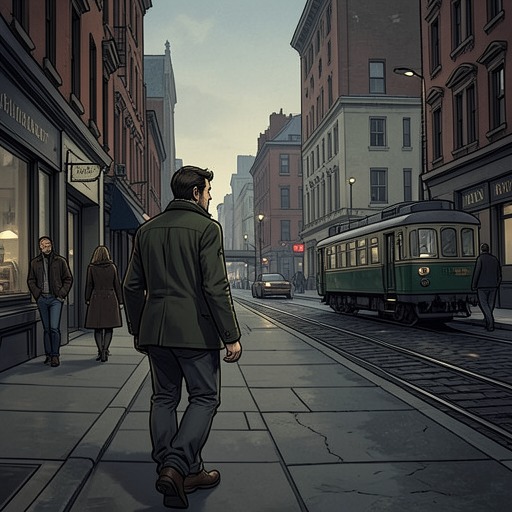
Roth’s most direct confrontation came in 1975, after he had spent several weeks alone in Prague one spring. Two uniformed policemen stopped him on the street and asked for his papers. He showed them his passport, visa, and hotel identification card, but they insisted that he accompany them to the police station. Roth shouted in English and the French he had learned in high school that he wanted to see the American ambassador. Near a trolley stop, he appealed to the bystanders and demanded to be taken to the American Embassy.
A plainclothesman in a blue raincoat was waiting farther up the street. Each time Roth refused to go to the station, one of the uniformed officers returned to consult him, then came back with the same demand. A young German couple approached, and Roth asked them to stay and gave them his name and hotel, telling them to contact the ambassador if he was taken away. After about fifteen minutes, the officers went to confer with the plainclothesman again. When a trolley arrived, Roth boarded it rather than wait to be arrested. Two stops later he jumped off, ran across a bridge, and caught a trolley going in the opposite direction. He eventually got off near a telephone kiosk and called a Czech friend.
Aftermath and Narrative Significance
The friend told Roth that the police had wanted only to harass and frighten him, and assured him that he could return to his hotel safely. Roth did so, and nothing further happened to him there. The consequence came afterward: he says he was never again able to obtain a visa to Czechoslovakia. On the evening after his departure from Prague, the friend he had called was taken from his home and questioned at the police station through the night. According to Roth’s account of the letter that followed, the interrogators concentrated on his annual visits and why he kept coming to the country.
Prague thus gathers together several forms of pressure without reducing them to a single episode: a writer’s repeated visits, a young woman’s questioning after a hotel encounter, a library employee’s refusal of recruitment, and a police stop that ends in escape but leaves a friend exposed to interrogation. The city is at once a place of books, conversation, and personal attachment, and a setting where those connections can be watched, questioned, and made consequential.