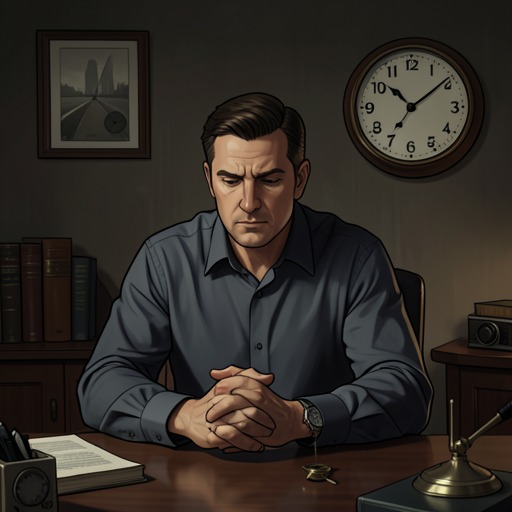
God’s laws are unjust
Decoded“God’s laws are unjust” names the grievance at the center of Rong Jinzhen’s rain-soaked crisis: a mysterious voice gives words to his sense that misfortune has become unbearable and unfair. The phrase returns as a dream utterance, a waking refrain, and the basis for his defiant outburst; by the scene’s end, the lost notebook and the possibility of its return have entered the same unstable stream of thought.
The phrase enters through a dream
After hearing parallel slogans from deep within himself, Rong Jinzhen turns his eyes from the downpour. The rain, previously unbearable, has become gentle enough to soothe him; he lies down, entranced by its sound, and falls asleep. In the dream, a distant voice challenges his faith in God, calls God a coward, and invokes the imperfect life of Johannes before declaring divine law unjust. The accusation does not arrive as a conclusion Rong Jinzhen has reached for himself. He does not recognize its speaker or understand why it addresses him, leaving the phrase suspended between dream, memory, and an unknown source.
The dream’s charge survives waking. The last word repeats until it grows louder in his mind and seems to crack like lightning in his ears, forcing him awake. Even then, “Unjust – unjust – unjust…” continues to sound. Its repetition makes the phrase more than a proposition about God: it becomes an intrusive rhythm that follows him out of sleep and demands a response before he can explain what it means.
From bewilderment to accusation
Awake, Rong Jinzhen considers the words, even entertaining the proposition that God’s laws are unjust, but cannot yet make thought cohere around it. His mind feels like a boiling pot with nothing of value inside; ideas begin and then drift away. The image captures the difference between hearing a powerful accusation and being able to understand its bearing on his own circumstances. At first, the phrase produces agitation without insight.
Memories then gather: the train ride, the thief, his leather attaché case, and the rainstorm. They bring his personal doom back into view, although he initially fails to grasp their significance. When they press upon him again, his mind begins to move toward a destination. The mysterious voice now frames an accident as the beginning of catastrophe and asks how it could be just to let that accident beat him down. In this sequence, the abstract complaint about divine law acquires a particular weight: it is bound to the remembered events and to the damage they have brought into his life, even while their full meaning remains beyond his grasp.
The refrain becomes an act of defiance
Rong Jinzhen’s answer is physical as well as verbal. He smashes through the door and runs into the downpour, cursing God for injustice. He declares that he wants to let BLACK defeat him, because only through that defeat, he insists, can there be justice. The statement turns the refrain inside out: instead of asking for a fair outcome, he imagines surrender to defeat as the only way to expose the unfairness he believes he has suffered. His anger is directed at a divine judge he calls wicked and vicious, and he vows to fight God to the bitter end.
That outburst is not presented as a settled argument. The scene has shown his thoughts as disordered, interrupted, and driven by a voice whose identity remains unknown. His declaration therefore registers the extremity of his crisis rather than a reasoned account of justice. The phrase gives form to his protest, but it does not resolve the confusion that produced it.
Rain, the lost notebook, and a fragile possibility
After the outburst, the rain seems to burn against Rong Jinzhen’s body. He feels himself streaming outward and dissolving into sky and earth, as if his boundaries were melting away. This merging echoes the earlier moment when rain became soothing, but the change is stark: what first offered calm now accompanies a feeling of bodily disintegration. The water binds together his dream, his distress, and the scene outside the door without clarifying whether the voice that speaks to him has any source beyond his own mind.
The final voice seems to issue from his lost notebook, lying in dirt and mud. It offers no certainty that the water will bring the notebook back; instead, it repeats the possibility that the same flood that carried it away might return it. That possibility answers the scene’s language of injustice with an uncertain counterthought. The refrain does not disappear, and the notebook is not recovered here. Yet the repeated prospect of its return keeps the ending open: against Rong Jinzhen’s conviction that catastrophe has overtaken him, the rain carries both loss and the chance, however unconfirmed, of reversal.