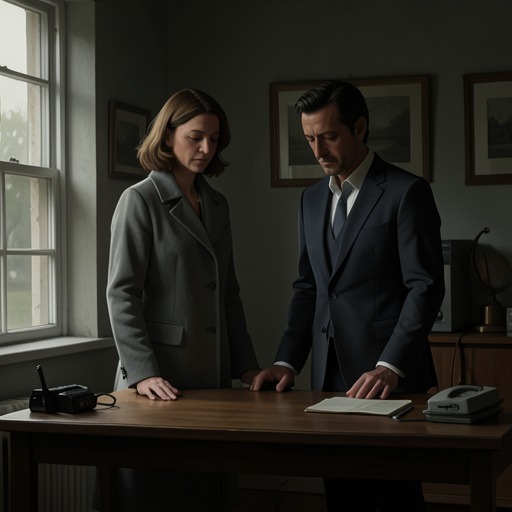
I love him as I love my country
DecodedThe expression “I love him as I love my country” is the woman’s answer when the interviewer asks whether she loved Rong Jinzhen. Its importance sharpens later in the exchange: after she acknowledges that he regretted their marriage, she is asked whether she regrets it herself. Her answer turns the comparison into a refusal—“When you love your country, how can you regret it? No! For ever the answer will be no –!”—and ends in tears. The phrase thus binds devotion to Rong Jinzhen to a standard that, in her account, leaves no room for regret.
A declaration after a brief courtship
The woman recounts that she asked Rong Jinzhen to let her be his wife. He replied, “Yes.” Three days later they were married. The interviewer reacts to the speed and simplicity of the account as almost legendary, practically unbelievable. Against that compressed sequence, the declaration of love is not preceded by an elaborated courtship in the passage; it arrives as a direct answer to a direct question.
The story’s brevity also sets up a contrast between the apparent ease of the marriage’s beginning and the difficulty of understanding what it meant to her. When she tells the interviewer how the marriage came about, she displays no discernible sadness or happiness, surprise or wonder. The interviewer says that her manner makes it hard to determine how she felt then, or how she feels while remembering it. Her comparison of love to love of country is therefore delivered within an account whose emotional meaning initially seems inaccessible.
Marriage and absence
The interviewer next asks whether Rong Jinzhen’s adversary began using BLACK soon after the marriage, and whether Rong Jinzhen thereafter rarely returned home. The woman confirms both points. The exchange places the marriage beside a consequential change in his life: the adversary’s use of BLACK and Rong Jinzhen’s repeated absence from home. The passage does not elaborate on the practical circumstances of those absences, but it makes them the immediate context for asking whether the marriage brought regret.
Asked whether she thinks Rong Jinzhen regretted marrying her, she answers, “Yes.” The interviewer then turns the question around and asks whether she regrets marrying him. That reversal distinguishes their positions without explaining his reasons or supplying her earlier thoughts: his regret is affirmed, while hers becomes the subject of a newly emphatic answer. The phrase about loving him as she loves her country becomes more than a description of attachment; in this exchange, it grounds her rejection of regret despite the acknowledged imbalance between them.
From composed recollection to tears
The interviewer’s description of the woman’s manner changes at the final question. Until then, her account seems detached even from the emotional attachment usually associated with memory, as though she were recounting a dream she had told many times. But when asked whether she regrets the marriage, she is taken by surprise, opens her eyes wide, and stares at the interviewer. Her reply is excited and absolute: “Regret? When you love your country, how can you regret it? No! For ever the answer will be no –!”
Immediately afterward, her eyes fill with tears and she begins to sniffle as if about to cry. The physical response does not settle what she felt at the time of the marriage, a question the interviewer had already found difficult to answer. It does, however, mark a change within the remembered conversation: the earlier neutral telling gives way to visible distress as she defends the absence of regret. The declaration’s force lies in that contrast between controlled recollection and the emotion that breaks through at its close.
The phrase’s meaning in the exchange
The comparison with country-love supplies the woman’s own terms for describing her attachment. When the interviewer first asks whether she loved Rong Jinzhen, she answers with the compact declaration. Later, faced with the question of regret, she expands its logic: if love of country is not a reason for regret, then loving him in the same way cannot be one either. The passage presents this as her stated reasoning, not as an explanation of Rong Jinzhen’s feelings or of the marriage’s wider history.
The phrase consequently holds devotion and pain in the same brief account. She confirms that Rong Jinzhen regretted the marriage and that he rarely came home after BLACK entered the story, yet answers her own question of regret with an emphatic no. Her tears complicate the apparent certainty without overturning it: the response is emotionally charged, but the words remain categorical. In the scene, love of country is not a passing ornament to a declaration of love; it is the comparison through which she insists that the marriage is not something she wishes to disavow.