Cortoise
DingoCortoise is presented chiefly through its railway station and the ten-kilometre route connecting it to Ponteilles-en-Barcis. More than a fully described town, it is the village’s threshold to outside traffic: letters and parcels pass through it, the local carrier makes the journey twice daily, and even the sale of small items such as mole skins reaches a buyer there. This practical importance is paired with persistent disorder. The connection exists, but distance, unreliable delivery, and the village’s limited access to supplies make it an imperfect conduit between rural life and the wider world.
The station and the village route
The station at Cortoise is the starting point of the service run by Vincent Péqueux. In an antique yellow diligence, he carries passengers and messengers between the station and Ponteilles-en-Barcis, a journey of ten kilometres that he makes twice a day. The route gives Cortoise a recurring place in village life: it is where correspondence and incoming goods are collected, and where residents’ errands and expectations meet the railway.
The traffic is not always orderly. Vincent wears a Russian leather cap and a short leather jacket lined with sheepskin in every season, even during the hottest summer weather, and complains of the heat without changing to lighter clothes. He stops at bars and cafés along the way, accepts drinks from passengers, and takes on errands for almost everyone. As a result, he often misses the train; when he has drunk too much, he mislays mailbags and postal parcels. His route makes Cortoise accessible, but his habits turn that access into a source of comic uncertainty.
Incoming goods and delayed deliveries
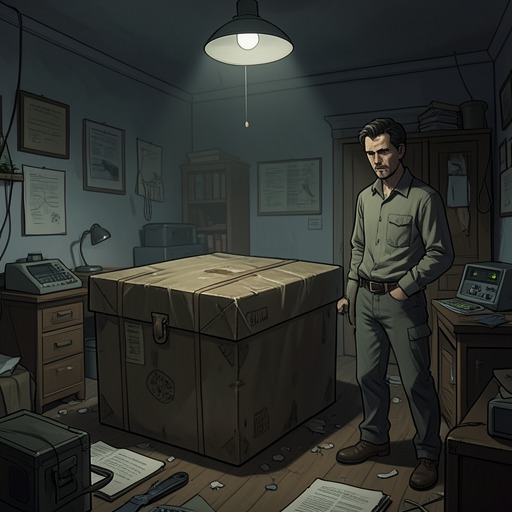
The station’s role appears vividly in the narrator’s account of a delivery made on the morning before Easter. Vincent brings him a box from London: a roughly black-painted pine container with two openings covered by wire. Its funereal appearance suggests a child’s small coffin, an old automobile hood, or a strangely packed shipment of flowers. The box is delivered with papers to sign, but its contents remain unknown to the narrator at first; Cortoise enters the episode as the point in a longer journey from London where an unsettling parcel reaches the village.
That delivery is not the only shipment left behind. Vincent remembers that three large baskets of hens are still at the station because there was no room for them beneath the diligence’s tarpaulin. He promises to bring them later, having asked the baggage chief to give them food and water in the meantime. The detail shows how easily the movement of living cargo depends on space, timing, and an improvised promise. The station is not merely a place where goods pass through: what cannot be loaded remains there awaiting care and another trip.
Cortoise also appears in a smaller transaction that links village subsistence to the local market. Pierre Piscot sells mole skins to a ragman there for one sou apiece, after catching the moles himself with a spade rather than traps. The price is meagre, but it gives the skins a route out of the village and a cash value. The exchange sits beside Piscot’s use of the animals for food, making Cortoise the endpoint of one part of a resource gathered through his precarious work.
Commerce and the limits of access
The village’s dependence on the route is sharpened by its lack of a railway. When the narrator asks Jaulin whether he can buy all his petrol from him, Jaulin explains that obtaining and selling it is entangled with local connections, advance notice, and transport costs. His claim to sell petrol is embodied by two rusty, usually empty cans outside his forge; when he does have fuel, it is often priced so high that passing motorists leave without buying it. He complains that transport is what consumes the margin and that the village has no railway.
The contrast is significant: Cortoise has the station, but Ponteilles-en-Barcis remains ten kilometres away and must rely on the diligence to bridge the gap. A rail connection therefore does not make goods readily available in the village. Petrol can be difficult to obtain, passengers and parcels depend on Vincent’s punctuality, and bulky or living shipments may have to wait. The account presents infrastructure not as a simple cure for rural isolation but as a chain of dependencies, each vulnerable to cost, distance, capacity, or human unreliability.
Narrative significance
Cortoise is defined less by description of its streets or inhabitants than by what travels to and from it. The station supplies a recurring framework for arrivals, missed trains, delayed cargo, and the movement of small commodities. In that sense, it is a functional setting: its importance is measured through the village’s reliance on a route whose everyday failures are as memorable as its service.
The episodes also make the connection between village and outside world uneven in scale. A box arriving from London carries an air of mystery; baskets of hens require a practical promise of food and water; mole skins yield a single sou each; petrol is burdened by transport costs. These different goods pass through the same transport network, but their value and urgency are not alike. Cortoise consequently serves as both a point of access and a measure of Ponteilles-en-Barcis’s distance from dependable supply. The station brings the wider world close enough to send parcels, passengers, and trade, while the repeated delays reveal how far the village remains from controlling when or how those things arrive.