Ponteilles-en-Barcis
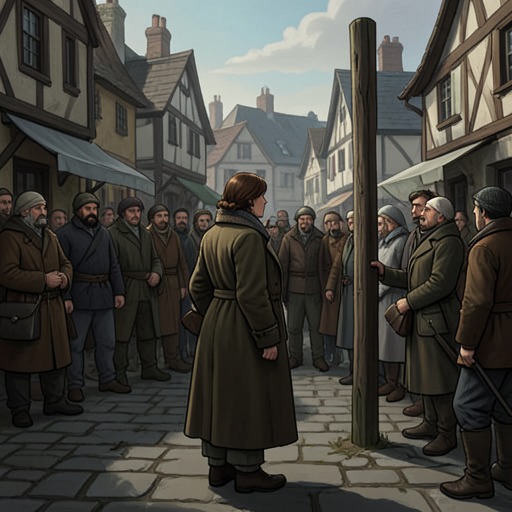
DingoPonteilles-en-Barcis is the village where the narrator is living when Dingo arrives from London, and the setting of the dog’s first uneasy contact with its human community. Its geography opens onto a broad agricultural landscape, but its social world is compressed into a single dirty street and a small evening gathering place. The contrast helps define the early life there: movement through the village brings Dingo into view, while neither the villagers nor the dog readily turn that proximity into fellowship.
Setting and Geography
Ponteilles-en-Barcis stands above the broad, fertile plateau of Barcis and the green valleys of the Biorne, Siorne, and Viorne. The village itself stretches for eight hundred meters along the road from Paris to Compiègne. Though its position commands a wide rural landscape, its built form is notably narrow: the main street is the settlement’s defining route, and small lanes branching from it soon peter out into the fields.
The approach from beyond the village is also established through Dingo’s delivery. Nine years, one month, and five days before the narrator recalls it, on the morning before Easter, Vincent Péqueux brought a box from London by way of Cortoise, where he ran the messenger service between the station and Ponteilles-en-Barcis. The dog’s arrival thus connects the village to distant places, but his reception will be shaped by the local community into which he is delivered.
The Village Street and Its Buildings
The street is described as exceptionally dirty and hard underfoot, its uneven surface collecting animal dung and household refuse in the hollows between the paving stones. Small alleys begin at its edges but quickly retreat into the fields. This is not a village of tidy façades: old, sagging barns, stables, and sheepfolds line the road, with narrow openings in place of proper windows and blind haylofts above. A pulley hangs outside an advanced loft opening, creaking in the wind.
The houses open onto yards where manure heaps smolder and sit in stagnant liquid. The strips of beaten earth that serve as sidewalks are edged with thistles, broken bottle bottoms, and human excrement. Against these neglected buildings, a few shops and somewhat more elevated homes stand out. The mayor, Théophile Lagniaud, the notary, Anselme Joliton, and Irma Pouillaud, the widow of a wealthy dairyman, have houses that show their fronts toward the street; their faded greenery and poorly grown trees do little to lift the otherwise bleak scene. The contrast marks differences in status without making even the more prominent homes appear grand.
Public Life and Suspicion
Ponteilles-en-Barcis is quiet for much of the day. It becomes somewhat animated only in the evening, after work and when the herds return, and even then the activity gathers in a limited space between Jaulin’s house and the gate of the narrator’s enclosure. Men form small groups; young women walk there in search of sweethearts or husbands; dogs, too, gather at this local meeting point. The street is therefore both a thoroughfare for labor and livestock and the village’s principal shared social space.
The community’s response to unfamiliar presences is wary. The narrator makes Marie take Dingo with her on errands, hoping he will become known to the inhabitants, if not liked. From the first day, however, the dog is poorly received: he belongs to the narrator, and uncertainty about his status and origins makes him unsettling to the villagers. Stories about Dingo begin to circulate before there is cause for them, much as stories had circulated about the narrator upon his own arrival. In Ponteilles-en-Barcis, ordinary differences can quickly acquire an alarming, exaggerated character.
Dingo in the Village
From behind the narrator’s gate, Dingo watches the street: exhausted, dust-covered horses, heavy milk cows, and the passing herds. Sheep provoke a particularly intense response. As a flock moves in orderly formation, bounded by its shepherd and the dogs keeping it together, Dingo becomes restless behind the bars. The strong smell of the sheep excites him; he makes athletic leaps and lunges like a predator, his eyes bright in the setting sun. The gate holds him in place, but it also makes his bodily reaction visible to everyone passing by.
His attention to people is different. He likes to watch them go by, but makes no display toward them. The narrator interprets this as a kind of pessimistic pleasure in observing their tired movements, heavy backs, and expressions that seem made more hostile and acquisitive by fatigue. This remains the narrator’s reading of the dog, not an explanation that can be verified from Dingo himself. The village setting makes that uncertainty consequential: the villagers judge the unfamiliar animal from appearances and rumor, while the narrator reflects on how little can truly be known of another being.
Narrative Significance
Ponteilles-en-Barcis brings together a stark physical environment, a tightly bounded public life, and a community quick to mistrust what arrives from outside. Dingo’s passage through its street and his confinement behind the narrator’s gate place his animal nature beside the routines of herding, work, and village sociability. The same place that provides a route into human company also exposes the limits of welcome: the narrator can bring Dingo among the villagers, but cannot ensure that they will accept him. The early episodes in Ponteilles-en-Barcis thus establish the setting not simply as a rural backdrop, but as the social world against which Dingo’s difference becomes visible.