Montbiron
DingoMontbiron is a small town three kilometres from Ponteilles, linked to the village by a road that rises over a hill before descending toward its roofs. Though ordinarily a place of shops, cafés, and local services, it becomes the destination for a crowd drawn by a notorious crime. Its changing function—from a possible resting place for a weary traveler to the setting of a public spectacle—makes it a recurring point of contact between rural routine, official authority, and the narrator’s encounters with Dingo.
Setting and connections
On the road toward Montbiron, the climb ends with the town visible about four hundred metres away: red and blue roofs, white and yellow façades, and a slate church spire among the trees. The scene marks a practical stopping point for an old man hauling a cart uphill. Once he has helped the man reach the summit, Dingo leaves him to continue toward Montbiron and returns to the narrator. Later, Dingo watches the cart recede toward the town, reluctant to turn back. The route thus establishes Montbiron as the next settlement along a familiar road, while giving the episode a small but telling measure of Dingo’s concern for a stranger.
The town is also close enough to Ponteilles for news, shopping, and medical help to pass between them. Montbiron’s shops serve people from the surrounding countryside, and its streets can accommodate both ordinary business and gatherings that draw visitors from nearby villages. The contrast between its modest scale and the crowds it attracts becomes especially pronounced when a crime turns a quiet Sunday outing into a kind of local event.
The murder and the crowd
The day after Dingo helps the old traveler, news reaches Ponteilles that a twelve-year-old girl, Marguerite Radicet, has been murdered at Montbiron. Reports disagree over the precise sequence of the violence, but the account identifies the accused as a passing laborer whom her father, Charles Radicet, had given lodging. The crime provokes hostility toward itinerant strangers before the investigation has run its course. The town becomes a destination for curious visitors from Ponteilles, who set out in their best clothes as though attending a celebration. Their journey passes through a landscape continuing its ordinary seasonal growth, an unsettling counterpoint to the reason for their excursion.
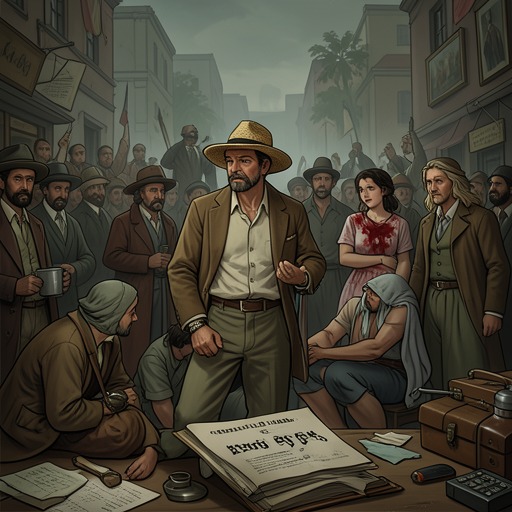
In Montbiron, groups fill the streets, cafés, and shops. A waffle seller has set up near the town-hall square, where a large crowd presses together. The visitors go as far as the house where the crime occurred, at the end of the road toward Compiègne. Its doors and shutters are closed; a dog barks in the yard and cattle call from nearby stalls. People circulate outside, looking toward the house and discussing what they have heard. The town’s public spaces turn private grief into an occasion for observation and talk, while the crowd’s curiosity coexists with the gravity of the crime.
The case also brings official business into view. At the town hall, an attendant tells Jaulin that the accused, Joseph Coquereux, has confessed, identifies him as a tiler, and says he will be taken to Beauvais. The crowd answers the news with cries for his death, though the narrator notes that its talk avoids explicit or indecent remarks about the crime. When Coquereux is brought out, Dingo recognizes him and breaks free of his collar. He approaches the man and publicly shows affection, licking his chained hands and touching his legs and chin. The gesture shocks the spectators because it offers sympathy to a prisoner whom they have already reduced to the role of an object of anger and curiosity.
Shops, services, and everyday life
Away from the crime, Montbiron appears as a commercial center for its rural surroundings. Toutlemal, a dealer in new goods on the Grande-Rue, sells a work smock to Pierre Piscot for nine francs, a major expense for a man who is nearly without clothes. The shopkeeper’s business extends beyond his premises: he also owns a traveling shop wagon that visits the roads around the area. Its advertisement carries the name of his Montbiron store, making the town’s trade visible beyond the main street.
The town also supplies professional services to nearby residents. When Piscot becomes too ill to work, the narrator has difficulty persuading him to seek care and calls Dr. Lebriche, a physician from Montbiron known for taking difficult and desperate cases. His reputation reaches as far as Cortoise, where other doctors consult him. Montbiron is therefore not only a destination for shopping or crowds; it is a place on which Ponteilles depends when illness requires outside medical attention.
Local authority and narrative significance
Montbiron’s institutions appear in less reassuring encounters as well. Piscot, a veteran, tells the narrator that he has gone to the town’s gendarmes about the medal he believes he should have received for military service, but their advice to file a claim has not secured it. His account connects the town’s official presence with a wider frustration: recognition and assistance seem available in principle, yet remain out of reach in practice. The same local setting that brings police and medical authority within reach does not guarantee that rural residents’ claims will be resolved.
Across these episodes, Montbiron gathers together the practical and the theatrical sides of village life. Its distance from Ponteilles makes it accessible; its shops and physician make it useful; and its streets provide a stage for public reaction when a crime draws visitors in from the countryside. The old man’s journey there, the crowd’s trip to the crime scene, and the recurring movement of residents between the two places give the town a connective role. It is less a secluded backdrop than a nearby center where news becomes spectacle, private need meets public institutions, and Dingo’s actions expose a response at odds with the crowd’s settled judgment.