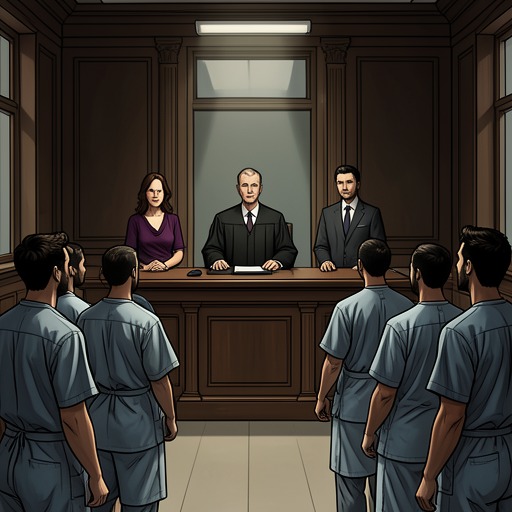
Drug Court Bans on Medication-Assisted Treatment
DopesickDrug Court Bans on Medication-Assisted Treatment refers to the practice of excluding or restricting prescribed treatment with medications such as buprenorphine for people in drug courts. The book presents this conflict as a consequential divide between treatment supported by public-health evidence and rules enforced within parts of the criminal-justice system. Drug courts can coordinate supervision and care, but when participation requires abstaining from medication, that same structure can make a treatment associated with reduced relapse unavailable to the people it is intended to help.
What the Restriction Means
Drug courts combine criminal-case supervision with a structured program intended to reduce further drug use and offending. Participants may be monitored intensively, including through random checks at different hours, and face swift penalties—sometimes jail—if they fail a drug test or commit another crime. In most of the country’s roughly three thousand drug courts, charges are dropped after participants complete a program lasting twelve to eighteen months. The book reports that graduates are roughly one-half to one-third less likely than regular probationers to return to crime or drugs.
That record makes drug courts an important setting for the debate over medication-assisted treatment, not a simple counterexample to treatment. Prosecutors, defense attorneys, judges, and mental-health advocates may gather around the same table to discuss a participant’s daily challenges and coordinate care. Yet the book notes that many courts, including courts controlled by elected prosecutors, continued to bar medication-assisted treatment even as scientific support for its use accumulated. A court’s ability to connect people to services could therefore coexist with a rule that excluded a particular evidence-supported service.
The restriction also matters because participants’ treatment needs are not uniform. The book cautions that not every person wants or needs maintenance medication, and that addiction and recovery differ from one person to another. Its argument is not that medication must be imposed on everyone, but that effective options should remain available and that people should be helped to obtain the treatment they need rather than denied health care because they are under criminal-justice supervision.
Evidence and Institutional Conflict
The book contrasts drug courts’ rehabilitative potential with their resistance to medication. In Kentucky, an appeals court mandated that drug courts allow medication-assisted treatment. Not long afterward, the Obama administration’s Office of National Drug Control Policy announced it would deny funding to drug courts that cut off access to it. Those developments placed the dispute within a larger policy debate over whether publicly supported courts could claim to promote treatment while refusing access to a form of care supported by scientific evidence.
In Virginia, the divide was especially pronounced in rural communities. The book describes only a handful of the state’s rural drug-court judges as permitting participants to use medication-assisted treatment. That restriction existed alongside visible demand for treatment: a billboard along I-81 advertised a Suboxone doctor whose patients were often in and out in thirty minutes. The juxtaposition points to a fragmented landscape, where treatment could be advertised as readily accessible while court rules still prevented some people under supervision from using it.
There were also examples of the potential benefit of allowing treatment. Jack Hurley, a judge in Tazewell County, Virginia, reported that thirteen babies had been born to mothers receiving medication-assisted treatment and none had neonatal abstinence syndrome. His example challenged the assumption that treatment with medication could be dismissed without regard to its outcomes. More broadly, the book describes drug courts as places where public-health and legal approaches meet, but shows that convening those professions does not by itself resolve disagreement over which treatments participants may receive.
Stigma and the Cost of Exclusion
Restrictions within courts echoed stigma beyond the courtroom. Tess Henry had attended Alcoholics Anonymous and Narcotics Anonymous meetings before, but felt marked as not clean because she was taking buprenorphine. Although Narcotics Anonymous officially accepted medication-assisted treatment, members asked to sponsor or mentor her declined. Her experience was not itself a drug-court ruling; it illustrates how the same dispute about medication could shape access to peer support as well as formal treatment. A patient could be offered help in principle while encountering an informal or institutional boundary around the form that help was allowed to take.
Art Van Zee described the consequences of applying court discipline to opioid addiction while withholding medication. In his view, expecting an opioid-addicted person to succeed in drug court without Suboxone could be cruel and unusual punishment. He also acknowledged that lax practices among some rural providers had contributed to diversion and abuse. His distinction was between misuse and responsible treatment, which he said opponents could fail to see when their contact with addiction was concentrated on trafficking, child-welfare cases, or patients injecting medication obtained on the black market.
Van Zee’s clinical experience, as reported in the book, included patients who were progressing in education and employment, regaining custody of their children, or sustaining years without illicit drug use while taking treatment. He also described long-term patients who had reduced their doses, while hesitating to taper them completely because he had seen discontinuation lead to relapse. The book cites research indicating substantial relapse after people were weaned from buprenorphine, while also noting that outcomes varied: some patients became drug-free, some remained on medication, and others returned to heroin or illicit opioids. This evidence supports preserving treatment choices, rather than treating medication use as proof of failure or a violation of recovery.
Consequences for Access and Recovery
The conflict was part of a wider gap between criminal justice and health care. The book describes families and volunteers trying to keep people alive while people with addiction struggled to stave off withdrawal, and health workers faced shortages of treatment capacity. In Roanoke, an effort to create a smoother transfer from emergency care into outpatient medication-assisted treatment and counseling ran into bureaucratic, financial, and legal obstacles, including too few providers and too few detoxification and treatment beds. These service shortages did not result solely from court rules, but they formed the conditions in which exclusion from an available treatment option could carry greater weight.
The book also connects treatment policy to unequal enforcement. Its account contrasts the public call to avoid relying on arrest for the largely white population of opioid users with the continued imprisonment of people such as Ronnie Jones for heroin distribution. It reports that people of color were disproportionately represented among federal and state drug offenders, while 2014 data showed that doctors prescribed painkillers to people of color at lower rates than to white patients. These comparisons do not establish that drug-court medication bans alone produced racial disparities. They situate those bans within systems where access to medical treatment and exposure to criminal punishment were already unevenly distributed.
Significance and Proposed Direction
The book treats drug courts as a promising but incomplete institution. Their monitoring, coordinated attention, and potential to reduce recidivism can be valuable; the contradiction arises when a court’s demand for recovery conflicts with a clinician’s prescribed treatment. Steve Loyd argued that people in recovery, including those who relapse, should be allowed medication-assisted treatment, and likened withholding legitimately prescribed medicine from an opioid-addicted person to denying insulin to a person with diabetes. He further argued that excluding treatment could violate the Americans with Disabilities Act.
This policy dispute therefore turns on what recovery is permitted to look like. If abstinence from medication is made an entry condition for legal leniency, people may be required to relinquish treatment in order to participate in a program designed to prevent relapse. The book’s account instead calls for courts to preserve access to appropriate medication while maintaining supervision and individual assessment. Drug Court Bans on Medication-Assisted Treatment names a practical and ethical fault line: institutions that recognize addiction as a health problem cannot fully coordinate care if their rules disqualify one of its established treatments.