Formation and mobilization of Relatives Against Purdue Pharma
DopesickRelatives Against Purdue Pharma (RAPP) was a grassroots organization formed by bereaved parents and allies to challenge Purdue Pharma’s promotion of OxyContin and make the losses associated with the drug publicly visible. Its members carried their campaign from online discussion into policy lobbying, school workshops, and protests, building a sustained counter-mobilization around families’ experiences of addiction and death.
Formation and Shared Loss
RAPP emerged from an alliance among Ed Bisch and Lee Nuss, two parents who had each lost a son, and Art Van Zee and Sister Beth Davies. Nuss initially found it difficult to reach out to Bisch in her grief; her daughter Monique eventually called him and asked him to speak with her mother. The two parents discovered that they had grown up less than a mile apart in Fishtown, a working-class neighborhood of Philadelphia. Nuss’s eighteen-year-old son Randy had died after taking an OxyContin pill obtained through a friend. She had not known he was using pills and had thought his use could not have lasted long, since she still had opioid medication prescribed after dental surgery.
After reading Barry Meier’s 2003 book Pain Killer, the Fishtown parents formed an informal alliance with Van Zee and Sister Beth Davies. The group’s work soon became a nonprofit called Relatives Against Purdue Pharma. The book presents its emergence as an answer to the widening reach of OxyContin: if the drug’s supply chain had spread across the country, Bisch and Nuss sought to give its opposition a similarly broad reach. Bisch’s online message board became an in-person and political campaign that would continue over the following decade.
Campaign Methods
RAPP’s members pressed for statewide prescription monitoring programs, which would let doctors check a patient’s prescription history and help prevent patients from obtaining prescriptions from multiple providers. They also sponsored drug-prevention workshops in schools. These efforts addressed both the prescribing system and the community-level spread of drug use, rather than treating bereaved families’ experiences as isolated tragedies.
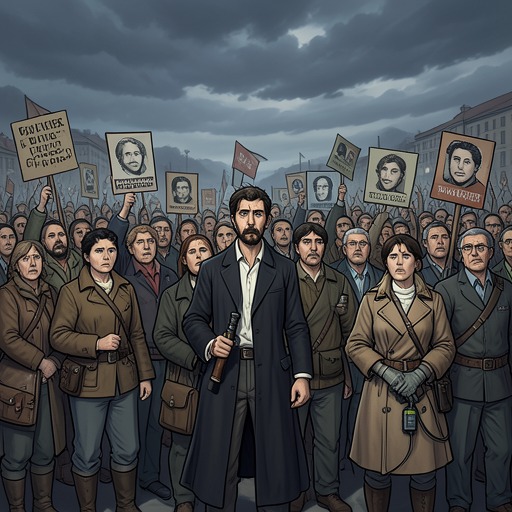
The organization made public memorialization central to its activism. Members stood outside Purdue’s corporate headquarters holding poster-sized photographs of their dead children. RAPP also appeared wherever Purdue became a subject of public attention, including court proceedings and medical seminars. Its members’ presence made family loss part of debates otherwise conducted through legal claims, industry statements, and medical evidence.
Public Protest and Remembrance
In 2003, RAPP members traveled from Rhode Island and New Jersey to protest at a drug-abuse-prevention conference at the Caribe Royale resort in Orlando, where Purdue was an exhibitor. They were already contending with the rain when Bisch began reading the names of 260 people memorialized on his website. An unidentified woman then turned a sprinkler on the protesters; a hotel executive denied that the hotel had arranged to soak them. The episode captured the difficult conditions under which the parents made their losses visible, while the roll call transformed an online memorial into a public act of remembrance.
Purdue’s spokesman at the conference expressed condolences to people who had lost loved ones to overdose but maintained that the company’s marketing of OxyContin had been appropriate. RAPP’s presence thus set bereaved families’ testimony beside the company’s defense of its conduct. For Nuss, remembrance also traveled with her: she wore rosary beads at such events and carried a tiny bronze urn containing some of Randy’s remains, while keeping the main urn at home. These objects connected the public campaign to the private relationship that had brought her into it.
Dispute, Policy, and Significance
RAPP’s opposition also played out online and sometimes in person against chronic-pain patients who credited OxyContin with helping them function or sleep. Bisch suspected that some of the drug’s online defenders were paid advocates hired by Purdue to challenge his website; the account notes that this suspicion proved correct in a few cases. The conflict placed two kinds of experience in direct tension: patients describing relief from pain and families seeking recognition of the harms they associated with the drug.
The wider setting of the campaign included a heroin market expanding beyond the communities where it had previously been regarded as concentrated. In Roanoke, for example, federal prosecutor Don Wolthuis recalled that heroin had once been associated with a small, largely invisible group of users, while a later trafficking network reached teenagers in the affluent Hidden Valley area. The book also describes a recurrent transition in which people began with prescriptions and turned to heroin, sometimes selling part of their supply to finance the next purchase. These developments give RAPP’s focus on prescription monitoring and prevention a wider context, without making the organization responsible for the later heroin networks.
RAPP’s memorials and policy work also unfolded amid unequal responses to addiction. The book contrasts the treatment-oriented language often used for predominantly white opioid users with the continued imprisonment of people such as Ronnie Jones, a Black heroin dealer, and notes that doctors prescribed painkillers to people of color at lower rates than to white patients. Those disparities underscore that opposition to a pharmaceutical company did not by itself resolve the broader division between medical access, public-health responses, and criminal punishment. RAPP’s distinctive contribution was to turn families’ bereavement into organized pressure: lobbying for monitoring, educating students, challenging Purdue in public, and keeping the names and images of the dead present in debates about the drug.