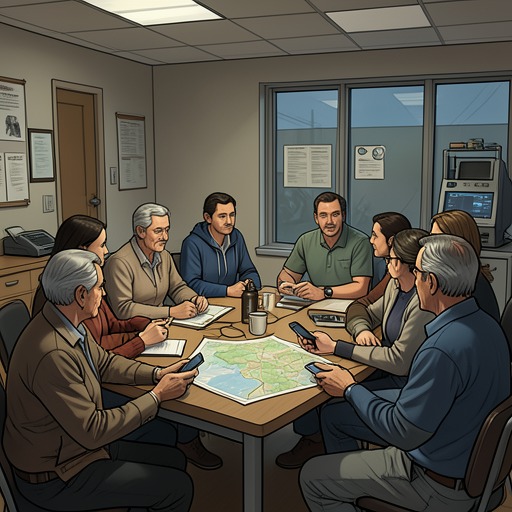
Virginia declares an opioid emergency and expands naloxone access
DopesickVirginia declares an opioid emergency and expands naloxone access in 2016, making the state’s response to overdose an explicit public-health matter. The declaration was accompanied by a standing order for naloxone, widening access to a medication that can reverse an opioid overdose. In the book’s account, this action marks a change in the tools available to respond to immediate danger, while also exposing the distance between emergency intervention and sustained treatment.
Emergency action and naloxone access
The policy’s practical measure was the standing order issued alongside the emergency declaration. Rather than leaving naloxone access dependent on an individual prescription, the order made the overdose antidote available more broadly. The event thus joined recognition of a statewide crisis to a concrete means of responding when an overdose occurred. It did not, by itself, resolve the separate problem of how people who survived an overdose could enter and remain in treatment.
The treatment-access gap
The surrounding accounts show why wider emergency access mattered, and why it was not enough. Jesse Bolstridge’s mother wanted to understand how her son had moved from high-school football and construction work to a fatal heroin overdose. In another case, Jesse’s friend Dennis Painter had bought heroin many hours before Jesse died; the elapsed time and the number of people involved made the chain from sale to death difficult to establish. These stories locate overdose response within a crisis that families experienced as both urgent and hard to explain.
Access to ongoing care was also uneven. Jesse’s earlier rehabilitation in Jacksonville involved ten weeks of treatment and a brief course of buprenorphine, yet his mother still owed $25,000 for the stay. Tess Henry, pregnant and recently released from jail, found one of the few Virginia facilities that accepted patients receiving medication-assisted treatment; her family faced a $6,500 deductible on a $20,000 program. Later, buprenorphine helped her feel normal, but the doctor’s visits needed to obtain it were cash-only, with a $700 initial charge and follow-up visits costing $90 to $100, potentially four times a month. The emergency declaration addressed a crucial moment of overdose risk, not these financial and institutional obstacles to continuing care.
A response still being built
In early 2017, the Hope Initiative in Roanoke was using a five-page spreadsheet of thirty-six rehabilitation and aftercare providers to match people with placements according to cost and bed availability. Volunteers also helped arrange outpatient medication-assisted treatment, though some remained opposed to treating addiction with medication. That effort illustrates how much coordination could be required to connect a person seeking help to an available service.
Treatment capacity remained limited even as the state’s response developed. Federal rules then capped the number of patients that many specially qualified buprenorphine prescribers could treat at 100, before the cap was raised to 275 later in 2016. In Virginia, broader access to medication-assisted treatment followed in 2017, alongside efforts to expand Medicaid reimbursement and encourage clinics to accept insurance. Yet waiting lists persisted. A later pilot led by Warren Bickel at the Virginia Tech Carilion Research Institute sought to streamline emergency-room-to-outpatient transitions by connecting overdose patients directly with outpatient buprenorphine, including through a newly approved monthly injection. The book presents this as part of an evolving continuum of response, not as an outcome guaranteed by the emergency declaration.
Significance
The declaration and standing order addressed the immediate possibility of death by making overdose reversal more accessible. The surrounding evidence insists on a wider measure of success: whether a person can move from rescue to treatment without being lost to cost, waiting, eligibility rules, or gaps between institutions. The policy therefore stands both as an emergency intervention and as a contrast with the slower, incomplete work of building accessible long-term care.