Alcoholism
DublinersAlcoholism in Dubliners is less a single crisis than a recurring condition that reorganizes family life and public sociability. Mr Kernan’s drinking leaves him incapacitated for days, while his wife accepts his frequent intemperance as part of their domestic climate; Freddy Malins’s anticipated and actual drunkenness, meanwhile, makes him a source of anxiety and management at the Morkan sisters’ annual dance. Across these scenes, habitual drinking is recognized as harmful but also treated as familiar, tolerated, and woven into ordinary social obligations.
Mr Kernan’s Drinking and Its Domestic Cost
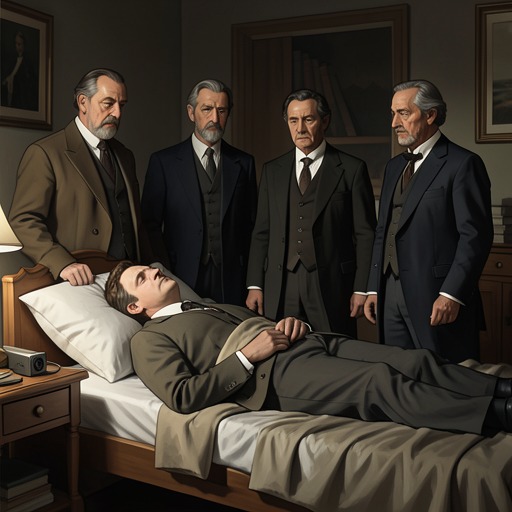
After Mr Kernan has been drinking since Friday, he is brought home and put to bed. His wife describes the episode as a warning of what may happen if he continues, while Mr Power—who had helped him—makes clear that he was present by accident. Mrs Kernan distinguishes him from the other men who associate with her husband: she remembers Mr Power’s help during domestic quarrels and the small loans he provided, and contrasts that practical friendship with companions who, she says, are welcome so long as Mr Kernan has money to keep away from his family.
Mr Kernan sends a letter to his office the following day and remains in bed. His wife makes beef-tea and scolds him, but also tends him whenever he is sick and tries to get him to eat breakfast. The narration places these efforts within a long marriage: she has kept house for twenty-five years, her two eldest sons have left home for work in Glasgow and Belfast, and the younger children are still at school. Her acceptance of his frequent intemperance as part of the climate registers not approval but accommodation—a recurring domestic burden that she has incorporated into the routines of care.
That tolerance has limits, and the account makes them specific. Mr Kernan has not been violent since the boys grew up, and his wife knows he will walk to the end of Thomas Street and back to secure even a small order. The juxtaposition preserves both his capacity for work and the strain his drinking imposes: she does not reduce him to the episode, but neither does she mistake his recovery for an end to the pattern.
Friendship, Status, and Decline
Mr Power’s role in bringing Mr Kernan home belongs to a longer friendship. A younger man employed in the Royal Irish Constabulary Office in Dublin Castle, he has risen socially while Mr Kernan has declined. Yet Mr Power continues to esteem his old friend as a character, even as the debts associated with Mr Kernan have become a byword among their circle. His intervention is therefore not simply a rescue from one night’s excess: it shows how personal loyalty persists alongside awareness of the decline.
The morning after the drinking episode, Mr Power’s earlier assistance remains part of how Mrs Kernan assesses him. Her recollection of his useful support in quarrels and timely loans gives their friendship a practical dimension, while her complaint about Mr Kernan’s other companions links drinking to money and absence from the household. In her account, social fellowship can either mitigate domestic trouble or enable a husband to evade family responsibilities.
Freddy Malins and the Dance
The Morkan sisters’ annual dance carries its own apprehension about alcohol. Long after ten o’clock, Gabriel and his wife have not arrived, and the sisters are also anxiously wondering whether Freddy Malins will appear drunk. They fear that Mary Jane’s pupils might see him under the influence and know that he can be difficult to manage in that state. His habitual lateness already makes his arrival uncertain; the possibility of drunkenness turns that uncertainty into a practical concern for the hosts.
Freddy arrives behind Gabriel, laughing at a story told on the stairs and moving unsteadily. His manner is both sociable and conspicuously unsettled: he laughs in a high register, rubs the knuckles of his left fist against his eye, and greets the Misses Morkan in a fashion that seems offhand. The detail of his entrance makes the sisters’ earlier worry concrete, without turning the gathering into a separate crisis; the party’s work of greeting and entertaining guests continues around him.
Aunt Julia signals a warning to Mr Browne as she leaves the room with Gabriel. Mr Browne responds by offering Freddy a full glass of lemonade, ostensibly to buck him up, after first drawing his attention to the disorder of his dress. Freddy waves away the offer while engrossed in his story, then accepts the glass mechanically as he adjusts his clothing. He does not drink it: laughing before reaching the story’s climax, he sets down the untasted, overflowing glass and returns to rubbing his eye and repeating the last phrase. The scene’s small failed intervention captures the gap between others’ attempts to manage his condition and Freddy’s absorption in his own performance.
A Repeated Social Pattern
The two episodes show different scales of accommodation. Mr Kernan’s drinking keeps him in bed and draws his wife into another round of tending and reprimand; Freddy’s threatens the decorum of a crowded family dance and leads Mr Browne to offer a non-alcoholic drink. In each case, those around the drinker anticipate consequences and adjust their behavior, whether by nursing, warning, managing, or making allowances.
The narration does not present these responses as simple solutions. Mrs Kernan’s domestic care addresses the immediate aftermath but coexists with her husband’s frequent intemperance. Mr Browne’s lemonade remains untouched, while Freddy continues his story. Alcoholism thus appears through repetition and its surrounding accommodations: a familiar condition whose effects become visible in missed work, family strain, anxious hospitality, and the effort to keep a social occasion going without openly stopping it.